
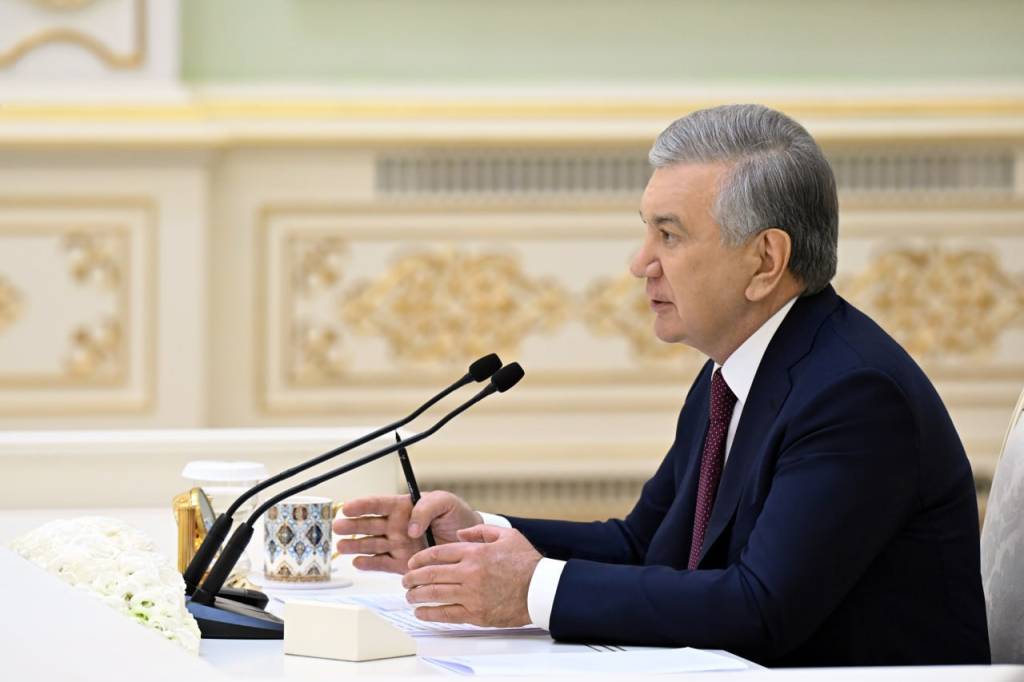
Tashkent ( WNAM MONITORING) A videoconference meeting chaired by President Shavkat Mirziyoyev was held to review the performance of the Ministry of Foreign Affairs and Uzbekistan’s diplomatic missions abroad.
“We are meeting at a difficult time, when sharp geopolitical shifts are taking place worldwide and threats to state sovereignty continue to intensify. Under these conditions, time itself requires us to critically reassess our foreign policy activities and reorganize the work of the Ministry of Foreign Affairs and our diplomatic missions abroad in a new way,” the President said at the opening of the meeting.
The Head of State noted that Uzbekistan’s foreign policy in 2025 had been largely effective. High-level visits were made to 26 foreign countries during the year. For the first time in the history of the new stage of independence, Uzbekistan hosted official visits by the leaders of Bulgaria, Finland, Slovakia, Serbia, Jordan and Paraguay.
Multilateral negotiations in the “Central Asia Plus” format proved productive. Over recent years, strategic partnership relations have been established with 11 countries, bringing their total number to 19, while allied relations were formed with Kazakhstan, Azerbaijan and Tajikistan.
“Thanks to our open, pragmatic, well-considered and proactive foreign policy, Uzbekistan is becoming one of the global centers of peace and diplomacy,” the President emphasized.
Since 2017, 16 new diplomatic and consular missions have been opened abroad, bringing their total number to 60, while the number of countries with which Uzbekistan has established diplomatic relations has reached 165.
It was noted at the meeting that staffing levels at embassies, consulates and missions to international organizations, as well as salaries of Ministry of Foreign Affairs employees, have been increased.
“But do all our diplomatic missions understand this correctly and are they using the opportunities available to them to the fullest? There is only one criterion for assessing diplomatic activity — results. In today’s conditions, an ambassador is not merely a person conducting political dialogue. An ambassador is a state representative who attracts investment and technology, opens new export markets, launches transport and logistics routes, increases tourist flows, creates conditions for legal labor migration and, most importantly, protects the rights of our citizens,” the President stressed.
From now on, key performance indicators for ambassadors will include export revenues from their countries of accreditation, tourist inflows, and the placement of Uzbek citizens in legal employment abroad.
The President underscored the need to strengthen economic diplomacy in order to increase exports and investment. Economic diplomacy serves to create new jobs, raise incomes and living standards, and thereby strengthen human dignity. Economic security, in turn, is the foundation of national security.
Within bilateral and multilateral engagements in 2025, agreements on investment projects and trade contracts totaling US$160 billion were signed. For the first time in history, Uzbekistan’s foreign trade volume exceeded US$80 billion, with exports reaching US$33.5 billion. Foreign investment also surged, surpassing US$43 billion.
It was noted that exports to 75 countries increased by nearly US$4.5 billion last year. If ambassadors work closely with foreign investors and major companies, this will open additional opportunities to further expand these figures.
As an example, Iraq — a country with almost no domestic production that imports goods worth US$100 billion for its internal market — represents a promising destination for Uzbek manufacturers. In this context, the visit of 150 of Iraq’s largest companies to Uzbekistan was positively assessed. They became closely acquainted with the operations of local enterprises and were surprised to discover that they previously had almost no information about Uzbek products. Going forward, they plan to open an official distributor for Uzbek companies in Iraq and actively enter Middle Eastern markets. As a result, agreements have already been reached this year on supplying goods to Iraq worth hundreds of millions of dollars.
It was noted that Uzbek ambassadors in countries such as Vietnam, Bahrain and Portugal should work according to a similar model, identifying partners and facilitating access to new markets.
Exports to Europe increased by 23 percent last year, reaching US$2.3 billion. However, it was also noted that in some countries Uzbek embassies have yet to demonstrate tangible results in promoting national products.
France is viewed as a new export channel for Uzbekistan’s chemical industry and a major market for enterprises in the Fergana, Navoi and Kashkadarya regions, as well as Tashkent. The Uzbek Embassy in France has been tasked with informing these enterprises about fertilizer demand in France, relevant standards, and organizing exhibitions featuring company leaders and products. Overall, the task has been set to develop a program to increase exports of mineral fertilizers to European countries with advanced agriculture.
It was emphasized that Spain has achieved significant success in agriculture even amid climate change and water scarcity. In the Almería region, a complex of continuous greenhouses covering more than 30,000 hectares has been created, generating €1.5 billion in tax revenues alone. Crucially, these greenhouses operate on solar energy and do not use gas. The Uzbek Ambassador to Spain has been instructed to develop a program to transfer advanced Spanish agricultural experience and technologies to the Surkhandarya and Kashkadarya regions.
The Netherlands ranks among the world’s top three exporters of agricultural products. The World Horti Center, an innovation and education hub uniting more than 100 greenhouse-related companies, is visited annually by over 40,000 specialists from around the world for professional training. The Uzbek Ambassador to Belgium has been tasked with organizing a visit for at least 100 domestic specialists to this center to study advanced innovations and best practices in greenhouse farming.
As a result of reforms in recent years, a class of large-scale entrepreneurs has emerged in Uzbekistan. It was noted that the time has come to assist such entrepreneurs in locating their projects in promising countries, enabling rapid entry into new markets.
Qatar, for example, offers attractive tax incentives for investors in free economic zones and provides subsidies covering 20–30 percent of electricity, water and other utility costs. Establishing production facilities for Uzbek enterprises in Qatar’s industrial zones would allow unobstructed access to the Gulf market, with a population of 60 million people. The Uzbek Ambassador to Qatar and other responsible officials have been instructed to work with local companies and launch projects in this direction.
This year, based on Egyptian experience, 100 tons of “super-super elite” seed potatoes were harvested from five hectares in the Kitab district. Following negotiations led by Uzbekistan’s Ambassador to Egypt, Egyptian investors have expressed readiness to expand planting areas to 1,000 hectares. One Egyptian company proposed utilizing 2,000 hectares of desert land in Tuproqkala to establish production of pivot irrigation equipment, while another major company initiated plans to produce a medication for hepatitis C treatment in Uzbekistan. Responsible authorities have been instructed to launch these projects.
Overall, the meeting emphasized the need to intensify trade and economic cooperation with the African continent, comprising more than 50 countries and an economy valued at US$3 trillion, as a new export direction.
The Ministries of Foreign Affairs, Investment, Industry and Trade, along with ambassadors to Egypt and Qatar, were instructed to approve a relevant roadmap for implementing these initiatives.
Against the backdrop of the current geopolitical situation, it was noted that transportation costs to Europe have doubled, negatively affecting the competitiveness of Uzbekistan’s national products.
In this context, it was noted that Poland serves as a key gateway for access to European markets, and Uzbekistan’s ambassador to that country has been instructed to present proposals aimed at reducing logistics costs.
Responsible officials were tasked with reaching an agreement with Polish counterparts on allocating a dedicated lane for Uzbek freight carriers at the Brest border crossing.
In addition, the relevant ministries were instructed to organize a meeting of the Uzbekistan–Romania intergovernmental commission and to achieve concrete agreements on expanding economic cooperation.
The importance of establishing a trade house in the Romanian city of Constanța was underscored, along with the objective of doubling export volumes to Romania in 2026.
In countries that collectively import textile products worth US$90 billion — the United States, Türkiye, the United Arab Emirates, China, Germany, Saudi Arabia, Russia and Poland — representative offices of the Agency for the Development of the Light Industry will be established.
Together with ambassadors and missions in these countries, they have been tasked with attracting at least 15 foreign sourcing companies and international brands to Uzbekistan, as well as introducing programs and standards such as Better Work, BCI and Organic across the operations of 100 local enterprises.
Regional governors, in cooperation with ambassadors, were instructed to place product samples from 500 major textile exporters in each embassy.
It was emphasized that ambassadors must be personally interested in identifying projects and ensuring their implementation. To this end, a system of bonus payments will be introduced for diplomats who successfully bring projects to completion.
Significant progress has been achieved this year in increasing exports to US$40 billion and investment to US$50 billion.
To sustain this momentum, each ambassador must analyze the comparative advantages of their country of accreditation and work with clear objectives and measurable results in exports, investment and the introduction of new technologies.
It was noted that some ministers and sectoral leaders are not effectively utilizing opportunities to attract foreign grants. With proper organization and coordinated work with donor organizations, supported by ambassadors, an additional US$200–300 million in grants could have been attracted last year alone.
Each year, international organizations and donor countries announce grant funding totaling around US$200 billion.
The task has been set to make effective use of this potential and to establish a new, systematic approach to working with grants.
In addition, together with ambassadors to the United States, the United Kingdom, Germany, Switzerland, China, Japan and Singapore, specific measures have been mandated to engage foreign universities ranked in the global Top 100 in partnerships with higher education institutions in Uzbekistan.
Another priority task is to provide Uzbek citizens with well-paid jobs abroad.
It was noted that whereas previously Uzbek citizens mainly worked in two or three countries, today, through organized labor migration, they are employed in more than 30 countries.
For example, companies from Germany, Japan and South Korea, based on their demand for specialists, have organized training courses in Uzbekistan.
A Japanese company has launched a project titled “Attracting 10,000 Uzbek Specialists” in the fields of construction, driving, and hotel and restaurant services. Seasonal worker placement schemes have also been organized for the United Kingdom.
At the same time, it was pointed out as a shortcoming that ambassadors in other countries have not shown sufficient initiative in replicating this experience with additional states.
In this regard, the work of ambassadors in Austria, France, Spain, Italy, the Czech Republic and Saudi Arabia in actively facilitating overseas employment was deemed unsatisfactory.
According to analysis, Sweden, Denmark and Norway currently have a demand for 300,000 workers.
Norwegian employers are ready this year to train 3,000 Uzbek citizens and issue them certificates in line with European standards. At the same time, Sweden is offering a grant to train social workers and employ 500 people as early as this year.
Responsible officials were instructed to reach agreements with Sweden, Denmark and Norway to facilitate the placement of Uzbek citizens in high-paying jobs.
Overall, ambassadors to Sweden and Latvia have been instructed to jointly develop a cooperation program on external labor migration with the Nordic countries.
It was noted that last year the United States government simplified the procedure for obtaining special visas for agricultural workers. The ambassador to the United States has been tasked with holding negotiations to include Uzbekistan in the list of countries from which seasonal workers are recruited to the US.
Furthermore, each regional governor has been instructed to establish a practice of direct engagement with developed countries that accept foreign labor.
In general, every ambassador bears responsibility for identifying high-paying jobs abroad, as well as for facilitating training of the population in relevant professions and foreign languages.
In this context, it was emphasized that it is important to conclude intergovernmental and interagency agreements on migration with Japan, Sweden, Norway, Bulgaria, Austria, Croatia, Slovenia, Serbia, Greece and Oman.
“Our concern is caused by the presence of our citizens abroad in an irregular legal situation,” the Head of State stated.
Last year, a “migration amnesty” was applied in Russia to more than 150,000 Uzbek citizens. Similar efforts must be pursued in other countries to ensure that our citizens are able to work legally, to intensify negotiations with foreign partners in this area, and at the same time to ensure that citizens comply with the laws of the countries in which they reside.
From now on, work with labor migrants in countries experiencing growing migration flows, particularly in Europe, will become a primary responsibility of consular officers at embassies.
In addition, instructions were given to simplify procedures for registering Uzbek citizens with consulates abroad and to reduce excessive bureaucracy.
Reports of violations of the rights of Uzbek citizens during various raids overseas have caused serious public concern. In most cases, the Ministry of Foreign Affairs has limited its response to issuing an official diplomatic note.
“Ambassadors and consuls must provide qualified legal assistance in every such case and protect the rights and interests of our citizens abroad,” the President emphasized.
It was also noted that situations in which young people or students become involved in dubious activities abroad should be a matter of serious concern.
From now on, ambassadors must abandon “desk-bound diplomacy” and personally visit workplaces, dormitories and student classrooms abroad in order to understand the problems faced by citizens and identify ways to address them.
Responsible officials were instructed to establish a free call center for citizens who find themselves in difficult situations abroad, as well as to put in place a system that enables prompt resolution of their appeals in coordination with relevant ministries.
In recent years, tourism has become an important and steadily developing strategic sector of the economy.
Last year, the number of tourists visiting Uzbekistan rose sharply to 11.5 million, while tourism exports reached US$4.7 billion.
By 2030, the country aims to double tourist arrivals to 20 million. To achieve this goal, ambassadors have been tasked, together with the Tourism Committee, with developing new approaches and initiatives and attracting major outsourcing companies.
In this regard, specific tasks have been assigned to Uzbekistan’s ambassadors to Russia, Belarus, South Korea, Germany and the United States.
Tourism and culture counselor positions will be introduced at the embassies of Uzbekistan in the United States, the United Kingdom, Indonesia, Russia, France and China. Ambassadors in these countries have been instructed to make effective use of this opportunity in order to increase tourist flows by two to three times.
From this year, a visa-free regime has been introduced for citizens of the United States. It was emphasized that active negotiations should be held with major US companies employing more than 100,000 people, with the goal of doubling the number of tourists arriving from the United States within the current year.
Issues related to expanding bilateral and multilateral political and diplomatic ties and enhancing the international standing of New Uzbekistan were also discussed.
Uzbekistan will assume the chairmanship of the Non-Aligned Movement in 2027–2029, and its candidacy is being put forward for election as a non-permanent member of the UN Security Council for the period 2035–2036.
It was underscored that all Uzbek diplomats must maintain a high level of activity on the international stage this year and make substantial efforts to ensure that the country’s foreign policy agenda becomes even more substantive and results-oriented.
It was noted that preparations for high-level visits should begin well in advance, rather than one month before an event. Poorly thought-out agreements may turn into unpromising projects in the future, while investors risk losing years without achieving tangible results.
Dissatisfaction was expressed over the fact that high-level visits to major countries with significant global influence and potential—such as the United Kingdom, Spain, Indonesia, Australia, Brazil and Canada—have not yet taken place, and that proposals to intensify cooperation with countries where relations remain underdeveloped have not been prepared.
A task was set to improve the quality of preparation for high-level foreign visits and to strengthen the strategic analytical and planning capacity of the Ministry of Foreign Affairs.
The meeting also emphasized the need to retrain professional diplomatic personnel and to improve the system for forming a reserve of promising staff.
The importance of intensifying the work of the Dunyo Information Agency was highlighted, along with establishing systematic cooperation with reputable foreign PR companies, specialized media projects and leading international media outlets.
Within this framework, it was identified as a priority to regularly communicate Uzbekistan’s foreign policy initiatives and strengthen its image through international press conferences and interviews.
The President stressed that the time has come to transition to a new system of engagement with foreign embassies operating in Uzbekistan and with international organizations.
It was noted that it would be expedient to invite foreign diplomats to the regions, conduct joint monitoring of cooperation, and develop joint proposals for new projects.
Deep geopolitical changes taking place in the world, instability in the system of international relations, regional confrontations and global economic transformations require every state to continuously reassess its foreign policy and adapt it to national interests and the demands of the time.
“As a result of our open, pragmatic and balanced foreign policy in recent years, Uzbekistan’s position and international standing on the global stage have been consistently strengthening.
At the same time, changes in the global security architecture, the formation of new economic alliances and trade routes, as well as transformations in technology and energy markets, require our foreign policy to adopt an even more active, clearly targeted and results-oriented approach,” the President noted.
In this regard, the need was emphasized to update the Concept of Foreign Policy Activity of the Republic of Uzbekistan, revise its priority areas, and define clear objectives aimed at protecting national interests and strengthening the country’s position in the international arena.
“The new concept must, in an integrated and interconnected manner, reflect the country’s long-term strategic objectives, the logic of domestic reforms, as well as our national interests in the areas of economic diplomacy, security, investment, exports, transport and logistics development, and water and climate issues,” the head of state emphasized.
In order to ensure the effective organization of work, it was decided to allocate additional funding to each diplomatic mission. As a sign of proper recognition of the merits of Uzbek diplomats, a proposal was made to establish the honorary title “Honored Diplomat of the Republic of Uzbekistan.”
“Each of you is a reliable representative of the state and the people, working abroad on behalf of Uzbekistan and clearly demonstrating the spirit and momentum of the transformations of New Uzbekistan.
You must set an example for those around you through your intellect, high personal standards, a strong level of knowledge, and the embodiment of the best values and traditions of our noble people.
The time has come for genuinely patriotic diplomats of a new format—working in a renewed spirit, achieving concrete results, and firmly defending the interests of Uzbekistan on the international stage.
It is through you, first and foremost, that the new image and identity of New Uzbekistan are shaped, along with its honor and prestige. I wish you all success and victories on this honorable and responsible path,” the President said in concluding the meeting.
During the meeting, reports and proposals were also heard from Uzbekistan’s ambassadors serving abroad.