
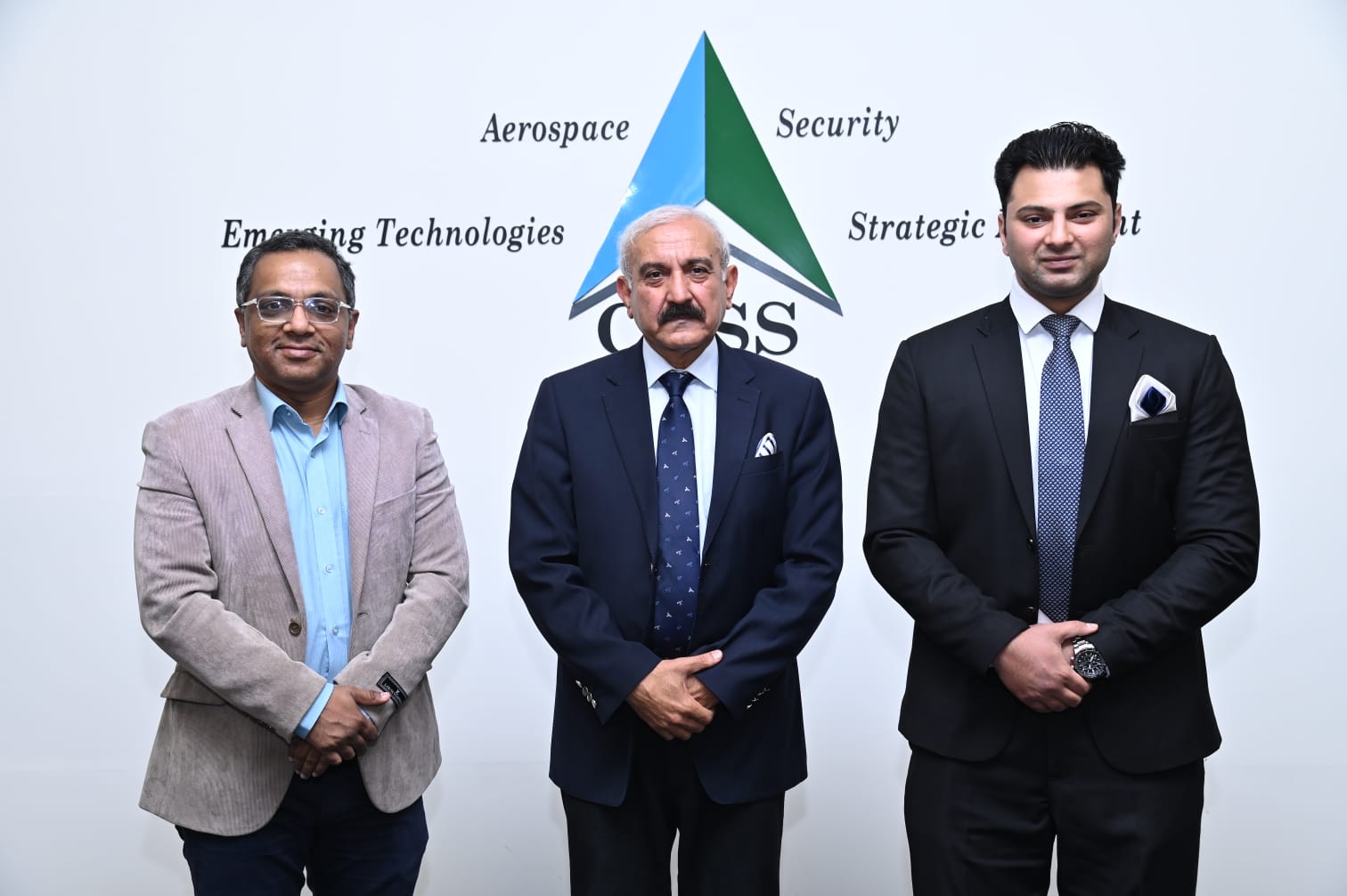
WNAM REPORT: The Centre for Aerospace & Security Studies ( titled ‘Space and Pakistan’s Future: Mobilising the Youth and Fostering Innovation’ as part of its Tech Talk series on 21 January 2026. The session brought together experts and researchers to examine the evolving significance of space and the role of youth in Pakistan’s national space ecosystem.
In his opening remarks, Air Marshal (Retd) Javaid Ahmed, President CASS, stated that space was one of CASS’ niche areas of research with significant strategic and developmental potential. He noted that CASS had played a consultative role during the formulation of Pakistan’s Space Policy by providing policy-oriented inputs, and highlighted the lack of sufficient awareness within academia, where space studies remained largely confined to disciplines such as physics, while remaining underexplored in other academic fields.
The talk was delivered by Mr Muhammad Iftekhar Yezdani, Chief Executive Officer (CEO), Raheqamar. He argued that with nearly 64 per cent of Pakistan’s population under the age of 30, the country possessed immense demographic potential to build a vibrant space ecosystem. He highlighted how the digital age had transformed attention into a commodity and called for a shift from an ‘attention economy’ to an ‘aspiration economy’ by making space science engaging, accessible, and culturally relevant.
Mr Yezdani further proposed a four-pillar framework, i.e., Cultivate, Educate, Activate, and Amplify, to promote space awareness and innovation. His recommendations included supporting local science content creators, integrating real-time satellite data into education, launching national space challenges and CubeSat programmes, strengthening incubators, and using digital platforms to build communities around space learning. He emphasised the importance of modern science communication tools such as short-form video, immersive platforms, storytelling, and gamification to cultivate interest in space among youth. He also stressed that Pakistan’s next major leap in space would be driven not by a single technological breakthrough, but by the collective imagination, skills, and creativity of its youth.
In his concluding remarks, President CASS appreciated the speaker for an insightful presentation, particularly for highlighting the importance of a bottom-up approach to space sector innovation, and reiterated the need for sustained policy focus and institutional support for Pakistan’s space development. He also stated that Pakistan’s entry into the space domain was commendable and highlighted the National Aerospace Science & Technology Park (NASTP) as a positive initiative for strengthening the national technological ecosystem.
CASS emphasises youth engagement as a key to realising Pakistan’s space potential
11
previous post