
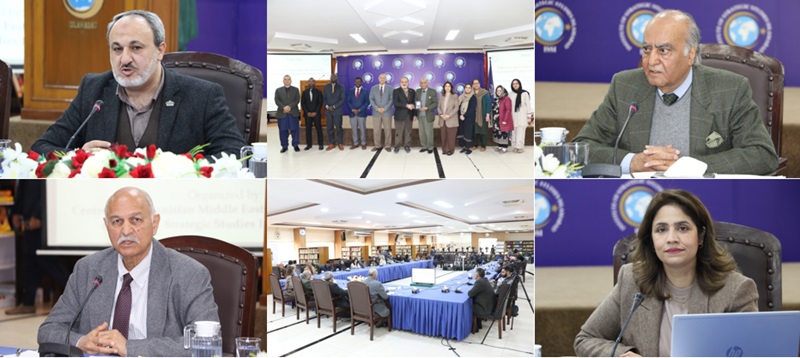
WNAM REPORT: The Centre for Afghanistan, Middle East and Africa (CAMEA) at the Institute of Strategic Studies (ISSI) organized a public talk under its Distinguished Lecture series, titled, ‘Palestine at a Crossroads: The Future of the Palestinian Cause under the Board of Peace.’ The Chief Guest at the event was Mr. Mohammad Makram Omar Moh’d Balawi, Secretary General of the League of Parliamentarians for Al Quds (LP4Q). Senator Mushahid Hussain Sayed, President, Pakistan Africa Institute for Development and Research (PAIDAR), was the keynote speaker at the event. Dr. Amina Khan, Director CAMEA and Ambassador Khalid Mahmood, Chairman, BOG, ISSI also spoke on the occasion.
Dr. Amina Khan, in her welcome remarks said, that despite global outrage and mounting evidence, Israel remains actively engaged in the systematic genocide of the Palestinian people, marked by mass civilian killings, destruction of entire communities, and the deliberate dismantling of Palestinian life in Gaza and the other occupied territories. Any credible pathway forward, including initiatives such as the Board of Peace, must be anchored in justice, accountability, and the realisation of Palestinian self-determination in accordance with UN resolutions and international law.
Mr. Makram Balawi, while expressing his views said that Pakistan’s acknowledged stance on Palestine is historically defined. Palestinians are going through a very sensitive phase while President Trump is defining a new world order. One of the reasons for this untenable situation is the inaction by the UN. Meanwhile world is repeating the Israeli narrative about Palestine. He further pointed out that the Israeli settler colonialism is evident in occupied Palestine. In his opinion, the Trump era is one of its kind as he views international politics like a kind of a deal. There is no focus on finding a political solution for the Palestinian people and this is the main challenge. The Europeans are now talking about a two-state solution but not doing anything substantive about it. Israel has always been ignoring the two-state solution and there is also talk about recognizing Jerusalem as the new capital of Israel. However, Israeli atrocities have led to changing perceptions and as a result we witnessed large demonstration in the big cities in the West. He further emphasized that as Palestinians, we are happy that Muslim counties are involved in the Board of Peace, but it is not a good solution. The choice is very challenging; however, Palestinians are satisfied that they have Muslim countries in the board of peace as a balancing factor. The Board of Peace is a project of Trump and this is likely to collapse sooner. Israelis are also undermining Trumps plan and are pushing Palestinians to retaliate. He concluded that Israel wants to create an environment where Palestinians find it difficult to survive.
Senator Mushahid Hussain stated that the discourse on Palestine has changed with the emergence of three key realities: growing awareness in Western countries of Israeli brutality, increasing perception within the Arab and Muslim world of Israel as a major threat, and the rise of a coordinated Indo-Israel nexus driven by extremist ideologies of Hindutva and Zionism respectively, linking the issues of Kashmir and Palestine. He emphasized Pakistan’s historic and unwavering support for the Palestinian cause, recalling that Quaid-e-Azam Muhammad Ali Jinnah’s first formal diplomatic communication with U.S. President Harry Truman was on Palestine. He reaffirmed Pakistan’s commitment to using international peace platforms to help resolve this longstanding issue.
Ambassador Khalid Mahmood, in his remarks, emphasized the need to keep the Palestinian issue firmly on the international agenda. He reiterated that Pakistan’s position on the Palestine issue has been principled and unwavering since the inception of the country and remains unchanged. This position, he noted, is not only grounded in Pakistan’s ideological commitment but is also firmly aligned with relevant United Nations General Assembly (UNGA) and Security Council resolutions and international law. He expressed deep concern over the current situation in Palestine, highlighting the grave humanitarian crisis faced by the Palestinian people as a matter of serious international concern. He underscored that Al-Quds (Jerusalem) holds a special place for Pakistan and the Pakistani people, particularly since its occupation. He noted that Israel’s attempts to alter the status of the city through illegal settlements have been repeatedly rejected by the United Nations. In this context, he stressed that the two-state solution remains the only viable path forward, and Pakistan remains fully committed to this internationally recognized framework.
The talk was attended by diplomats, academics, students, practitioners and members of the civil society and ended with an engaging Question and Answer session.