
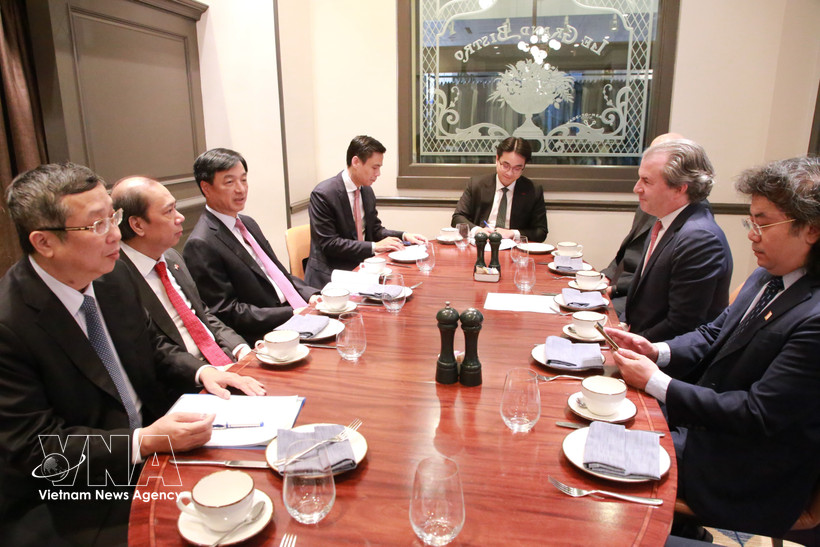
WNAM REPORT: Nguyen Duy Ngoc, Politburo member and deputy head of the Central Steering Committee for the Development of Science, Technology, Innovation and Digital Transformation, chaired working sessions with Rosen Partners, Arizona State University (ASU), Meta Platforms, and the Semiconductor Industry Association (SIA) on February 19-20 within the framework of Party General Secretary To Lam’s trip to Washington D.C. for the inaugural meeting of the Gaza Board of Peace.
Meeting with Daniel Rosen, CEO of Rosen Partners – a privately held, industry-leading investment firm in the US, Ngoc, who is also Secretary of the Hanoi Party Committee, welcomed the group’s interest in investing in the Vietnamese capital, expressing his hope that the proposed project will bring substantial foreign direct investment (FDI) and advanced management expertise in the tourism and entertainment sectors.
Ngoc said that Vietnam recently concluded the 14th National Congress of the Communist Party of Vietnam, which set out long-term development orientations toward the centenary of the Party and the nation, with an economic strategy targeting double-digit growth driven by science, technology and innovation.
He highlighted Resolution 57-NQ/TW, which promotes venture capital policies, including some pilot investment projects. The country has established high-tech parks in Hanoi, Ho Chi Minh City and neighbouring provinces to attract advanced technology projects in areas such as artificial intelligence and semiconductors, he said.
Providing an overview of Hanoi’s economic performance, he said the city recorded the GRDP growth of 8.16 percent in 2025 and contributed roughly one quarter of the country’s total budget revenue. Hanoi is targeting 11% growth from 2026 onward. To realise these goals, the capital has identified three strategic pillars, namely implementing a 100-year master plan for the city; promoting multi-layered, multi-centered urban development; and strengthening connectivity with surrounding provinces as satellite growth hubs. Hanoi is also proposing special institutional mechanisms to unlock breakthrough development policies.
The city is pursuing a long-term vision to become a green, smart and globally connected mega-city, while sustaining double-digit growth from 2026 to 2045. This goal requires a new growth model based on knowledge, science and technology, innovation, digital transformation and high-quality human resources, as well as substantial social investment capital.
Therefore, Hanoi is calling on US companies and corporations, particularly in financial investment, urban infrastructure, strategic technologies, telecommunications, energy, healthcare, education and high-end tourism, to expand their presence in the city.
He suggested that, beyond real estate and tourism, Rosen Partners explore opportunities in priority sectors aligned with Hanoi’s 100-year vision. In research and development, he encouraged the firm to consider establishing research centres in Hanoi, particularly at the Hoa Lac Hi-Tech Park.
He affirmed the city’s commitment to building a competitive and transparent investment environment, with streamlined procedures, “green-lane” mechanisms, low transaction costs and the application of international best practices. He added that Hanoi stands ready to provide clean land and favourable conditions for major strategic investors such as Rosen Partners.
During a working session with Arizona State University (ASU), Ngoc welcomed Kevin McGinnis, ASU’s Vice President for Strategic Technology Initiatives, and ASU representatives, commending the university’s continued interest in and support for Vietnam in education and high-quality workforce training, as well as in science, technology, innovation and the semiconductor industry.
Introducing Resolution 57-NQ/TW to ASU officials, Ngoc emphasised that Vietnam identifies science, technology, innovation and digital transformation as top important breakthroughs and key drivers for modernising productive forces, renewing national governance and enhancing economic productivity, quality and competitiveness.
He highly valued progress made with ASU following the January seminar on shaping the future of the semiconductor industry, and proposed that ASU explore signing cooperation agreements with major Vietnamese cities to accelerate semiconductor industry development. Priority areas include workforce training, attraction of leading US semiconductor firms to invest in research and development centres, and expansion of collaboration in chip design, artificial intelligence, packaging and testing, and advanced materials manufacturing.
For Hanoi, he said the city plans to deepen cooperation on a semiconductor workforce development programme, focusing on joint training, research and ecosystem building with semiconductor enterprises. Proposed initiatives include curriculum development, faculty capacity building for universities and colleges in Hanoi, research partnerships, and collaboration with leading Vietnamese universities to promote advanced semiconductor education and research.
He called on ASU and leading US semiconductor companies to prioritise investment and advanced technology development at Hoa Lac Hi-Tech Park. He noted that Hanoi and Ho Chi Minh City host major, reputable universities capable of piloting a “university-based enterprise” model, fostering innovation ecosystems within university campuses.
Reaffirming Hanoi’s commitment to creating a transparent and business-friendly investment climate, he pledged that the city will adopt special mechanisms and policies to support partners in research, training, investment and project implementation in Vietnam. He expressed confidence that cooperation with US partners and ASU in particular would achieve new breakthroughs in the coming period.
At a working session with representatives from Meta Platforms on February 19, Ngoc expressed his pleasure at meeting Chief Global Affairs Officer at Meta Joel Kaplan.
He appreciated the group’s strong interest in cooperation, investment and presence in Vietnam, including its device manufacturing activities and negotiations on a memorandum of understanding (MoU) on strategic cooperation with the Ministry of Science and Technology.
He said the current context presents a timely opportunity for both sides to elevate their ties to a long-term strategic technology partnership.
The Vietnamese official noted that Resolution No. 57-NQ/TW promotes a shift in mindset and implementation mechanisms by allowing pilot schemes for new issues, accepting appropriate venture investment risks, and fostering the development of research institutes and universities into strong research actors; closely linking research, application and training, thereby strengthening substantive connections among the State, businesses, research institutes and universities.
In prioritising strategic technologies, the country’s list of strategic technologies has identified semiconductor chips and related product groups, including specialised chips, AI chips and Internet of Things (IoT) chips, he added.
Based on assessments of potential and room for expanding cooperation, Ngoc called for stronger investment cooperation with Meta in the coming period to develop a national-scale Vietnamese-language dataset, a move he said will both safeguard national digital sovereignty and enhance Vietnam’s global connectivity and competitiveness.
He proposed that Meta support Vietnam in building and standardising a national Vietnamese-language dataset to form a unified data platform for Vietnamese-language AI systems, with the aim of completing a comprehensive dataset for large-scale AI models by the end of 2027. The cooperation, he noted, will help bring AI into practical application across daily life and production in Vietnam.
He also suggested Meta assist Vietnam in fine-tuning globally popular foundational AI models into specialised applications suited to local conditions, language, culture and the legal system of the country; provide technical support; share international experience in deployment, safety assurance and AI risk governance; offer regular technology updates; continue supporting digital and AI skills training for youth and labourers affected by AI and automation; help Vietnamese small- and medium-sized enterprises develop e-commerce; and coordinate efforts to combat fake news and online fraud.
He reaffirmed Vietnam’s welcome and appreciation for Meta’s investment activities in the country, saying cooperation with the group aims to further concretise the Comprehensive Strategic Partnership between Vietnam and the US.
At a meeting with representatives from the Semiconductor Industry Association (SIA) on February 20 (local time), Ngoc spoke highly of the association’s strategic role as a representative of companies accounting for about 99% of US semiconductor industry revenue and roughly 50% of the global market, serving as a key policy and strategy hub for the US chip industry.
He said Vietnam’s orientation for developing the semiconductor industry has been clearly set out in Resolution No. 57-NQ/TW, which identifies mastering strategic technologies as a core task, with semiconductor chip technology included in the list of strategic technologies alongside specialised chips, AI chips and IoT chips.
Ngoc noted that the Vietnamese Government has approved a strategy for semiconductor industry development through 2030, with a vision to 2050, focusing on human resources and industrial capacity. Key targets include training more than 50,000 engineers and graduates for the sector; building design capabilities with at least 100 design firms; gradually developing assembly, test and packaging (ATP) capacity with at least 10 facilities; and researching the establishment of at least one small-scale chip manufacturing plant.
On behalf of the Central Steering Committee for the Development of Science, Technology, Innovation and Digital Transformation, he proposed cooperation with SIA in workforce training and mutual recognition of certifications, particularly short-term programmes in ATP for STEM students in Vietnam, potentially through US universities such as Arizona State University, while promoting direct links between SIA member companies, including Intel, Marvell and Amkor, and key universities to align graduate output with real industry demand. He also suggested cooperation in advising on the improvement of the legal framework and policies to attract R&D investment.
Ngoc highly appreciated the valuable policy advice and cooperation proposals with Vietnam from SIA President and CEO John Neuffer, expressing hope for close coordination in the period ahead.