
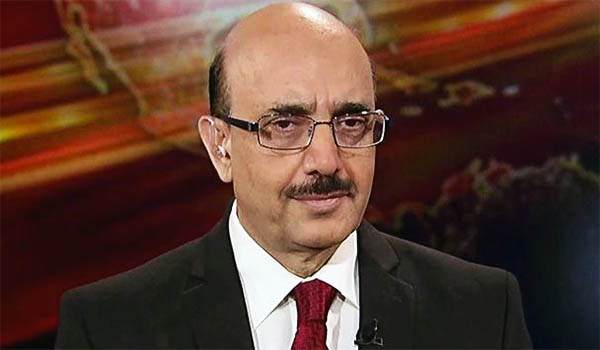
WNAM REPORT: Ambassador Masood Khan, former President of Azad Jammu and Kashmir and former Ambassador of Pakistan to the United States and the United Nations, has stated that Pakistan’s principled participation in the Gaza Peace Board has not only reaffirmed its unwavering support for Palestinian statehood but has also elevated Pakistan’s strategic standing in and strengthened Pakistan–United States relations at the highest level.
In a televised interview, Ambassador Khan underscored that Pakistan’s engagement in the Board is firmly anchored in its longstanding commitment to the establishment of a sovereign, contiguous Palestinian state based on pre-1967 borders with East Jerusalem as its capital. He emphasized that Pakistan’s presence in Washington was not symbolic but substantive, aimed at securing a durable ceasefire, ensuring humanitarian access, and advancing reconstruction in Gaza.
Referring to the inaugural session of the Board of Peace held on February 19, 2026, in Washington, D.C., Ambassador Khan noted that the initiative operates within the framework endorsed by the United Nations Security Council through Resolution 2803. He described the mechanism as a practical diplomatic avenue to alleviate the suffering of the Palestinian people and to move toward a structured and time-bound peace process.
Highlighting the significance of the moment, Ambassador Khan pointed to the public recognition extended to Pakistan’s leadership by U.S. President Donald Trump during proceedings at the United States Institute of Peace. He termed this acknowledgment a diplomatic inflection point, signaling renewed institutional confidence in Pakistan’s constructive regional role and its emergence as a strategic pivot linking South Asia, West Asia, Central Asia, and the broader Middle East.
Ambassador Khan observed that the improved political climate has translated into tangible economic and strategic dividends for Pakistan. He cited expanding dialogue on cooperation in critical minerals such as copper, lithium, and rare earth elements; collaboration in energy, including renewables and prospective oil exploration; engagement in emerging sectors such as digital finance and cryptocurrency frameworks; and prospects for expanded trade and industrial partnerships. These developments, he noted, reflect a shift from episodic engagement to structured, long-term strategic dialogue.
He further highlighted growing institutional support within Washington, including engagement with senior policymakers such as Marco Rubio, indicating that bilateral ties are increasingly anchored in shared strategic interests rather than transient political considerations.
Reaffirming Pakistan’s consistent position, Ambassador Khan stated that participation in the Peace Board does not dilute Islamabad’s principled stance on Palestine. Prime Minister Shehbaz Sharif, in his address to the session, outlined three core pillars for lasting peace: an immediate and verifiable ceasefire; comprehensive humanitarian relief and reconstruction; and a credible pathway toward Palestinian sovereignty in accordance with relevant United Nations resolutions.
Ambassador Khan also emphasized the urgency of reconstruction, noting the extensive loss of life, displacement, and destruction in Gaza. He stressed that humanitarian corridors must be established in coordination with the International Committee of the Red Cross and relevant UN agencies to address famine, disease, and infrastructure collapse.
On the legal and political front, he reiterated Pakistan’s firm opposition to annexation measures and settlement expansion in occupied Palestinian territories, recalling that such actions contravene international law and United Nations Security Council Resolution 2334. He stressed that the two-state solution remains the only viable path to durable peace.
Regarding security arrangements, Ambassador Khan clarified that Pakistan would not automatically join any stabilization or enforcement force. Any future participation would strictly adhere to United Nations mandates and align with the wishes and national interests of the Palestinian people. He ruled out involvement in combat or peace enforcement operations, consistent with Pakistan’s longstanding and respected contributions to UN peacekeeping missions worldwide.
Concluding his remarks, Ambassador Masood Khan stated that Pakistan’s principled diplomacy has demonstrated that national interest and moral clarity can advance together. “Our engagement in Washington,” he observed, “has reinforced Pakistan’s global standing, strengthened bilateral ties with the United States, and reaffirmed our unwavering commitment to justice, reconstruction, and the legitimate rights of the Palestinian people.”
Masood Khan: Pakistan’s Palestine Policy Elevates US Ties
2