
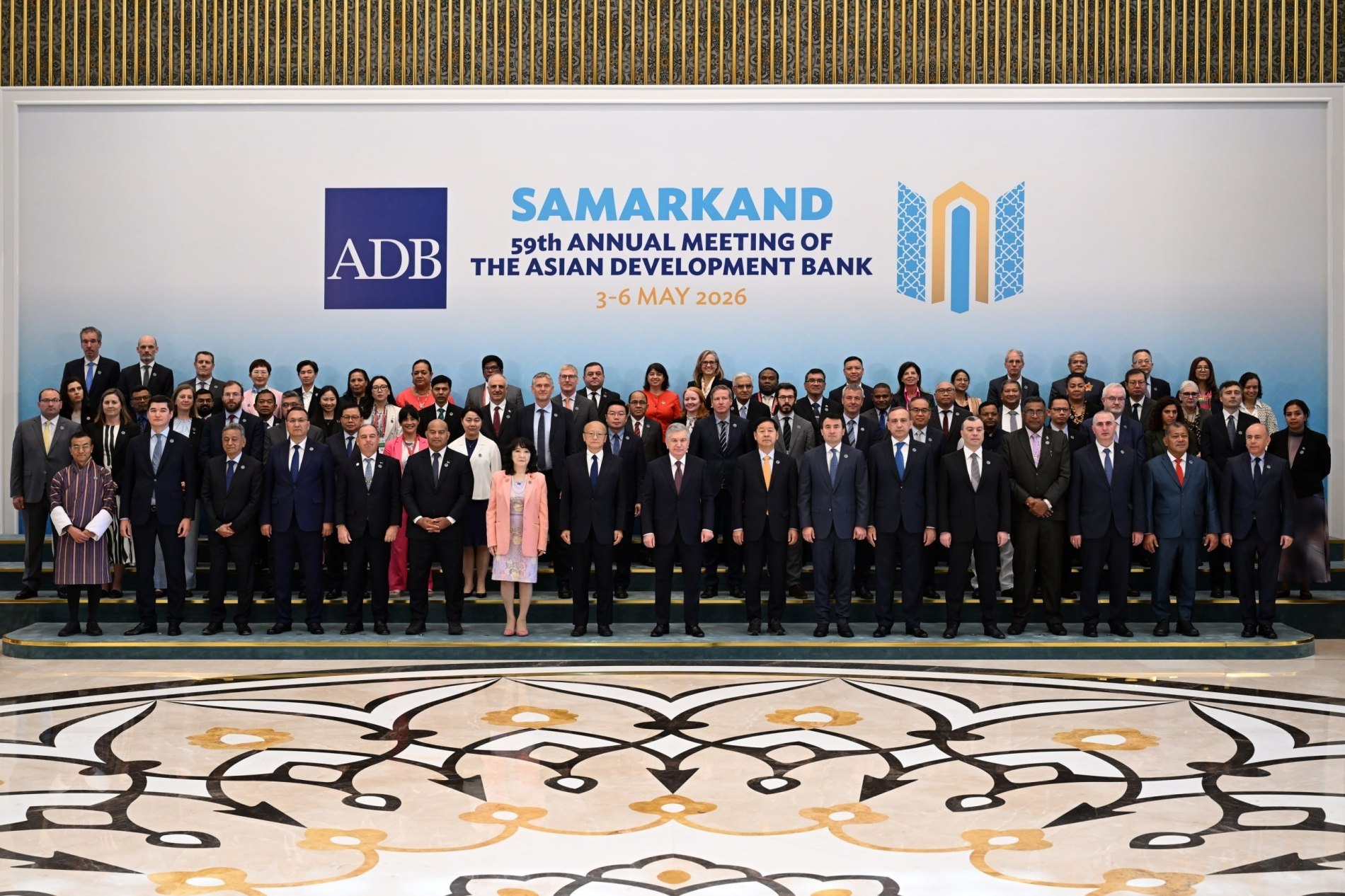
WNAM MONITORING: The 59th Annual Meeting of the Board of Governors of the Asian Development Bank officially opened on May 4 in Samarkand, bringing together more than 4,000 participants from over 100 countries. Held under the theme “Crossroads of Progress: Advancing the Region’s Connected Future,” the forum has given Uzbekistan a high-profile platform to promote its reforms, regional connectivity plans, and ambitions in green energy and artificial intelligence.
The agenda covers digital and green transformation, climate resilience, supply chain development, and food security. The meeting also gives Central Asia a chance to present itself as a more active player in regional infrastructure, energy, and trade planning.
President Shavkat Mirziyoyev addressed the forum, highlighting Uzbekistan’s recent economic reforms and development trajectory. He said the country has attracted $150 billion in foreign investment in recent years, while exports of goods and services have tripled and the economy has expanded from $50 billion to $147 billion.
“Most importantly, our reforms have focused primarily on improving the daily lives of every single family and individual,” Mirziyoyev said, noting that poverty levels have declined significantly, from nearly 35% to 5.8%. He added that Uzbekistan’s economy grew by 8.7% in the first quarter despite global economic challenges.
The president also emphasized the role of international financial institutions, noting that Uzbekistan’s joint project portfolio with the ADB has reached nearly $16 billion. He expressed appreciation for cooperation with organizations, including the World Bank, the International Monetary Fund, and the European Bank for Reconstruction and Development.
Particular attention was given to digital transformation and artificial intelligence. Uzbekistan has launched initiatives, including the creation of an AI Hub, the expansion of data centers, and training programs aimed at developing technological expertise. “The use of open AI models is also required in areas that are most essential to the population’s primary needs,” Mirziyoyev said.
Green energy and transport connectivity were also central topics. Uzbekistan has already commissioned 5,600 megawatts of renewable energy capacity and aims to increase the share of renewables to 54% by 2030. The president also highlighted major infrastructure projects, including the China-Kyrgyzstan-Uzbekistan railway, which is expected to reduce cargo delivery times and strengthen regional transit links.
In addition, proposals were put forward to develop a regional “Digital Customs and Logistics Alliance,” expand cooperation in critical minerals, and launch initiatives such as the “Green Belt of Central Asia” and a “Central Asia Tourist Ring.”