
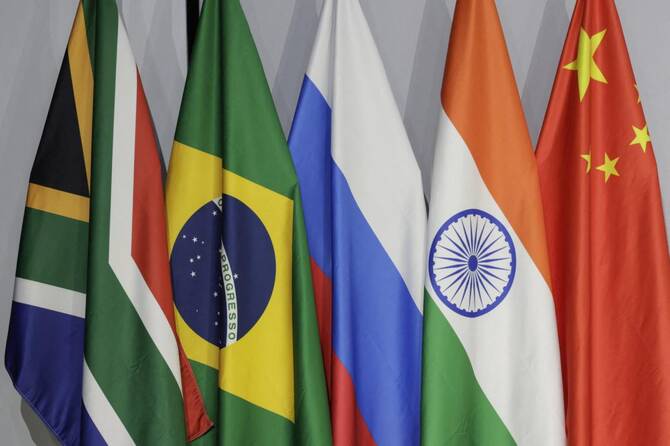
WNAM REPORT: The US-Israeli war on Iran is set to cast a shadow over a two-day meeting of the foreign ministers of the BRICS grouping that kicks off in New Delhi on Thursday, testing the bloc’s ability to reach a unified position and produce a joint statement.
The grouping, which originally included Brazil, Russia, India, China, and South Africa, has expanded over the years with the inclusion of Egypt, Ethiopia, Indonesia, Iran and the United Arab Emirates.
Iran had urged India, the BRICS chair for 2026, to use the BRICS platform to build a consensus condemning US and Israeli actions in the in the Gulf conflict.
The main differences have emerged between Iran and the United Arab Emirates, which are on opposing sides of the front line in a war launched by the US and Israel on February 28. Iran’s Foreign Minister Abbas Araghchi is likely to arrive late on Wednesday to attend the gathering, which will run through May 14–15.
Russian Foreign Minister Sergey Lavrov is also expected to attend the meeting. It was not immediately clear who will represent the UAE during the meeting.
Indian Foreign Ministry spokesperson Randhir Jaiswal had said in March that some BRICS members were involved directly in the conflict, due to which it had been “difficult for us to forge a consensus.”
Another ministry official told Reuters India was hopeful to get a joint statement after the latest round of meetings with foreign ministers.
“Glad that the foreign ministers from all the BRICS countries, except China who is otherwise tied up, are coming. This is a good sign on efforts to build a BRICS coalition around a matter of interest to emerging economies and the global south,” said former Indian diplomat Manjeev Singh Puri.
“Of course political solutions are difficult but the fact that they are meeting is positive and hopefully it will lead to a way forward.”
Soaring energy prices caused by the war have prompted many BRICS nations, including India, to introduce emergency measures to protect their economies and consumers.
So far China has taken a nominally neutral stance, given its robust ties with both Iran and Sunni-majority Arab states.
China will be represented by its Ambassador to India Xu Feihong to fill in for their Foreign Minister Wang Yi who is unlikely to travel with US President Donald Trump visiting Beijing this week.