
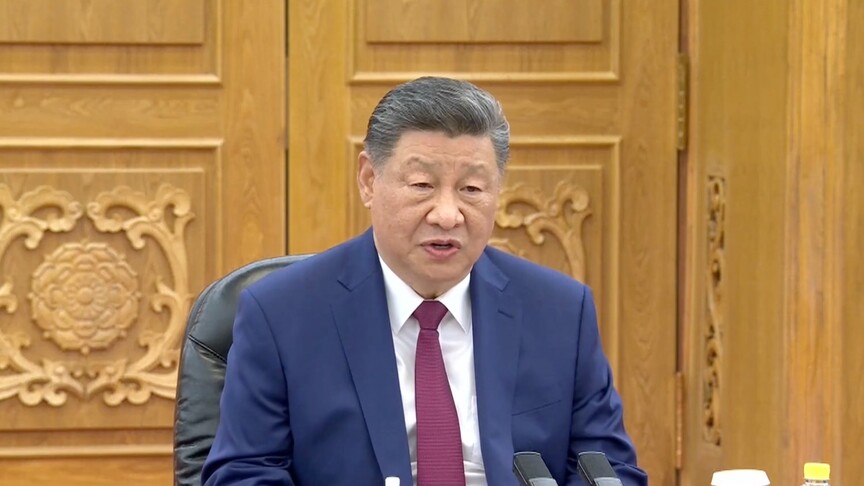
WNAM REPORT: China’s President Xi Jinping told his US counterpart Donald Trump Thursday that Washington and Beijing should be “partners, not rivals” as the two leaders met in the Chinese capital.
China and the US “both stand to gain from cooperation and lose from confrontation,” Xi said in opening remarks at the Great Hall of the People, China’s ceremonial state building, adding that the meeting had drawn global attention.
“We should help each other succeed, prosper together, and find the right way for major countries to get along in the new era,” he said.
Xi said the world was undergoing transformations “not seen in a century” and described the international situation as fluid and turbulent, adding that the it had reached “a new crossroads.”
He said China and the US faced questions “vital to history, to the world and to the people,” including whether they could “create a new paradigm of major country relations,” jointly address global challenges and “provide more stability for the world.”
“They are the questions of our times that you and I need to answer as leaders of major countries,” Xi said.
Saying he “always believed” Beijing and Washington had “more common interests than differences,” Xi added that one country’s success represented “an opportunity for the other” and that stable bilateral ties were beneficial for the world.
He said he looked forward to further discussions on issues important to both countries and the wider international community, and to working with Trump “to set the course for and steer the giant ship of China-US relations,” with the aim of making 2026 “a historic landmark year” that opens “a new chapter” in bilateral ties.
Xi also emphasized that economic ties between the two nations are “mutually beneficial and win-win in nature,” according to state-run news agency Xinhua News Agency.
“Yesterday, our economic and trade teams produced generally balanced and positive outcomes. This is good news for the people of the two countries and the world,” Xi said.
The Middle East conflict, Taiwan, trade and tariffs were among the issues high on the agenda in the talks between the two leaders.
Trump was accompanied by Secretary of State Marco Rubio and Defense Secretary Pete Hegseth, along with executives from major US companies, including Nvidia’s Jensen Huang, Tesla’s Elon Musk, Apple’s Tim Cook, BlackRock’s Larry Fink, Blackstone’s Stephen Schwarzman, Boeing’s Kelly Ortberg, Cargill’s Brian Sikes, Citigroup’s Jane Fraser, GE Aerospace’s Larry Culp, Goldman Sachs’ David Solomon, Micron’s Sanjay Mehrotra and Qualcomm’s Cristiano Amon.
Trump’s son Eric Trump and his wife, Lara Trump, also accompanied the president and disembarked from the plane shortly after him.
First lady Melania Trump did not accompany the president, unlike during Trump’s 2017 visit, when the couple was hosted by Xi and Chinese first lady Peng Liyuan.
The visit comes amid the Middle East conflict triggered after US and Israeli forces launched strikes against Iran on Feb. 28, prompting retaliatory attacks against Israel and US allies in the Gulf, as well as the closure of the Strait of Hormuz.
A prolonged ceasefire is currently in effect in the region.
China has repeatedly called for dialogue in the region, while Washington has accused Beijing of supporting Iran’s military and economic capabilities.