
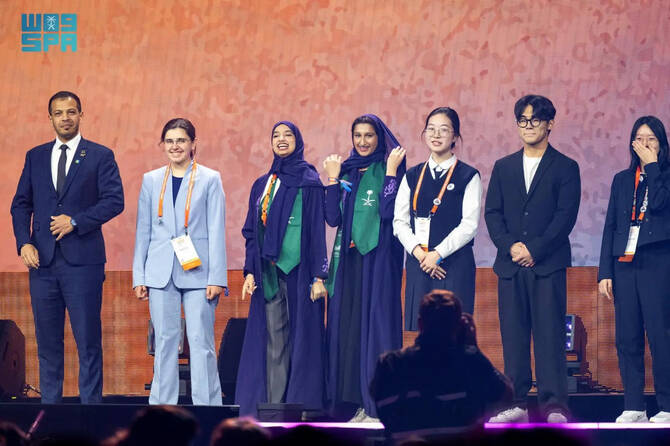
WNAM REPORT: Saudi Arabia topped the global rankings in computational biology and bioinformatics at the Regeneron International Science and Engineering Fair in the US.
The Kingdom also came second globally for the number of grand awards achieved for the third consecutive year, behind the US.
Competing in Phoenix, Arizona, from May 9 to 15 against more than 1,700 students from 70 countries, the Saudi delegation won 12 grand awards — including one first, four second, five third and two fourth places, as well as 12 special awards.
The 40-strong team included 23 students competing in person and 17 remotely from Riyadh. Their projects covered engineering, medical sciences, energy and advanced technologies.
The first place in computational biology and bioinformatics went to Mohammed Nasser Al-Asmari of the Royal Commission Education Administration in Jubail.
Second-place awards went to Dalin Badr Qadeer from Makkah Education in earth and environmental sciences, as well as Munira Suleiman Al-Roumi, Imran Omar Al-Turkistani and Jumanah Talal Bilal from Eastern Province and Riyadh education departments in materials science.
Third places went to Jouan Rayan Hindi from Jeddah Education in biomedical and health sciences, Abdulrahman Basel Jamal from Jeddah Education in chemistry, Fatimah Mohammed Al-Saleem from Tabuk Education in energy, Yara Youssef Al-Qadi from Eastern Province Education in environmental engineering, and Abdullah Ahmed Al-Rashid from Eastern Province Education in materials science.
Fourth-place awards went to Lana Abdullah Abu Talib from Jazan Education in energy and Fatimah Hussein Al-Moqren from Eastern Province Education in environmental engineering.
This achievement brings Saudi Arabia’s total tally at the fair to 209 awards since it began participating in 2007 under the supervision of King Abdulaziz and His Companions Foundation for Giftedness and Creativity, otherwise known as Mawhiba, and the Ministry of Education.
The students were selected from more than 357,000 participants who submitted over 34,000 research projects nationwide, highlighting Saudi Arabia’s growing role in pre-university research and global innovation.
Mawhiba Secretary-General Abdulaziz Al-Karidis said the results reflected the Kingdom’s continued investment in education, giftedness and innovation.
He said Saudi Arabia’s leadership continued to empower national talent to compete at the highest international scientific levels, adding that the results showed the maturity and competitiveness of the Kingdom’s talent development system.
“The Kingdom’s strong presence at the competition reflects the strategic partnership between Mawhiba and the Ministry of Education, which plays a key role in identifying, nurturing and preparing gifted students for international participation,” Al-Karidis said.
He added: “The awards highlight the strength of Saudi research output, the quality of academic training, and the effectiveness of the national talent development system, supported by Saudi Aramco, the National Cybersecurity Authority, and the Saudi Commission for Health Specialties.”
Ahmed Al-Rashid, father of award-winner Abdullah Ahmed Al-Rashid, told Arab News: “Abdullah developed his scientific skills through participation in various competitions and activities, which helped him gain knowledge and refine his abilities. He also benefited from intensive training programs offered by the ministries of education and culture, along with several other entities.
“Abdullah showed strong personal initiative and built a network of contacts and friends who encouraged him to take part in competitions. The family’s role was limited to providing moral and logistical support, including attending events such as Formula One World Championship races, Saudi Aramco activities, and programs organized by the Ministry of Culture.”
Al-Rashid said his son also took part in the competition last year but did not win. This year, however, he made exceptional efforts and “did not sleep at night,” leading to his success. He added that he was not surprised by the result, given Abdullah’s dedication and hard work.
On the sidelines of the event, Mawhiba organized a specialized seminar to highlight Saudi Arabia’s approach to identifying and developing talented students and preparing them for international scientific competitions.
The seminar focused on strategies for building scientific exhibitions, preparing students for global contests and training personnel to support innovation programs as part of the Kingdom’s broader effort to strengthen its scientific ecosystem.
Tahany Al-Baiz, Saudi cultural attache to the US and Canada, said the team’s participation reflected Saudi Arabia’s commitment to investing in its youth and empowering them to compete at leading international scientific forums.
She said the students’ projects addressed national priorities including energy, engineering, medical sciences and future technologies, areas seen as vital to enhancing the Kingdom’s competitiveness and supporting economic diversification goals.
Al-Baiz added that the Saudi Arabian Cultural Mission in the US oversees more than 1,500 Saudi scholarship students studying at the world’s top 30 universities and she was confident many Regeneron fair participants would go on to join them.
Calling the students “ambassadors of ambition,” Al-Baiz encouraged the delegation to continue achieving new milestones for the Kingdom on the global scientific stage.