
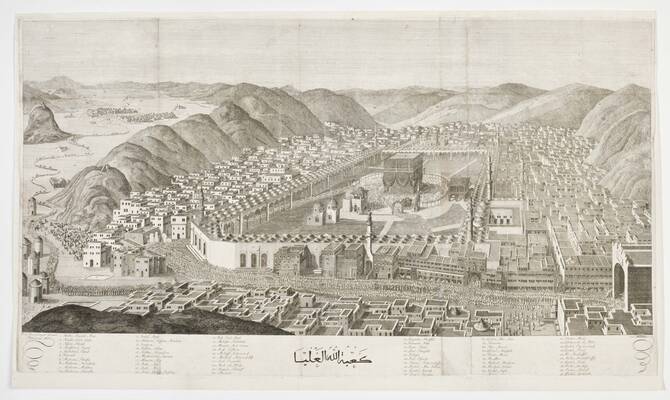
MAKKAH ( WNAM MONITORING): For centuries, the Hajj pilgrimage has been a journey unlike any other, one in which the punishing demands of the road have been inseparable from the spiritual weight of the destination.
The pilgrim caravans of the past paint a human and devotional canvas without parallel, faithfully chronicled by travelers and historians whose books and manuscripts now rank among the most valuable historical witnesses to how this sacred rite evolved.
From sea passages to long stretches of desert and grueling overland tracks, these accounts have preserved the journey to the Kaaba in remarkable detail, bequeathing to later generations a living picture of the grandeur of the rituals and of Muslim unity across the centuries.
In earlier ages, reaching the holy land was no simple matter.
The journey could consume months — even an entire year — exposing pilgrims to the hardships of the road, the unpredictability of the elements, and the perils of both desert and sea.
Speaking to Arab News, Dr. Fawaz Al-Dahas, director of the Makkah History Center, described how rulers and sultans shaped the pilgrimage routes.
Chief among them was Caliph Harun Al-Rashid, famed for his repeated pilgrimages from Baghdad, and Sultan Al-Zahir Baybars, who established supply posts and security details to safeguard the pilgrim caravans on routes from Damascus and Cairo.
This pattern, Al-Dahas said, reveals how early Islamic states grasped the importance of organizing and protecting the sacred journey.
The historic pilgrimage routes including Darb Zubaydah from Iraq and the Egyptian Road, were, in Al-Dahas’ view, pivotal to the rise of the towns and waystations that sprang up along the trails.
They also served as arteries of commerce and culture, knitting the various corners of the Islamic world together through trade and exchange.
These journeys, he added, also lay bare the scale of the care that successive Islamic civilizations lavished on the pilgrims.
Reservoirs and wells were dug, caravanserais and rest houses built, security details deployed, and medical services made available — an early blueprint, in effect, for the organized management of large crowds.
The literature of pilgrim travel, Al-Dahas argued, amounts to a civilizational archive in its own right.
He pointed to the writings of Abd Al-Ghani Al-Nabulsi, who recorded the encounters and cultural exchanges between pilgrims, gatherings that, in concept, anticipated the international conferences of the modern era by several centuries.
The literary legacy of the Hajj also boasts a number of landmark works, among them “Fi Manzil Al-Waḥy” (In the House of Revelation), “The Road to Makkah”, and “To the Land of Prophethood,” texts that distilled the spiritual and human experience of the pilgrimage through varying literary and intellectual lenses.
For all the centuries that separate them, and despite the diversity of the tongues in which they were written, these accounts remain, in the view of researchers, a living register tracing the evolution of the Hajj.
Researcher and historian Saad Al-Joudi spoke to Arab News about how Hajj was a complete civilizational event, one that helped document Muslim life and track the shifting fortunes of societies across the ages.
Many of the pilgrim travelogues, he observed, now stand as indispensable historical sources for understanding the texture of Islamic societies in their respective eras.
Ibn Jubayr, Al-Joudi noted, left an exceptionally precise account of his journey from Andalusia to the Hijaz, recording his sea voyage to Alexandria and his onward overland trek to Makkah.
He captured the scenes of Ihram, Tawaf, Sa’i, the standing at Arafat, and the stoning of the Jamarat — a narrative that wove historical accuracy together with deep spiritual reflection.
Ibn Battuta’s writings, Al-Joudi added, opened yet another window onto the journey: the supply stations, the makeshift markets, the physicians’ tents pitched along the pilgrim roads, as well as the scenes of Islamic unity in which he found himself shoulder to shoulder with pilgrims of every ethnicity and tongue.
It is in such passages, he said, that the human and social dimensions of the pilgrimage come most fully into view.