
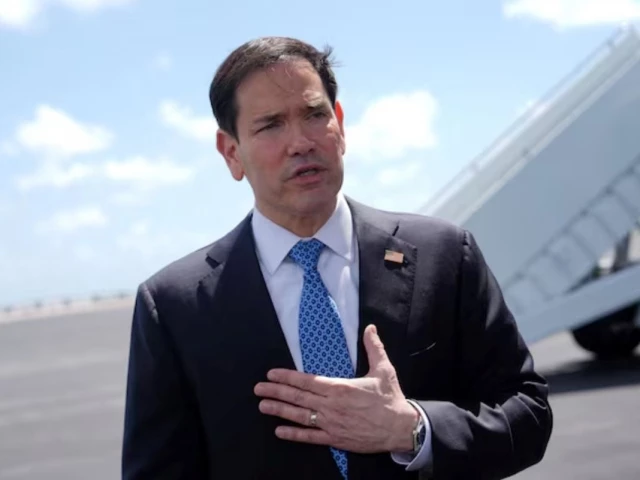
WNAM MONITORING: United States Secretary of State Marco Rubio on Friday reiterated that Pakistan remained the “primary interlocutor” in Washington’s negotiations with Iran aimed at ending the ongoing conflict.
“The primary interlocutor on this has been Pakistan and continues to be and they’ve done a, you know, I think an admirable job. And that’s what we continue to work through,” Rubio told reporters in Sweden after meetings with NATO allies.
“Obviously, other countries, you know, have interests because especially Gulf countries that are, you know, in the middle of all this, may have their own situation going on. We talk to all of them. But I would just say that the primary country we’ve been working with on all of this is Pakistan, and that remains the case,” he said.
He also referred to reports regarding Chief of Defence Forces Asim Munir visit to Iran, saying he had information about the trip and was in constant contact with him at the highest level of government.
“And it’s my understanding he was supposed to go yesterday, but it could be as early as today that Field Marshal Munir could be travelling there very, very soon,” Rubio was quoted as saying by Fox News.
“And we’re in constant communication with him [and] the highest levels of our government are constantly talking to him.”
He said the United States hoped to reach an agreement with Tehran, while cautioning that Washington and its partners must also prepare a “Plan B” if Iran refuses to reopen the Strait of Hormuz.
He said he had raised the matter with NATO allies, adding that any contingency plan would not necessarily involve NATO as a whole but could include select partner countries with strategic interests in the waterway.
“We all would love to see an agreement with Iran in which the straits are open and they abandon their nuclear ambitions,” Rubio said, adding that diplomatic efforts toward such an agreement were ongoing.
However, he warned that alternatives would be required if Iran declined to cooperate. “What if Iran refuses to open the straits? What if Iran decides, ‘We refuse to open the straits, we’re going to own the straits, and we’re going to charge tolls for it?’ At that point, something has to be done about it,” he said.
Rubio said he had received “a lot of nods” from NATO foreign ministers when he raised the issue during discussions.
He also said the United States did not require allied assistance to reopen the strait or clear it of sea mines, though it would welcome cooperation from partners.
“We don’t need their help, but they’re willing to do it,” he said.
Meanwhile, Iran’s Foreign Ministry spokesperson said talks between Iran and the United States were continuing through Pakistan as a mediator, with both sides having exchanged responses to a recent Iranian proposal.
‘Slight progress’ made on Iran, Strait of Hormuz situation: Rubio
US Secretary of State Marco Rubio said on Friday there had been “some slight progress” regarding the situation involving Iran and the Strait of Hormuz.
“There’s been some slight progress, I don’t want to exaggerate it, but there’s been a little bit of movement, and that’s good,” Rubio told reporters ahead of a NATO foreign ministers meeting alongside NATO Secretary General Mark Rutte.
Rubio said the “fundamentals remain the same,” adding: “Iran can never have nuclear weapons, it just cannot make them.”
He said Washington was awaiting the outcome of ongoing discussions related to Iran while underlining that issues surrounding uranium enrichment and Tehran’s stockpile of highly enriched uranium would have to be addressed.
Rubio also accused Iran of attempting to establish a “tolling system” in the Strait of Hormuz, saying Tehran was trying to persuade Oman to join the initiative.
“There is not a country in the world that should accept that,” he said, calling the idea “not acceptable.”
“If that were to happen in the Straits of Hormuz, it will happen in five other places around the world,” Rubio added.
The top US diplomat said Washington was working through the UN on a Bahrain-sponsored resolution related to the issue, claiming it had garnered broad international backing.
“Let’s see if the United Nations still works,” Rubio said, while criticising unnamed Security Council members allegedly considering vetoing the resolution.
For his part, Rutte said the NATO meeting would focus on defence spending, Ukraine, and freedom of navigation amid growing concerns over Iran and the Strait of Hormuz.
“I hear from many of my colleagues here that it is not acceptable that the freedom of navigation is basically trampled upon as it is at the moment,” Rutte said.
He also thanked the US for continuing military support to Ukraine, particularly the supply of interceptor systems funded by European and Canadian allies.
Rubio also said the upcoming NATO leaders’ summit in Ankara would be “one of the more important leaders’ summits in the history of NATO,” citing defence industrial production, burden sharing, and global security challenges among the alliance’s priorities.
UAE’s Gargash sees ’50-50′ odds of US-Iran deal, warns against renewed fighting
There is a “50-50 chance” of a US-Iran peace agreement, the United Arab Emirates’ presidential advisor Anwar Gargash said on Friday, but stressed that any political settlement must address the root causes of instability in the region to avoid future conflict.
“It is a 50-50 chance that we will reach an agreement. My worry is that the Iranians have always over-negotiated,” Gargash said at the Globsec conference in Prague.
“This is not something new. They have missed many opportunities over the years because of a tendency to overestimate their cards. I hope they don’t do that this time,” Gargash said.
He also said that the region needs a political solution, and a second round of military confrontation would further complicate matters.
However, Gargash stressed that negotiations aimed solely at reaching a ceasefire risked laying the groundwork for future conflict if they failed to resolve underlying issues.
That “is not what we are seeking,” he added.
Gargash warned that any control over the Strait of Hormuz would set a dangerous precedent by politicising the strategic waterway and placing it under Iranian leverage.
Changes to the status quo in the strait would have serious global repercussions, including for Europe, he said, urging European countries to view the issue as directly linked to their energy security and trade interests.
He said the Strait of Hormuz must return to its pre-war status as an international waterway guaranteeing the free flow of energy, trade and maritime traffic, as it had for decades.
US House Republicans cancel vote on resolution limiting Trump’s Iran war powers
US House Republican leaders on Thursday cancelled a vote on a resolution to curb President Donald Trump’s war powers in Iran after Republicans appeared close to losing the measure due to members’ absence.
Democrats have repeatedly pushed votes in both the House and Senate to limit Trump’s war powers, with the effort gradually gaining more Republican backing in recent weeks.
The resolution was introduced by New York Democratic Representative Gregory Meeks, the top Democrat on the House Foreign Affairs Committee.
Top House Democrats criticised Republicans for cancelling the vote, accusing the GOP-controlled House of siding with the Trump administration and blocking bipartisan legislation that would have required Trump to end the Middle East conflict.
The cancelled House vote came after Trump said earlier this week that he believes the US campaign against Iran has received strong public support.
Iranian FM spokesperson comments on German president’s denouncement of war
Iranian Foreign Ministry Spokesperson Esmaeil Baghaei on Friday replied to the German President’s statements on the US-Israeli war on Iran.
He stated in a post on X that while it was “true that this imposed war could and should have been avoided,” the UN charter did not recognise “any notion of a ‘necessary war’ that would grant States the right to use force against another sovereign nation.”
“The American-Israeli attack on Iran cannot be downplayed or reframed as merely an “unnecessary war.” It was a flagrant violation of Article 2(4) of the UN Charter — a blatant act of aggression against a sovereign State,” Baghaei wrote.