
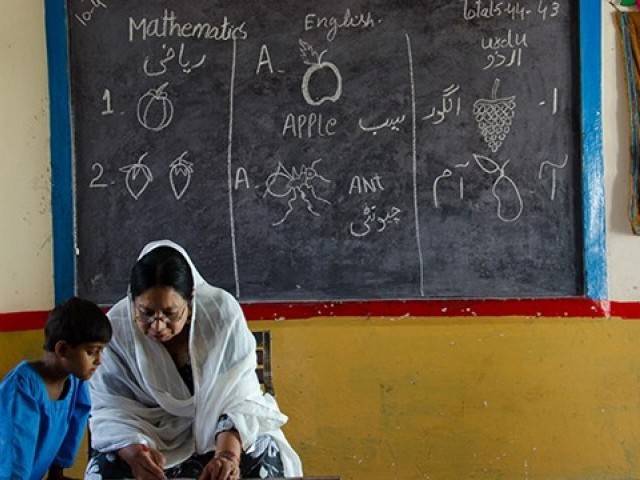
The image of the “chalk and talk” classroom; static rows of desks, a teacher lecturing at a blackboard, a single textbook dictating the pace of learning for forty children at once, is dying everywhere. In its place, a new architecture is emerging: the school as a living CPU, a hyper-integrated ecosystem of sensors, software, and data flowing between a Teacher Analytics Room, a Data & AI Server Room, and a Parent App on a mother’s phone. This is the blueprint of the “AI School System,” and it is no longer a speculative concept. It is being built, piece by piece, in campuses around the world.
The question for Pakistan is not whether this transformation is coming. It is whether the country will design its own version of it, one built for its own children, or simply inherit a version built for someone else’s.
Five Signs the System Is Being Rewired
When you look at how people are thinking about AI-integrated campuses right now, five quiet shifts keep showing up at the same time. The first one: teachers are stepping away from the lecture, not just physically, but in what their job actually involves. In the “Teacher Analytics Room,” educators no longer simply perform in front of a class; they read real-time dashboards of student progress and use AI-driven insights to build personalized learning paths, becoming, in effect, data scientists of their own classrooms.
Second, the school itself becomes a monitored organism. Security rooms with video walls watch the entrance and the playground; canteens and health rooms become data nodes tracking energy, and wellbeing; a “Smart Entrance-biomatrics based” manages attendance and safety at once. Third, beneath all of it sits a literal server room, the school’s hidden engine; where student data, learning analytics, AI models, cloud integration, and data security form the five pillars holding the entire structure up.
Fourth, the school stops ending at the gate. Through parent and student apps, grades, health alerts, and security notifications move instantly into family life, turning the report card into a relic. And fifth, alongside all this structure, campuses are carving out deliberately human counterweights; collaboration zones, AI labs, and libraries where students move from being consumers of a data-driven world to becoming its architects.
It’s a compelling vision. It is also, right now, almost entirely unavailable to the average Pakistani child.
The Gap Between the Blueprint and the Ground Reality
Pakistan’s education system is not failing for lack of ambition in its families. It is failing for lack of infrastructure, and the gap is structural, not incidental. Millions of children remain out of school entirely. Millions more sit in under-resourced classrooms with outdated textbooks, teacher shortages, and no meaningful exposure to the digital tools that already define the global economy their generation will have to compete in. Meanwhile, a small elite of expensive private schools have begun installing exactly the kind of AI-integrated infrastructure described above; smart classrooms, data dashboards, coding labs, creating a new and more dangerous version of an old problem: an education apartheid where postal code and household income determine not just school quality, but access to the future itself.
This is precisely the gap that a genuinely new education model has to close. Pakistan does not need a watered-down copy of elite AI schooling trickling down over decades. It needs an affordable, purpose-built version of that future, designed from day one for middle- and lower-middle-class families; the households with the discipline and ambition to raise world-class achievers, but not the income to buy their way into it.
A Pakistan-Specific Answer: Laptops, Languages, and Early Earning
This is where an emerging model like The Signature School franchise network becomes instructive, not as a promotional case study, but as a proof of concept for what a “new education system” for Pakistan could actually look like in practice. Its foundational move is disarmingly simple: replace the textbook with a personal learning laptop for every child, at a total monthly cost held deliberately between PKR 5,000 and 5,500. That single design choice does something structurally important, it makes the “Digital Learning Lab” and “AI & Coding Lab” described in visions of the future campus a baseline expectation rather than a luxury upgrade.
Around that laptop, the model layers in exactly the kind of AI literacy the global blueprint calls for, prompt engineering from Grade 1, progressing to AI-assisted code and app creation by middle school, alongside seven world languages (French, Arabic, German, Spanish, Persian, Chinese, and Japanese) that plug Pakistani students directly into international study, trade, and remote-work markets. But the most important departure from the generic “smart campus” vision is the Early Earning Program: a structured track in freelancing, digital design, content creation, and micro-enterprise, designed so that by their teenage years, students already hold marketable digital skills.
This matters enormously in the Pakistani context, where child labor is often not a failure of parental will but a survival calculation, a family pulling a child out of school because the household cannot absorb another year of costs without income in return. A model that turns education itself into an early, ethical earning pathway directly attacks the economic logic that pushes children out of classrooms in the first place. It reframes school not as a delayed investment but as an immediate structural shield.
The Warning Embedded in the Blueprint
Yet the same source material that inspires this vision also carries its most important caution. Even in the most advanced AI-driven campus designs, architects have deliberately preserved a Counseling Room; tucked between the data-heavy canteen and the high-tech server room, as “the last bastion of human-centricity.” The question it poses is not rhetorical: can the AI models in the basement ever truly understand the conversations happening on the counseling couch?
For Pakistan, this tension is not an abstract philosophical point; it is the design constraint that will determine whether a new education system succeeds or simply digitises existing failures. A laptop-per-child program without teacher training becomes a distraction device. AI literacy without ethical grounding becomes a liability. Any model, Signature School’s or another’s, will only work if concepts like “Tarbiyah,” character building, and human mentorship are engineered into the system as deliberately as the server racks and language labs, rather than treated as an afterthought competing for the same budget line.
The Real Choice Ahead
Pakistan’s education debate has spent decades arguing over curriculum reform, teacher salaries, and enrollment targets; all necessary, none sufficient on their own. The more urgent question now is architectural: will the next generation of Pakistani schools be designed around 20th-century assumptions with a coat of digital paint, or will they be rebuilt, from the ground up, as genuinely new systems; affordable, AI-literate, multilingual, economically empowering, and still unmistakably human at the core?
The technology to build that system already exists. The only remaining question is whether Pakistan will choose to build it for all of its children, or watch the gap between the privileged and the rest of the country turn permanent. Opinions expressed in this article are the author’s own and do not necessarily reflect the editorial policy of WNAM.
(The write is: Retired military officer, a Phd in Finance, MS Tecnology Management from HEC Paris, an MBA from LSE, London. Run a successful “Not For Profit” School as described in article).