
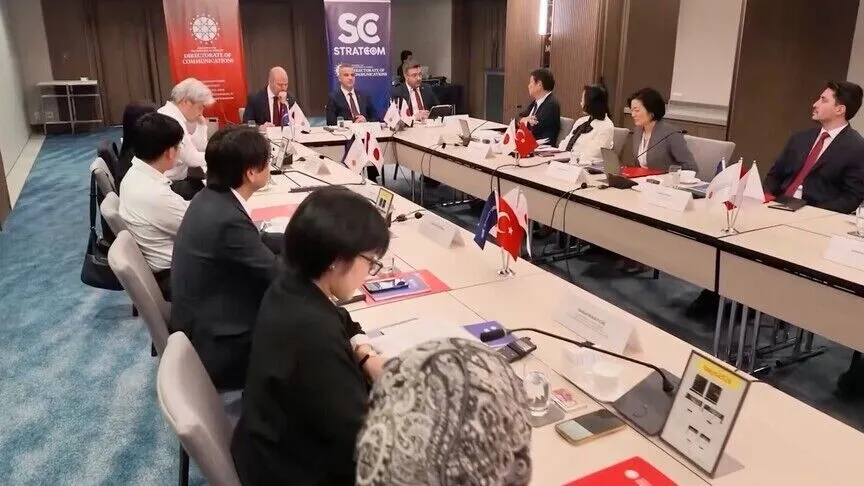
WNAM REPORT: The STRATCOM Roundtable and STRATCOM Public Forum, organized by Türkiye’s Communications Directorate in cooperation with the Embassy of the Republic of Türkiye in Tokyo, were held in Japan’s capital, Tokyo on Saturday.
According to a statement by the Communications Directorate, the STRATCOM Roundtable, held under the theme Changing Global Order in the Age of Emerging Technologies, and the STRATCOM Public Forum, titled Managing Economic Security in the Age of Geopolitical Competition, were organized in Tokyo as part of the International Strategic Communication Summit (STRATCOM Summit).
The forum addressed the multidimensional effects of emerging technologies — particularly artificial intelligence — on global order, strategic communication and economic security.
At the STRATCOM Roundtable, held under the theme Changing Global Order in the Age of Emerging Technologies, the effects of emerging technologies on global governance, strategic communication, digital sovereignty, information security and international cooperation were evaluated from a policy perspective.
Participants exchanged views on the impacts of artificial intelligence (AI) and emerging technologies on international power balances, technological competition, combating disinformation, the use of new technologies in strategic communication, the transformation of public diplomacy and technological applications in crisis management.
Economic security
As part of the program, the panel titled Managing Economic Security in the Age of Geopolitical Competition, held during the STRATCOM Public Forum, discussed the effects of intensifying geopolitical competition on economic security policies, critical technologies, trusted supply chains, data security and the transformation of the digital economy from different perspectives.
Communications Director Burhanettin Duran also addressed the program in a video message.
Duran said the world is going through a period of profound geopolitical, technological and social transformation, adding that alongside economic power, military capacity and diplomatic influence, the ability to build narratives, shape perceptions, communicate with global audiences and build trust is becoming an increasingly important dimension of national and international power.
Pointing out that digital technologies expand access to information and communication opportunities while also creating new vulnerabilities such as manipulation, polarization and uncertainty, Duran said: “Today, we are facing a situation that can be described as both a crisis of truth and a crisis of communication.”
“These crises operate through perceptions, emotions, fears and expectations,” he said, adding: “They can affect societies before governments have the opportunity to fully understand what is happening.”
“That is why a comprehensive and multidimensional approach is needed. No country, institution or organization can achieve this alone,” Duran stated.
“We need greater international cooperation, the sharing of experience and the development of common principles,” he stressed.
Stronger cooperation between Türkiye and Japan
Türkiye’s Ambassador to Tokyo Oguzhan Ertugrul and Deputy Communications Director Ferhat Pirincci also delivered speeches during the panel.
Ertugrul drew attention to the uncertainties and multiple crises increasing pressure on the international order.
Emphasizing that global challenges require stronger cooperation based on justice, diplomacy and multilateralism, he pointed to the importance of regional ownership and the reform of global institutions.
Stating that Türkiye and Japan are two countries located at the western and eastern ends of Asia with complementary strategic capacities, Ertugrul said the two countries can play a constructive and proactive role in supporting global peace, stability and prosperity.
He also stressed that the event provided an important platform for raising awareness of the need for stronger cooperation and coordination between Türkiye and Japan in the face of ongoing geopolitical transformations.
Fight against disinformation
Pirincci further said emerging technologies, particularly AI, are transforming not only the economic and technological fields but also a wide range of areas from international relations to public diplomacy and strategic communication.
Emphasizing that information security and a trusted information ecosystem are among the fundamental elements of economic resilience, he noted that disinformation can have direct effects on economic stability, the investment environment and public confidence.
He said strategic communication is of critical importance for protecting accurate and reliable information, combating disinformation and strengthening societal resilience, adding that international cooperation and the development of common policies in this field are becoming increasingly important.
Pirincci also noted that Ankara and Tokyo possess significant and complementary expertise in technology, innovation, strategic communication and crisis management, adding that joint initiatives between the two countries will contribute to regional and global stability.
AK Party Deputy Chair and Head of Information and Communication Technologies Omer Ileri also spoke at the panel.
Ileri pointed out that simultaneous transformations are taking place in the geopolitical and technopolitical spheres.
He said protectionism and an emphasis on domestic production are gaining strength in geopolitical dynamics, while developments such as AI, the growing importance of data and market concentration are reshaping the technology field.
He also underlined the potential of Türkiye and Japan to contribute to the development of more consistent and human-centered approaches to these transformations.
Information manipulation
Akira Igata, project associate professor at the Research Center for Advanced Science and Technology at the University of Tokyo and director of the Economic Security Intelligence Laboratory, focused on the growing relationship between economic security and information manipulation.
Giving examples of disinformation and influence operations targeting companies operating in critical mineral supply chains and data center infrastructure, Igata emphasized the importance of public-private cooperation, information sharing and education in strengthening societal resilience.
Kazuto Suzuki, professor at the Graduate School of Public Policy at the University of Tokyo, discussed the role of critical technologies, rare earth elements and strategic minerals in geo-economic competition.
Noting that interdependencies among major powers, particularly the US and China, continue to shape economic security policies, Suzuki said diversifying critical supply chains and reducing strategic vulnerabilities are becoming increasingly important.
Kunihiko Miyake, director and special adviser at the Canon Institute for Global Studies, stressed that effective strategic communication requires a clear strategy and a strong narrative.
Pointing out that technological tools alone cannot guarantee successful communication, Miyake highlighted the importance of developing messages aligned with strategic objectives and tailored to target audiences.
Participants also exchanged views on protecting a trusted information ecosystem, ensuring the flow of accurate information during periods of economic crisis, the impact of digital platforms on the global economy and models of public-private cooperation.
Türkiye-Japan strategic communication dialogue
The events contributed to strengthening institutional dialogue between Türkiye and Japan in the fields of strategic communication and crisis communication, evaluating common approaches to communication risks and opportunities emerging in the age of AI, and increasing the sharing of international information and experience.
Held annually with international participation, STRATCOM continues to serve as a global consultation platform where current issues in strategic communication are discussed from different perspectives, bringing together public institutions, international organizations, academia, the media and the technology sector.