
China’s energy development model appears to be holistic, comprehensive, innovative, pragmatic, integrated, coordinated, futuristic, and transformative. Its “growing by greening” mechanism pursuing strategic renewable expansion alongside energy security through fossil fuels represents a pivot toward a new quality productive forces paradigm, which is highly commendable.
According to China’s own official figures, clean generation growth, led by solar and wind, met 84 percent of China’s electricity demand growth in 2024. Additionally, in the first half of 2025, it enhanced demand growth while cutting fossil fuel use by 2 percent, clearly reshaping the country’s priorities and energy transition.
Interestingly, due to its structural energy transition from 2015 to 2023, fossil fuel use in final energy across buildings, industry, and transport in China fell by 1.7 percent. This clearly demonstrates that China’s green technologies are gaining momentum, gearing toward a new energy model based on efficiency, diversity, AI, innovation, and security.

Dr Mehmood Ul Hassan Khan
Battery storage investment in China registered an increase of 69 percent from the first half of 2024 to the first half of 2025, while grid investment enhanced by 22 percent. Consequently, China accounts for 31 percent of global clean energy investment a share that is constantly increasing, creating mutually beneficial propositions, protecting the environment, and moving toward the ultimate goal of carbon neutrality.
According to many published Chinese reports, Chinese companies lodge approximately 75 percent of global clean energy patent applications. In 2000, this figure was just 5 percent, subsequently increasing manifold.
Tremendously, projected Chinese solar manufacturing capacity in 2030 (1,255 GW) would be 65 percent higher than the global solar rollout projected for 2030 in the IEA’s Net Zero Roadmap (761 GW). This would represent a giant step toward national energy revitalization, regional energy integration, and last but not least global energy sustainability, protecting the planet, economies, communities, and enterprises alike.
It is a good omen that, as of early 2026, the defining feature of China’s energy development model has shifted from simple capacity expansion to establishing a green energy superpower status by focusing on technological sovereignty, system resilience, and systemic structural changes in the power sector a development that is highly appreciated.
The writer submits that China’s core policy of “growing by greening” reversing the traditional fossil-fuel growth model by making necessary adjustments in new energy technology (solar, wind, batteries, EVs) has been dubbed a primary driver of GDP growth, referred to as the “new three.”
Another defining feature of China’s energy development model is prioritizing a stable hydrocarbon supply (coal and oil) to ensure security while rapidly replacing and building new renewable capacity, thereby managing the transition phase to avoid energy shocks. This appears to be a functional and workable business model moving toward a more stable, sustainable, and systematic energy transition in the modern world. Thus, the Chinese model of “building before breaking” is effectively working and delivering its dividends.
The writer is of the view that China’s long-term Five-Year Plans and centralized planning mechanism, along with dual carbon control (controlling carbon intensity and absolute carbon emissions), ensure high-speed implementation and further support its energy transition model.
Certainly, China possesses its own unique, innovative, and integrated supply chain for key green technologies, aiming for leadership in battery energy storage, green hydrogen, and advanced solar technology. This makes its energy transition easier, smoother, and more balanced despite ongoing regional and global energy blockades and fluctuations.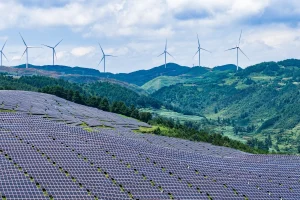
Another important factor behind its balanced and speedy energy transition model is massive investment in grid infrastructure, long-distance transmission, and energy storage to handle the intermittency of wind and solar. This approach should be replicated in other countries to achieve the desired goals of energy efficiency and productivity.
The 15th Five-Year Plan (2026-2030) recommendations serve as the real guarantor and custodian of achieving the goal of energy superpower status by 2030 through a green transition. This strategy is central to China’s energy vision, described as a defining feature of Chinese modernization, with the goal of shaping a new clean, low-carbon, safe, and efficient energy system while balancing (fossil, oil), replacing (solar, wind), and building new energy as the three drivers within the country.
It appears that China’s approach to renewable energy buildout combines large-scale investment, technological innovation, and market reform. As a result, China is installing more renewable energy capacity than any other economy. Currently, the country is undergoing one of the most ambitious energy transitions in history. It is striving to achieve the goals of peaking carbon emissions before 2030 and reaching carbon neutrality by 2060, while rapidly reshaping its power system to accommodate a new generation of clean energy.
According to multiple published reports from Chinese organizations, in 2024 alone, China installed 360 gigawatts (GW) of wind and solar capacity more than half of global additions that year. This brings the country’s total installed renewable capacity to 1.4 terawatts (TW), roughly one-third of the entire world’s 4.5 TW. Chinese renewable generation reached 366 terawatt-hours (TWh), making wind and solar the country’s largest sources of new power.
China’s simultaneous expansion of fossil fuel capacity and renewable energy has been rightly dubbed an ideal doctrine of “build before break” a highly pragmatic, dual-track strategy aimed at balancing rapid decarbonization with paramount energy security and economic growth.
Notably, China is not following a linear transition policy (coal to renewables) but rather an addition phase, stacking massive amounts of new renewable capacity on top of existing infrastructure while maintaining a strategic balance between fossil and green energy production.
Analytically, China adheres to a grid stability and security policy regarding fossil fuels and has prioritized building new coal-fired plants to ensure power supply during peak demand, especially given the intermittent nature of solar and wind energy. Moreover, China’s pursuit of renewables adding 360 GW of wind and solar in 2024 alone, with non-fossil sources exceeding 50 percent of total installed capacity for the first time is a clear indication of its green energy transition. Thus, the hybrid role of coal and the addition of new coal plants are increasingly designed as flexible backup for renewables rather than as baseload power.
Comparative studies confirm that by increasing domestic production of both renewables (manufactured) and coal (extracted), China reduces its reliance on foreign oil and gas, insulating its economy from global supply shocks. Consequently, China’s economy and energy security remain stable due to its self-reliant energy transition.
The writer is of the view that as China electrifies its industrial, transport, and residential sectors, its power demand is soaring, requiring immediate, high-volume additions from all sources to meet this need. Thus, China’s energy transition is balanced, diversified, and innovative.
According to many published reports, in 2024 and the first half of 2025, clean energy deployment was fast enough to meet nearly all new power demand. This meant that despite new coal plants being built, the utilization rate of the total coal fleet dropped, allowing coal-fired electricity generation to peak. This demonstrates Chinese economic wisdom, better energy policies, a sound financial model, and manufacturing capacity to sustain a long-term energy transition.
Nevertheless, although China is still commissioning high levels of coal capacity, the overall trajectory is toward a cleaner grid, with renewables expected to comprise approximately 63 percent of the power fleet by the end of 2026.
Despite the strategic value addition of CPEC Phase 1.0 and the promised new energy capacity of CPEC Phase 2.0, Pakistan’s saga of energy deficiency is far from over. This persistent shortfall has created numerous socio-economic, geopolitical, and geo-strategic consequences for the country. Load shedding remains a lingering burden on the economy, communities, and enterprises, obstructing the desired goals of prosperity, productivity, and progress.
Pakistan now has a mixed energy market comprising coal, hydro, solar, wind, and nuclear power, developed under the flagship projects of CPEC Phase 1.0 and 2.0. Interestingly, large industrial corporations have taken a bold step toward shifting to self-generation capacity by installing solar, wind, gas, and other renewable sources, thereby gradually reducing their reliance on state-produced energy systems. Meanwhile, ordinary citizens are investing heavily in rooftop solar systems to reduce their utility bills, which remain unrealistically high due to government mismanagement and misappropriation by Independent Power Producers (IPPs) in the country.
The solar energy surge in Pakistan has reached $18 billion over the last five years, vividly reflecting a paradigm shift in energy production, utility, scope, expansion, and importance. The government of Pakistan is working hard to create some balance in its energy transition, but due to constraints imposed by the IMF, the real goal of achieving an ideal energy diversity mix remains a distant prospect.
Owing to high utility bills, more than 177 textile mills have closed, and several of these units are relocating to other regional countries a clear demonstration of a failed energy transition in the country.
Significantly, energy cooperation between Pakistan and China has expanded in recent years, particularly in power generation under the flagship projects of the China-Pakistan Economic Corridor (CPEC). Analytically, CPEC has played a transformative role in Pakistan’s infrastructure development, with a core focus on energy and transportation networks. At its heart, CPEC aims to strengthen energy connectivity, ensuring both supply-side stability and demand-side expansion necessary for long-term economic growth.
Realistically, CPEC was initiated in 2013 at a time when Pakistan was facing severe energy deficits, leading to major economic disruptions. The country struggled badly with load shedding, unreliable power supply, unaffordable electricity, and unsustainable fuel dependency a “siege of darkness” marked by over 14 hours of load shedding in urban areas and 18 hours in rural regions, paralyzing the economy. High reliance on imported fossil fuels, capacity payment obligations, and dollar-indexed agreements exacerbated the problem, resulting in an alarming circular debt exceeding PKR 2.5 trillion and contributing to an annual GDP loss of 2–3 percent.
The CPEC energy projects, particularly during 2015–2017, played a crucial role in stabilizing power supply, promoting economic growth, job creation, and export expansion, while also reducing Pakistan’s import bills through an increased share of renewable energy in the national grid. According to multiple reports from the State Bank of Pakistan (SBP), the Securities and Exchange Commission of Pakistan (SECP), the Pakistan Planning Commission, and the federal ministries of investment, industries, and finance, CPEC’s energy projects have significantly transformed Pakistan’s power generation landscape by adding a cumulative 12 GW of installed capacity across coal, hydropower, solar, wind, and transmission infrastructure.
This ambitious investment has reshaped the country’s energy mix, reducing dependence on expensive imported fuels and improving supply reliability. The breakdown of these projects highlights the strategic approach adopted under CPEC, aligning with Pakistan’s long-term energy security objectives.
Evidently, hydropower projects a crucial component of CPEC’s sustainability-driven approach contribute 3.4 GW to the national grid, with 1.6 GW already commissioned and 1.8 GW under development. Key projects include the 720 MW Karot Hydropower Project and the 870 MW Suki Kinari Hydropower Plant, both employing run-of-the-river technology to minimize environmental disruption while providing clean, renewable energy. These hydropower projects align with Pakistan’s goal of increasing renewable energy’s share to 60 percent by 2030, ensuring a gradual transition away from fossil fuel reliance.
Renewable energy initiatives under CPEC have also expanded Pakistan’s solar and wind power portfolio. The 600 MW Quaid-e-Azam Solar Park Pakistan’s first major solar project has laid the foundation for future expansion, with an additional 100 MW in the pipeline. Wind energy projects totaling 300 MW, concentrated in the Jhimpir Wind Corridor, offer sustainable alternatives to conventional energy sources. The integration of renewable energy into the national grid has been a pivotal step toward reducing Pakistan’s carbon footprint and promoting climate resilience.
Furthermore, a vital milestone in transmission infrastructure has been the Matiari-Lahore High Voltage Direct Current (HVDC) Transmission Line, the first of its kind in Pakistan. This line has a transfer capacity of 4,000 MW, significantly reducing transmission losses and improving power flow stability.
However, persistent line losses, high debt rates, inconsistent energy policies, and bureaucratic delays have undermined the bright prospects of CPEC Phase 2.0. These obstacles must be removed as soon as possible to accelerate the energy transition in Pakistan.
It appears that CPEC 2.0 also presents an opportunity to modernize Pakistan’s transmission and distribution infrastructure. High-voltage transmission projects, such as the Matiari-Lahore HVDC line, have already improved power evacuation. Further investment in long-distance transmission corridors will be essential to ensure that surplus renewable energy from Sindh and Balochistan can reach major demand centers.
By leveraging China’s expertise in smart grid technology, Pakistan’s policymakers can implement real-time monitoring, automated fault detection, and AI-driven load management to minimize technical losses and outages. Analytically, AI-driven platforms can promote dynamic pricing to encourage efficient electricity use, while predictive analytics can prevent grid failures through proactive maintenance.
On the distribution side, Pakistan can adopt China’s experience in loss reduction, revenue collection, and grid modernization. Smart meters, automated billing, and AI-assisted theft detection would strengthen the financial sustainability of distribution companies (DISCOs). Digitized payment systems and prepaid metering can enhance revenue transparency and help mitigate the accumulation of circular debt.
The writer proposes that policymakers prioritize a diversified energy mix, with greater emphasis on renewables and hybrid energy solutions. This must be complemented by a proactive investment strategy, including private sector participation and regulatory transparency, to improve the ease of doing business.
To conclude, the writer submits that the Government of Pakistan and its policymakers should strive to include more renewable energy projects under CPEC Phase 2.0. They must further integrate their efforts toward energy diversity by shifting to peaceful nuclear power (smart and small modular reactors), green hydropower, solar, wind, lithium battery production, and last but not least, electric vehicles (EVs) in the country in which China would play an important role.
China is transitioning from a resource-reliant model to a technology-driven one, where green energy is used to replace fossil fuel dependence over time while maintaining rapid industrial growth. This trajectory is positive, productive, participatory, and progressive.
This appears to be a calculated policy shift aimed at avoiding the energy price volatility experienced by other countries during their transitions. By ensuring reliability, durability, and consistency through traditional sources until renewables and grid storage are fully mature, China has charted a pragmatic and resilient path toward a sustainable energy future.
CPEC has been instrumental in reshaping Pakistan’s energy landscape, playing a critical role in resolving the energy crises of 2014 and 2022. With continued technological collaboration, strategic planning, and sustainable policy implementation, CPEC 2.0 has the potential not only to secure Pakistan’s energy future but also to strengthen regional integration, paving the way for a reliable, affordable, and sustainable power sector.
Both countries should explore the possibility of building green hydropower units, nuclear power projects, and solar, wind, and lithium battery factories in Pakistan to support a successful and sustainable economic growth.