
ISLAMABAD ( WNAM REPORT ): Former Prime Minister and prominent political leader of the country Raja Pervaiz Ashraf has said that the private sector must be placed at the centre of Pakistan’s economic growth strategy, as no government can provide employment to the entire population. He called for business-friendly policies that enable entrepreneurs to expand investment, create jobs and generate economic activity, stressing that whenever a business grows, its benefits extend to employees, families, government revenues and the broader economy.
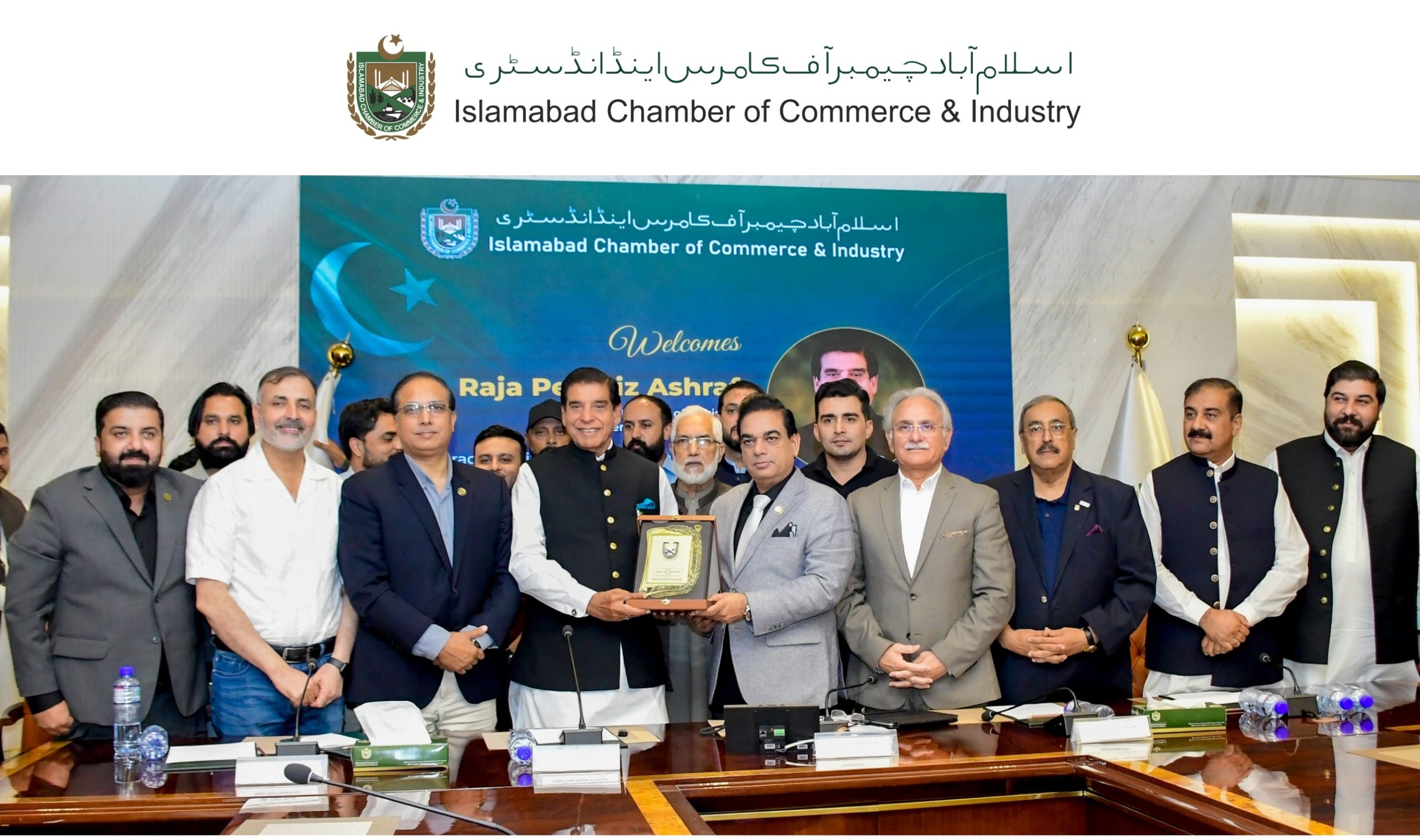
Speaking as Chief Guest at an interactive session at the Islamabad Chamber of Commerce and Industry (ICCI), Raja Pervaiz Ashraf said the government’s role should be to create an enabling environment in which businesses can operate, invest and expand without unnecessary hurdles. He highlighted the importance of Chambers of Commerce as a bridge between the government and private sector and said stronger consultation with the business community was essential for developing practical economic policies and promoting domestic and international trade.
Raja Pervaiz Ashraf said Islamabad, being the federal capital, had a unique administrative and institutional status and therefore required a clear, effective and sustainable governance framework. He acknowledged concerns over overlapping jurisdictions among CDA, ICT and other institutions and said the absence of an effective local government mechanism had made it difficult to establish clear responsibility and accountability. He maintained that practical proposals for strengthening representation and governance in Islamabad should be considered through meaningful consultation with all stakeholders.
He said Islamabad’s financial requirements also deserved serious attention, particularly as the capital generates revenues through property-related taxes, excise, transfers and other charges. He observed that the city’s development needs in areas such as water supply, healthcare, education, infrastructure and rural development should be adequately addressed. He assured the business community that if a workable and well-researched proposal was brought forward, he would support it within his capacity and raise the matter at the appropriate forums, observing that “it’s never too late” to find a better solution.
The former Prime Minister also supported a balanced approach to the issue of fire and safety compliance in commercial areas, saying protection of human life must remain the foremost priority but enforcement should focus first on correcting deficiencies rather than immediately shutting down businesses. He endorsed a system of comprehensive safety audits, identification of risks, issuance of notices and provision of reasonable time for rectification, followed by re-inspection and action against persistent non-compliance. He said indiscriminate sealing could disrupt businesses, affect employment and create additional economic difficulties without addressing the root cause.
Earlier, ICCI President Sardar Tahir Mehmood welcomed Raja Pervaiz Ashraf to the Chamber, describing him as a long-standing friend of Islamabad’s business community and recalling his association with ICCI during its formative years. He said Raja Pervaiz Ashraf’s experience as Prime Minister and parliamentarian, as well as his association with the Chamber, gave him an important role in raising the capital’s concerns at the national level. He urged him to become an effective voice for Islamabad’s business community and citizens in Parliament and other relevant forums.
Sardar Tahir Mehmood said Islamabad may be the country’s city of power, but its citizens and business community remain without an adequately empowered system of local representation and decision-making. He said the overlapping institutional structure involving CDA, ICT and other authorities often creates uncertainty for businesses, while the absence of a clear mechanism for retaining and reinvesting a fair share of locally generated revenues limits the city’s ability to meet its growing development needs. He called for a permanent, empowered and accessible framework under which Islamabad’s revenues could be channelled towards water, healthcare, education, infrastructure and development.
The ICCI President said the Chamber wanted to take the issue beyond individual complaints and work towards a consensus-based, long-term solution involving all political parties, government institutions, business organizations, experts and other stakeholders. He stressed that any new governance or legislative framework for Islamabad must be developed through grassroots consultation before implementation.
Sardar Tahir Mehmood also reiterated ICCI’s position that regulatory enforcement, including fire-safety measures, should protect human lives without unnecessarily disrupting legitimate businesses. He expressed the hope that Raja Pervaiz Ashraf’s support would help transform the Chamber’s proposals into practical initiatives for a more empowered, prosperous and business-friendly Islamabad.
ICCI Senior Vice President Tahir Ayub conducted the session in the most impressive manners. Those present also included former President Mohammad Ejaz Abbasi, Mian Shaukat Masood, Executive member Zulqurnain Abbasi, ICCI senior members Babar Bhatti, Nauman Bhatti, Ibrar Bhatti, Raja Jameel, Shehyar Butt and other were also pesent
Islamabad Needs Empowered Governance, Sustainable Financial Framework: Raja Pervaiz Ashraf
Give Islamabad its due share of revenues for development purposes: Sardar Tahir Mehmood
1