
There are moments in the history of a nation when an artist does more than create art. He gives a people a new way to hear themselves.
Uzeyir Hajibeyli was such a man.
When the first notes of his Leyli and Majnun rose from the stage in Baku in 1908, they carried with them something far greater than a new musical composition. They represented the meeting of two worlds: the ancient musical heritage of Azerbaijan and the emerging language of modern classical music. In that meeting, a new chapter of Azerbaijani cultural history was born.
Hajibeyli did not simply compose music. He transformed cultural memory into a modern artistic language.
His extraordinary journey would eventually make him one of the foundational figures of Azerbaijani music and one of the most remarkable cultural personalities of the Muslim world.
A Child of a Musical Civilization
Born in 1885 in the village of Agjabadi, Uzeyir Hajibeyli grew up within a cultural environment where music was not merely entertainment—it was part of the spiritual and social fabric of life.
At the heart of Azerbaijani musical tradition stood mugham, a sophisticated art form combining melody, poetry, improvisation and profound emotional expression. It had been transmitted across generations, carrying within it the joys, sorrows, romances and philosophical reflections of the Azerbaijani people.
Hajibeyli recognized its extraordinary potential.
But he also lived in an era of transformation. Baku was becoming a centre of commerce, education and intellectual activity. New ideas were moving across the Caucasus, while European musical forms were increasingly entering the region.
For Hajibeyli, this encounter was not a threat. It was an opportunity. He understood that tradition becomes truly powerful when it is allowed to evolve.
The Revolutionary Sound of Leyli and Majnun
In 1908, Hajibeyli achieved something unprecedented.
His opera Leyli and Majnun, based on the celebrated tragic love story of the same name, became the first opera of the Muslim East.
Its importance cannot be understood simply by calling it a historical “first.”
The real revolution was artistic.
Hajibeyli brought the expressive world of mugham into conversation with the dramatic architecture of opera. Ancient Azerbaijani musical sensibility found itself within a new theatrical framework.
The result was neither a rejection of tradition nor a simple imitation of Europe.
It was something new.
The story of Leyli and Majnun—love separated by social conventions and fate—provided a bridge between poetry, music and theatre. Hajibeyli turned that timeless narrative into an expression of Azerbaijani cultural identity.
In doing so, he demonstrated a principle that would define much of his life’s work:
A nation can enter modernity without leaving its cultural soul behind.
When Tradition Learned to Speak a New Language
Hajibeyli’s achievement was not merely that he used Azerbaijani melodies in classical compositions. His deeper contribution was to demonstrate that traditional musical ideas could become the foundation of sophisticated new artistic forms.
He studied, absorbed and adapted musical techniques from the broader European classical tradition while remaining attentive to the particular character of Azerbaijani music.
This creative synthesis helped establish the foundations of professional Azerbaijani classical music.
The orchestra, the stage, the conservatory and the concert hall were no longer foreign cultural spaces. They could become homes for Azerbaijani musical expression.
The traditional and the modern could coexist.
And perhaps that is one of Hajibeyli’s most important messages for our own age: cultural confidence does not require cultural isolation.
The Genius of Arshin Mal Alan
Hajibeyli’s artistic imagination was not confined to tragedy or grand opera.
He could also make an audience laugh.
His celebrated musical comedy Arshin Mal Alan became a cultural phenomenon, combining melody, humour, romance and social observation.
Beneath its entertaining surface was a perceptive commentary on society. Hajibeyli explored customs surrounding marriage, family expectations, social conventions and the tensions between inherited traditions and changing ideas.
His characters were lively, human and recognizable.
The work’s appeal eventually travelled far beyond Azerbaijan, illustrating the remarkable capacity of Azerbaijani artistic expression to communicate across linguistic and cultural boundaries.
Hajibeyli understood something fundamental about great art:
When a story is authentically rooted in one culture, it can still touch the hearts of people everywhere.
The Composer Who Became an Educator
Perhaps the greatest measure of Hajibeyli’s vision lies not only in the works he composed but in the musical world he helped build.
He understood that a cultural renaissance cannot depend upon one generation of artists. It requires education.
It requires institutions. It requires young people who can inherit tradition while possessing the knowledge and confidence to transform it.
Hajibeyli therefore devoted himself to music education and the development of professional musical institutions in Azerbaijan. His work contributed to the formation of an environment in which composition, performance, music theory and scholarship could develop systematically. In this respect, he was not merely a composer. He was an architect of a musical nation. His influence helped create the conditions from which later generations of Azerbaijani composers and performers would emerge.
From Leyli to Koroghlu
Three decades after Leyli and Majnun, Hajibeyli’s artistic journey reached another major milestone with his opera Koroghlu, premiered in 1937. Drawing upon the legendary figure of Koroghlu, the opera connected Azerbaijan’s epic cultural heritage with the grand possibilities of the operatic stage. The work revealed the maturity of Hajibeyli’s musical vision. The young composer who had once opened the door between mugham and opera had now developed a distinctive language capable of sustaining a large-scale national opera. Koroghlu was not simply a musical retelling of an old legend. It was an affirmation that Azerbaijan’s own history, heroes and cultural imagination could provide material for major classical art.
A Bridge Between East and West
The story of Hajibeyli is ultimately a story of bridges. He stood between the old and the new. Between folk tradition and classical composition. Between Eastern musical heritage and European musical forms. Between poetry and theatre. Between national identity and universal artistic expression.
Yet he did not allow these worlds to erase one another. His achievement lay in making them converse.
This is why his legacy extends beyond the borders of Azerbaijan. His work forms part of a much larger story—the emergence of modern national musical traditions in societies encountering rapid social, intellectual and cultural transformation. Hajibeyli showed that the meeting of civilizations need not produce cultural disappearance. It can produce cultural creativity.
Music as the Memory of a Nation
A nation’s history is preserved not only in archives and monuments.
It is preserved in songs. A melody can carry the memory of a village. A musical mode can preserve the emotional landscape of centuries. A poem set to music can survive long after the circumstances that produced it have disappeared. Hajibeyli understood this relationship between music and memory.
His work gave Azerbaijani musical heritage a new stage, a new vocabulary and a new international presence.
He did not ask Azerbaijanis to choose between their heritage and the modern world. He showed them how to carry their heritage into the modern world.
National Music Day: A Living Tribute
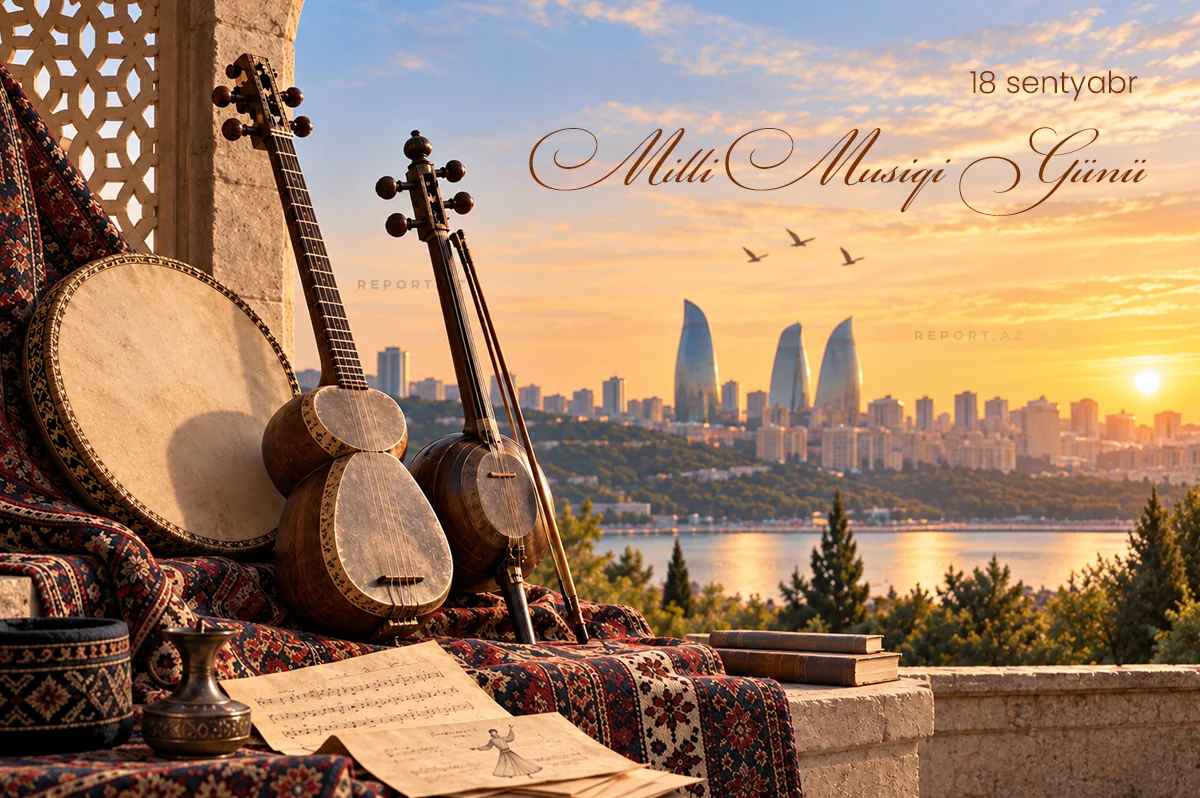
Hajibeyli’s contribution is commemorated in Azerbaijan every year on 18 September, celebrated as National Music Day.
The choice is deeply symbolic. On that day, Azerbaijan does not merely remember a composer. It celebrates an entire musical civilization. It celebrates mugham and opera, traditional melodies and orchestral music, poetry and performance, teachers and students, composers and audiences. And somewhere within all of those sounds remains the intellectual and artistic imprint of the man who helped bring them together. More than a century has passed since Leyli and Majnun first appeared on the Azerbaijani stage. Yet its significance has not faded. Because Hajibeyli’s real achievement was never simply the creation of individual musical works. His greater achievement was the creation of possibility. He showed that Azerbaijani music could be modern without becoming rootless; international without becoming indistinguishable; sophisticated without abandoning its traditional voice. He listened to the past—and heard the future. That may be the finest definition of a cultural visionary.
Uzeyir Hajibeyli did not merely write music for Azerbaijan. He helped Azerbaijan hear its own identity in a new and enduring voice. And as long as Azerbaijani melodies continue to rise from the stage, as long as mugham continues to breathe through generations, and as long as music remains a bridge between cultures, the final note of Hajibeyli’s legacy will never truly be played. It will simply continue to resonate. (By Riaz Ahmad Malik, Editor-in-Chief, World News AM)