
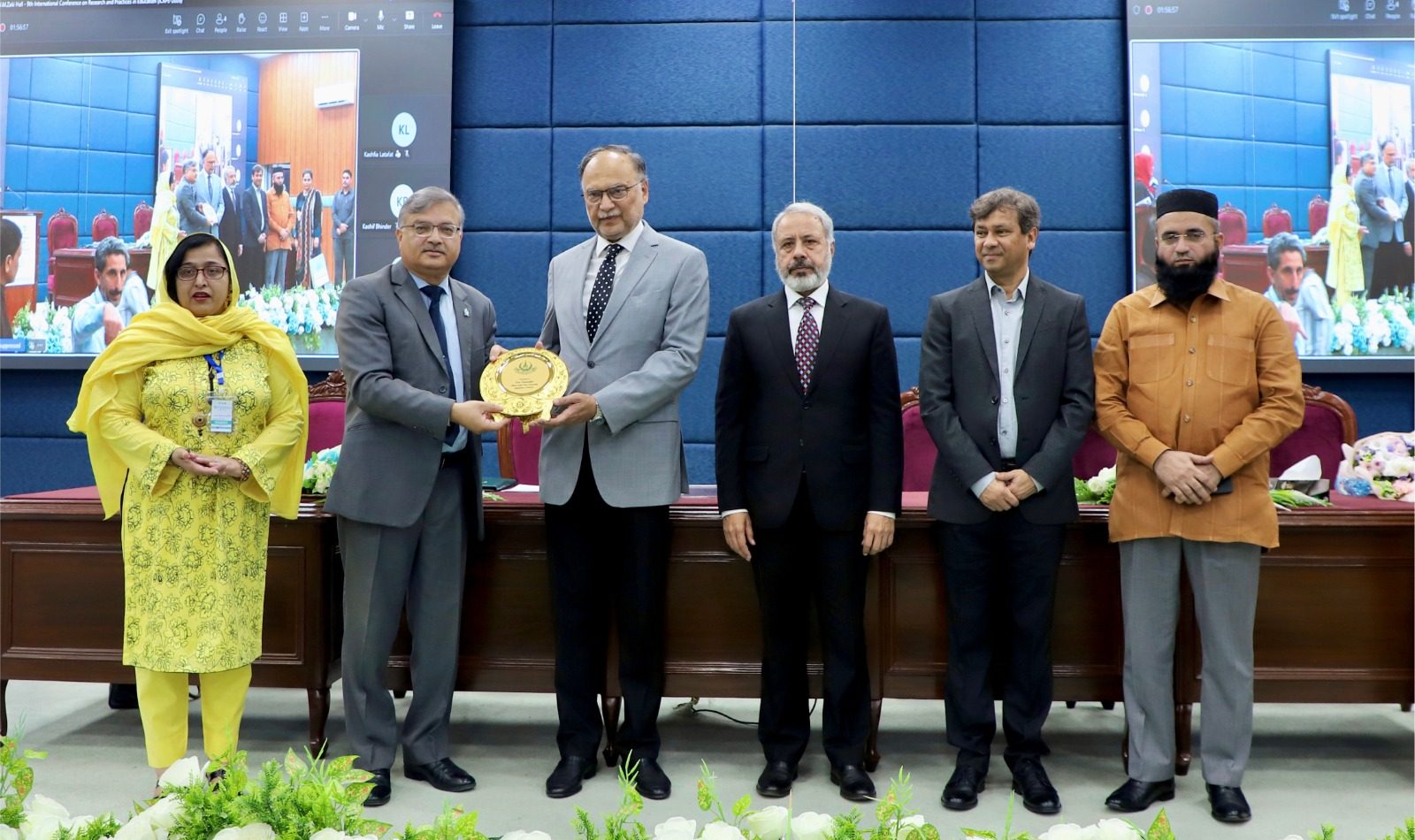
Islamabad ( WNAM REPORT ): Federal Minister for Planning, Development and Special Initiatives Professor Ahsan Iqbal has called for comprehensive reforms in the education system to meet contemporary and global challenges, stressing the need to promote quality education, research, innovation, creativity and modern technology to ensure Pakistan’s sustainable development and a bright future for its youth.
He was addressing the 9th International Conference on “Research and Practices in Education” held at Allama Iqbal Open University (AIOU).
Ahsan Iqbal said universities must develop an educational and research system that enables students to question, think critically and creatively, conduct research, solve problems and make informed decisions. He said the education system should not limit young people to merely obtaining degrees but should equip them with knowledge, research skills, creativity, awareness and self-confidence to face the challenges of practical life.
The Federal Minister said education is the foundation of a nation’s development and prosperity. He stressed that the education system should promote observation, reflection, analysis, questioning and problem-solving skills among students so that they could play an effective role in national development.
He said education in the mother tongue plays an important role in children’s intellectual development and better understanding. However, proficiency in English, modern disciplines and technology is also essential for competing at the global level. He said the government was focusing on reforms to bring the education system and curriculum in line with contemporary requirements.
Highlighting the key role of teachers in promoting quality education, Ahsan Iqbal said talented and well-trained teachers must be prepared who can instill in students a passion for learning, a spirit of research, creative thinking and self-confidence.
He congratulated Vice Chancellor Prof. Dr Nasir Mahmood and his team on successfully organizing the conference, saying that such academic and research activities contribute to improving educational standards and bridging the gap between research and practical experience.
Vice Chancellor Prof. Dr Nasir Mahmood said the world was changing rapidly, while artificial intelligence had given new directions to education, teaching and research. Therefore, universities must not merely observe these changes but become active participants in the transformation.
He said the future of education revolves around three fundamental concepts: “Connect, Teach and Growth.”
Dr Nasir Mahmood explained that “Connect” means connecting students, teachers and researchers with national and global academic communities; “Teach” refers to promoting quality teaching aligned with modern technology and artificial intelligence; while “Growth” means creating opportunities for continuous learning, research, creativity and professional development.
Dr Nasir Mahmood said that in the coming era, educational institutions that could connect knowledge with technology, research with practical needs, and people with new opportunities would be able to play an effective role in shaping the future of education.
Professor Dr Aftab Khan of Longwood University, USA was the keynote speaker at the inaugural session. Conference Secretary Dr Hina Noor and Conference Coordinator Professor Dr Naveed Sultana briefed the participants on the aims and objectives of the conference.
The two-day conference will feature panel discussions, parallel sessions and various academic and research sessions. National and international education experts and researchers will present their research papers and share their experiences on education, research, teaching, artificial intelligence and modern technology.
Comprehensive reforms in education system imperative to overcome contemporary challenges: Ahsan Iqbal
7