
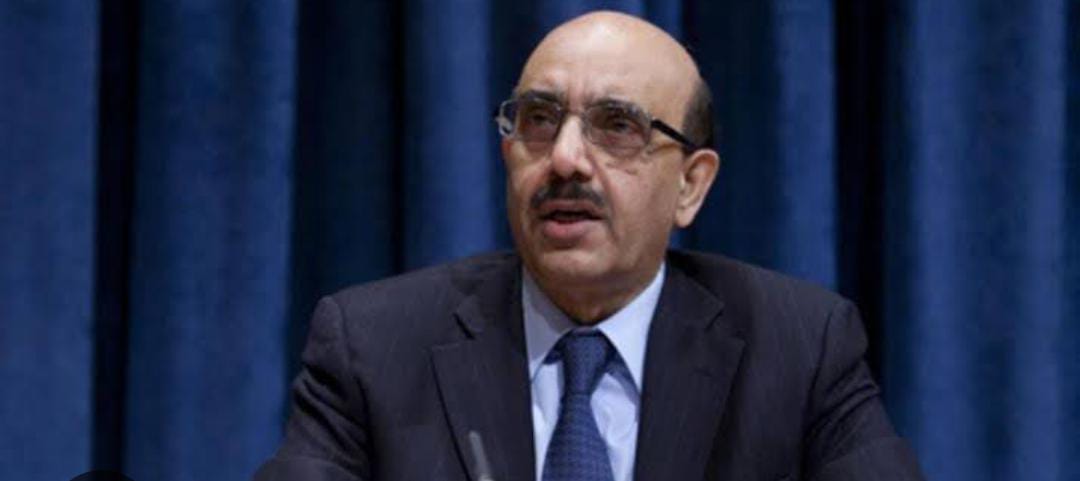
WNAM REPORT: The United Nations remains the world’s largest multilateral institution and must be strengthened, with the rule of law mainstreamed and multilateralism revitalised to address contemporary global crises, said Sardar Masood Khan, Former Ambassador of Pakistan to the United States, China and the United Nations, and former President of Azad Jammu and Kashmir.
Speaking in a television interview on the rapidly evolving conflict in the Middle East, Sardar Masood Khan said the widening US-Iran confrontation had created serious regional and global consequences, while the situation involving the Houthis, Saudi Arabia and the wider Gulf had further complicated the security environment. He said the present moment required sustained diplomacy alongside security measures.
Discussing the Houthis and the regional conflict, he said Pakistan’s commitments to Saudi Arabia under its existing defence arrangements had to be viewed alongside its continuing diplomatic role between Tehran and Washington. Pakistan, he observed, could simultaneously stand by Saudi Arabia and pursue diplomatic avenues to de-escalate tensions and bring the parties back to negotiations.
Sardar Masood Khan said the central question facing the US-Iran confrontation was whether the conflict would continue to escalate or whether a negotiated framework could emerge. He noted that both sides had publicly articulated positions while leaving some space for diplomacy. He stressed that direct engagement between the two sides, if it materialised, would be an important indication that their negotiators had found sufficient common ground for dialogue.
He said the continuing conflict had imposed enormous costs on Iran and the wider region, while also placing significant military and economic pressures on the United States. The broader consequences, he argued, extended beyond the immediate belligerents, affecting Gulf states, energy markets, trade and regional stability.
Turning to the United Nations, Sardar Masood Khan said the organisation’s diminishing role was partly linked to financial pressures and the inability of the Security Council to respond effectively to major conflicts. He also acknowledged concerns regarding bureaucracy, budgetary management and efficiency within the UN system, but argued that these shortcomings should be addressed through reform rather than abandonment.
“The United Nations should not be buried; it needs to be strengthened,” he said, stressing that the organisation remains the principal guardian of international conventions, treaties and the multilateral system.
He said Pakistan’s recent diplomatic engagement had demonstrated that effective mediation could fill gaps when larger multilateral mechanisms were unable to act. However, he stressed that Pakistan’s diplomacy was supported by Qatar, Oman, Türkiye, Saudi Arabia, Egypt and China and was not a unilateral effort.
Sardar Masood Khan also called for institutionalising Pakistan-US relations beyond personal relationships and political cycles, while maintaining balanced relations with both Iran and Saudi Arabia. He said Pakistan should pursue proactive diplomacy with India as well, particularly on water-related issues, while maintaining its principled position on Kashmir and the right of the Kashmiri people to self-determination.