
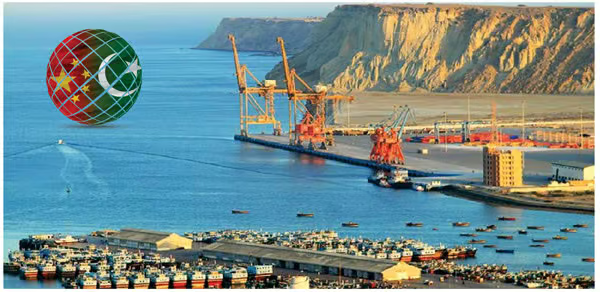
Pakistan’s 1,046 kilometre coastline, stretching from Sir Creek in Sindh to Gwadar in Balochistan, remains one of the country’s most underutilized economic assets. Despite its strategic location along major international shipping routes and its proximity to energy rich regions, Pakistan’s maritime domain has historically been treated as a peripheral space, limited largely to artisanal fisheries, basic port operations, and sporadic offshore exploration. The Blue Economy presents an opportunity to reverse this neglect, but its monetisation requires more than policy declarations. It requires a decisive “big push” by the state, a coordinated, front loaded intervention that simultaneously addresses institutional capacity, infrastructure gaps, regulatory certainty, and investor confidence.
The relevance of Big Push Theory to Pakistan’s Blue Economy is straightforward. Private and foreign investors are reluctant to enter sectors where returns depend on complementary investments that do not yet exist. No serious investor will finance fish processing plants without reliable landing facilities and cold chains, no port led industry will emerge without predictable governance and robust hinterland connectivity, and no coastal tourism project will materialise without adequate safety, zoning, and access infrastructure. In such environments, markets fail not because opportunities are absent, but because coordination is missing. This coordination failure can only be resolved through a deliberate state led push that creates the first credible examples of commercial viability.

Muhammad Arif
The starting point of this big push must be the creation of an effective and efficient administrative set up dedicated to the Blue Economy. Fragmented mandates across federal ministries, provincial departments, and autonomous bodies have historically diluted accountability and delayed decision making. A national Blue Economy administrative framework, endorsed by the Council of Common Interests and led exclusively by technocrats, must be established to plan, approve, and oversee marine economic activity. This institutional push is itself an investment signal. It demonstrates political commitment, reduces regulatory risk, and assures investors that projects will not be stranded in intergovernmental disputes.
Administrative consolidation alone, however, is insufficient. The state must also lead through targeted public investment, financed from the federal budget, to create early stage success stories that private capital can later replicate. This is the essence of the big push, the government absorbs initial coordination risk so that markets can subsequently function on their own.
In fisheries and aquaculture, for example, the state should directly invest in a limited number of modern fish landing and processing hubs along the Sindh and Balochistan coast. These hubs should include regulated auction halls, cold storage, quality testing laboratories, and export logistics. Once such facilities are operational and revenue generating, they provide tangible proof that value addition in fisheries is commercially viable. Private investors, both domestic and foreign, are far more likely to invest in fleets, processing lines, and branded exports once the state has demonstrated commitment to upstream infrastructure and regulatory enforcement.
Similarly, in aquaculture, the government should designate and develop a few fully serviced aquaculture zones, complete with water management systems, biosecurity protocols, and access roads. By absorbing the initial cost of zoning, environmental baseline studies, and common infrastructure, the state lowers entry barriers for private operators. Successful pilot zones can then become templates for private replication, both within Pakistan and through joint ventures with foreign investors experienced in sustainable aquaculture.
Ports and maritime logistics provide perhaps the clearest application of Big Push Theory. Rather than expecting private investors to gamble on underdeveloped port ecosystems, the state must first ensure predictable port governance, tariff clarity, and connectivity. Targeted federal investment in digital customs systems, port access infrastructure, and utility services within port zones can transform ports from cargo gateways into integrated logistics platforms. Once a few terminals or port led industrial zones demonstrate commercial success, private logistics firms, ship repair companies, and manufacturers are likely to follow, drawn by reduced uncertainty and proven demand.
Gwadar, in particular, requires a big push that is economic rather than rhetorical. Instead of announcing ambitious long term visions, the state should focus on making a limited set of services commercially functional, such as bunkering, ship maintenance, bonded warehousing, and regional transshipment. These initial investments, though modest relative to grand master plans, can generate early revenue streams and establish Gwadar’s credibility as a working port city. Foreign investors are far more responsive to operating examples than to strategic narratives.
Coastal and marine tourism also suffers from coordination failure. No serious investor will develop resorts or marine tourism facilities in the absence of access roads, safety regulation, and environmental zoning. The state’s big push here should involve developing a small number of planned coastal tourism zones with basic infrastructure, security arrangements, and clear land use rules. Once these zones demonstrate visitor flows and revenue stability, private developers can scale similar projects along the coast without requiring further state intervention.
Offshore energy, both hydrocarbons and renewables, similarly depends on the state’s willingness to absorb early stage risks. The number of unsuccessful offshore wells drilled so far is not sufficient to arrive at a conclusive determination regarding Pakistan’s hydrocarbon prospectivity. Considering the cost of drilling an offshore well, which can exceed US$200 million per well, this sector represents the single most significant area requiring application of Big Push Theory. The government should earmark a dedicated budget of approximately US$5 billion for offshore exploration, drilling, and development in the event of commercial discovery. A commercial oil and gas discovery offshore Pakistan would likely trigger large scale infrastructure development and accelerate Blue Economy monetisation. In parallel, offshore renewables offer an additional opportunity, where pilot wind or tidal projects supported by public guarantees can establish technical and commercial feasibility, paving the way for private financing at scale.
Crucially, the big push does not imply permanent state dominance or indiscriminate subsidies. Its objective is to create credible market signals and demonstration effects that crowd in private and foreign investment. Once coordination failures are resolved and viable business models are visible, the state should gradually withdraw from direct investment and refocus on regulation and oversight.
For this approach to succeed, it must be backed by constitutional consensus and political continuity. Endorsement by the Council of Common Interests ensures that provinces view the Blue Economy not as federal encroachment, but as a shared national project. Technocratic leadership, insulated from short term political cycles, ensures that early investments are commercially rational rather than politically motivated.
In essence, monetizing Pakistan’s Blue Economy requires recognizing that markets will not move first in an environment of institutional uncertainty. The state must move first, decisively, visibly, and intelligently. By applying Big Push Theory through coordinated administrative reform and targeted federal investment, Pakistan can create the initial examples that private and foreign investors need to follow. If executed with discipline, this approach can transform the coastline from a neglected frontier into a self sustaining engine of national wealth, employment, and resilience. (Opinions expressed in this article are the authors’ own and do not necessarily reflect WNAM’s editorial policy)
The author is former Member (Gas), OGRA; Managing Partner at Arif & Associates, a boutique petroleum and business-law consultancy; and a thought leader in energy, governance, regulatory reform, and consumer-rights. Email: [email protected] | Cell: 0333-5191381