
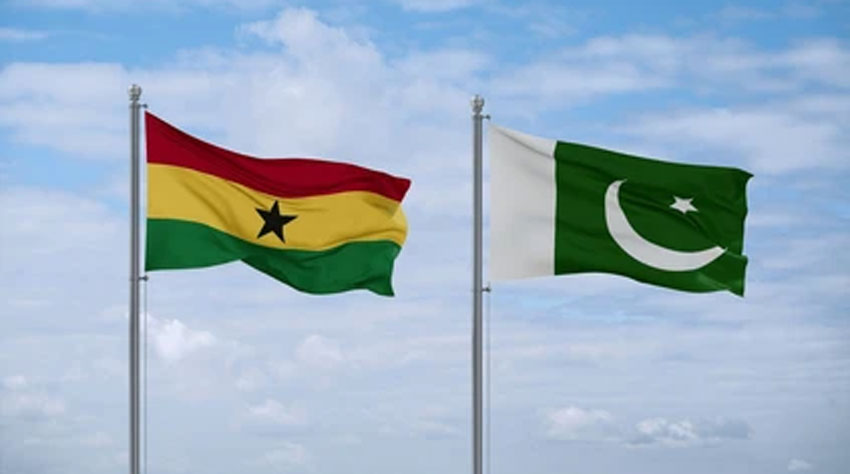
Pakistan and Ghana have long enjoyed cordial relations, which have been significantly strengthened, broadened, and diversified under “Pakistan’s Engage Africa Policy.” It is a promising sign that the two countries continue to deepen their diplomatic, economic, and strategic cooperation.
This presents a golden opportunity for the government of Pakistan, policymakers, and the private sector to realize the goals of the Engage Africa Policy through meaningful economic ties, socio-economic integration, banking and financial cooperation, investment, trade, manufacturing, and metal and mining collaboration. Key avenues include the Corridor of Knowledge, joint ventures, social marketing, and, above all, the active participation of both countries’ private sectors.

The Author
Analytically, Ghana is regarded as one of the most dynamic, competitive, and rapidly expanding economies in West Africa. With a nominal GDP exceeding $111 billion, it ranks as the eighth-largest economy in Africa. Its core economic strengths lie in robust natural resource wealth, a flourishing technology and services sector, and enduring political stability a vivid reflection of its macroeconomic resilience and manufacturing diversity.
Comparative studies show that Ghana is Africa’s leading gold producer and a major exporter of oil and cocoa. The mining and quarrying sectors continue to drive strong industrial growth, creating numerous win-win opportunities for both Pakistan and Ghana.
The services sector accounts for roughly half of Ghana’s GDP. As a regional information technology hub, bolstered by telecommunications expansion and tech investments, it clearly demonstrates substantial potential for Pakistan-Ghana cooperation in modernization, digitalization, IT, ICT, and AI areas that should be actively pursued in the years ahead.
Significantly, as a beacon of democracy with regular peaceful transfers of power, Ghana has long been a top destination for Foreign Direct Investment (FDI) in West Africa. Ghana is a formal partner in China’s Belt and Road Initiative (BRI), with the two nations signing a Memorandum of Understanding on BRI cooperation in 2018. This brightens prospects for connectivity, particularly as CPEC 2.0 serves as a flagship project of the BRI.
The country has successfully rebounded from previous fiscal challenges, posting strong GDP growth and a stabilized currency.
Historically, diplomatic relations between Pakistan and Ghana were established in 1958, and Pakistan’s High Commission was first set up in 1963. The High Commission has since worked diligently to strengthen bilateral relations across political, diplomatic, economic, social, and cultural spheres, taking numerous steps to re-energize the partnership.
On the economic front, relations between Pakistan and Ghana are gaining momentum. The first-ever Memorandum of Understanding to establish a Joint Business Council between the Federation of Pakistan Chambers of Commerce and Industry (FPCCI) and the Ghana National Chamber of Commerce and Industry (GNCCI) was signed in Lahore on 23 February 2023.
There is a regular exchange of trade delegations between the two countries. Official figures for 2023 put total bilateral trade at US57.2 million and imports from Ghana standing at US$8 million.
Pakistan’s major exports include rice, linen, cotton and textile products, ethyl alcohol, tractors, and cement clinkers. Ghana is estimated to be a potential market for Pakistani cereals, rice, textile products, light engineering and appliances, pharmaceutical and surgical goods, chemicals, food products, and confectionery.
The Pakistani community in Ghana contributes to the country’s development through business and professional expertise. Both nations remain committed to promoting bilateral relations and are collaborating across multiple areas and initiatives.
Africa stands at the forefront of global anticipation as the “Continent of the Future,” with immense economic potential, attractive investment opportunities, abundant natural resources, and a predominantly young population that represents a vibrant force shaping tomorrow’s trajectory. This provides ample opportunities for Pakistan to further diversify its economy, exports, and resource management.
A critical analysis of the current strategic partnership shows that bilateral ties are expanding beyond trade. In June 2026, delegations from institutions such as Riphah International University visited the Ghana Free Zone Authority to explore agro-food processing.
Pakistan’s “Engage Africa Policy” represented a giant step toward the geographical and product diversification of exports. Under this policy, the top ten African nations by economic size Nigeria, Kenya, South Africa, Morocco, Algeria, Egypt, Sudan, Ethiopia, Tanzania, and Angola were identified with the aim of enhancing and doubling trade by 2025. Preferential Trade Agreements with three African trading blocs SACU, ECOWAS, and the EAC were envisaged as key policy components. The Trade Development Authority of Pakistan (TDAP) was designated to provide a special 80 percent subsidy for Pakistani companies to encourage participation in African trade fairs, and a focus was placed on establishing new missions across the continent.
The African Development Bank projects Ghana’s economy to expand by 5 percent in 2026, strengthening further to 5.4 percent in 2027, positioning it among the stronger-performing economies in West Africa marginally higher than the 4.8 percent growth forecast by both the International Monetary Fund and the World Bank. According to the Bank’s 2026 African Economic Outlook Report, Ghana’s inflation is projected to end the year at 9 percent. On the external front, Ghana is expected to maintain a relatively strong current account surplus of 3 percent of GDP in 2026, underscoring resilience despite prevailing global uncertainties.
In summary, there is an urgent need to further strengthen Pakistan-Ghana bilateral relations through greater economic integration, investments, joint ventures, IT, digitalization, hybrid agriculture, halal food processing, metal and mining, and textiles.
A direct flight mechanism would represent a giant step toward greater connectivity with West Africa. Further consolidation of the Bilateral Political Consultations, the Joint Business Council, formation of a joint chamber of commerce, and holding joint trade and product expos, fairs, and online consultations would all be steps in the right direction.
Trade between Pakistan and Ghana could be further increased by specifically targeting high-demand sectors such as textiles, affordable generic medicines, and agricultural machinery, while also leveraging joint ventures and bilateral trade agreements to access the broader West African market.
Building mutual “Trade Houses” would be a valuable addition. Pakistan could boost exports by supplying Ghana with quality fabrics at competitive prices, alongside affordable generic pharmaceuticals, surgical goods, and light engineering equipment. Pakistan should also export its skilled manpower to Ghana, given the numerous business opportunities available there. Both countries should additionally focus on joint projects involving SMEs, community development, social engineering, science, disaster management, climate change, technology, and defense production in the years ahead.
Finally, it is recommended that Pakistani businesses consider using Ghana as a strategic entry point to access the larger ECOWAS market. Pakistan’s private sector should explore investments in Ghana’s ICT and automotive assembly sectors particularly motorcycle plants as well as the non-informal economy, all of which hold promising potential.