
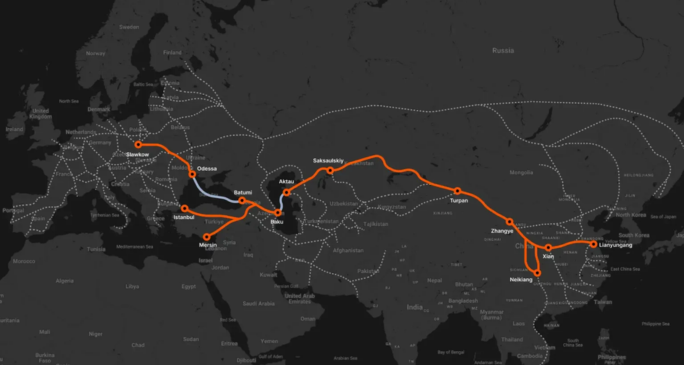
WNAM REPORT: In the current global economic environment, a country’s geostrategic position and the effective use of this advantage are among the main factors influencing economic growth. For energy-rich Azerbaijan, hydrocarbons remain a key source of revenue, yet it is the country’s location at the crossroads of Eurasia that offers long-term, sustainable economic dividends. Historically a bridge between East and West, Azerbaijan is now reclaiming this role through the development of the Middle Corridor, a transport route whose full potential is only beginning to emerge.
The Middle Corridor, also known as the Trans-Caspian International Transport Route (TITR), connects China and East Asia with Europe via Central Asia, the Caspian Sea, the South Caucasus, and Türkiye. While long regarded as an alternative to the Northern and Southern routes, recent geopolitical shifts, supply-chain diversification, and infrastructure investments are rapidly transforming the corridor into a primary trade artery.
According to research by Germany-based Rhenus Logistics, one of the world’s leading multimodal transport and supply chain management companies, cargo volumes on the China–Azerbaijan–Europe route could double by 2030.
According to the company, container traffic along the Trans-Caspian route has grown by approximately 35–40 percent annually over the past two years, rising from 1.5 million tons in 2022 to around 3.2 million tons in 2024. The company attributes this growth to the restructuring of global supply chains, the demand for more resilient logistics routes, and targeted investments in key hubs such as Baku, Aktau, and Kuryk.
Importantly, the Middle Corridor has evolved from a contingency route into a core logistics solution. Improved coordination among railways in Kazakhstan, Azerbaijan, and Georgia, coupled with the expansion of port capacity on the Caspian Sea, is laying the groundwork for sustained cargo growth. If current trends continue, the route’s throughput could double within the next five years.
Azerbaijan’s role in this transformation is pivotal. As the only country on the Middle Corridor with direct access to both the Caspian Sea and the South Caucasus transport network, it functions as the corridor’s central logistical hinge. Investments in the Port of Baku, the Baku–Tbilisi–Kars (BTK) railway, digital customs systems, and fleet modernization in the Caspian Sea have significantly increased transit capacity and reduced delivery times.
President Ilham Aliyev has repeatedly emphasized that the Middle Corridor is not merely an infrastructure project, but a strategic pillar of Azerbaijan’s economic policy. In a recent interview, he underlined that China will be the main driver of future cargo growth along the route. According to the President, Beijing is financing major railway projects toward the Caspian Sea, including lines through Kyrgyzstan and Uzbekistan – investments worth billions of dollars despite challenging terrain requiring extensive tunnels and bridges.
This, the President noted, is a clear signal that freight volumes heading toward the Caspian, and therefore Azerbaijan, will increase substantially. Additional cargo from China and Central Asia will, in turn, ensure the full operationalization of the East–West axis via the Middle Corridor.
Despite its strong growth trajectory, the Middle Corridor still faces several structural challenges:
Fragmented coordination among corridor countries, leading to inconsistencies in tariffs, documentation, and transit times;
Capacity constraints in ports, railways, and ferry services across the Caspian Sea during peak periods;
Regulatory and customs inefficiencies, particularly at border crossings;
Cost competitiveness, as the corridor must balance speed advantages against higher multimodal handling costs compared to traditional sea routes.
Without addressing these issues, the corridor risks losing momentum precisely at a time when global demand for alternative routes is accelerating.
The solution lies in deeper regional cooperation and institutional alignment. Harmonizing tariffs, digitizing customs procedures, and introducing unified scheduling and tracking systems across the corridor would significantly improve predictability and cost efficiency. Public–private partnerships can help align infrastructure development with market demand.
Equally important is the diversification of routes within the corridor itself. In this context, President Ilham Aliyev has highlighted the strategic importance of the Zangezur Corridor. Beyond reconnecting mainland Azerbaijan with the Nakhchivan Autonomous Republic, the route would serve as an additional international transport link to the West.
As the President noted, Azerbaijan currently has only one railway route to Western markets; the addition of a second would enhance competitiveness, prevent monopolization of transit flows, and allow for more flexible and competitive pricing. For a landlocked country, such redundancy is not a luxury but a strategic necessity.
The Middle Corridor’s expansion promises not only higher transit revenues for Azerbaijan but also broader economic revitalization across the region. By linking China, Central Asia, the South Caucasus, and Europe through a resilient, diversified route, the corridor strengthens regional interdependence and reduces vulnerability to external shocks.
As global trade continues to adjust to new geopolitical and economic realities, the Middle Corridor is increasingly positioned as a long-term solution rather than a temporary alternative. With sustained investment, coordinated policies, and strong international partnerships, Azerbaijan stands to consolidate its role as a key Eurasian logistics hub – turning geography into an enduring economic advantage.