
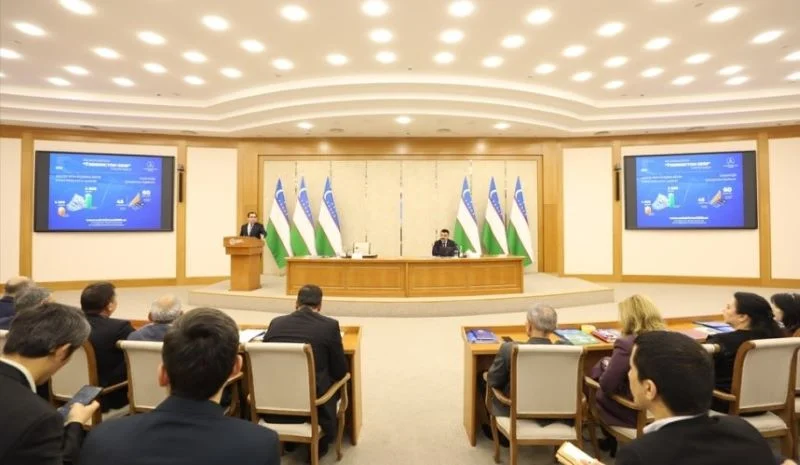
A public discussion of the draft of the updated ‘Uzbekistan – 2030’ Strategy was held at the Academy of Public Policy and Administration under the President of the Republic of Uzbekistan in cooperation with the Development Strategy Center. The event was attended by academic professors, teachers, and researchers.
At the beginning of the discussion, the Vice-Rector of the Academy of Public Policy and Administration under the President of the Republic of Uzbekistan, Alisher Umarov, and the Executive Director of the Center, Eldor Tulyakov, spoke about the tasks put forward in the President’s Address to the Oliy Majlis and the people of Uzbekistan, in particular, the issue of improving the ‘Uzbekistan – 2030’ Strategy, the scale of the tasks defined in the current Strategy as a result of the reforms being carried out in the country, the work performed, the achieved performance indicators, as well as the need to improve it, and the significance of the high milestones set.
It was noted that the ‘Uzbekistan – 2030’ Strategy, adopted in 2023, is an important strategic document that marked the beginning of a qualitatively new stage in the country’s development. In it, in accordance with the new edition of our Constitution, the main priority goals are defined as the enhancement of human dignity, ensuring sustainable economic growth, strengthening social protection, and building a state oriented towards serving the people.
The practical experience gained at the initial stage of implementing the Strategy has shown that there is a need for further clarification of specific goals and objectives, their planning by years, open definition of funding sources, and responsibility for implementation. Public discussions, proposals from the regions, and factors identified during the implementation process further increased the need to improve the strategy.
– The draft of the updated ‘Uzbekistan – 2030’ Strategy, developed on this basis, is a logical continuation of the current document and represents a new stage in terms of content and style. First of all, attention should be paid to the main difference in the strategic approach. If the current strategy defines the main goals and priority areas, the revised strategy links each goal to specific annual indicators. For example, if in the current strategy in the education and healthcare systems, the main task is defined as expanding coverage, then in the strategy under improvement, quality, environment, and result are put forward. In particular, along with bringing the coverage of children with preschool education to 80 percent, ensuring 100 percent coverage of all preschool educational organizations with clean drinking water and modern sanitary and hygienic infrastructure has been set as a specific goal. Full coverage of children with preparatory groups for school is also ensured through annual indicators, — said Eldor Tulyakov.
During the meeting, a presentation was made on the changes being made to the draft Strategy, and the analysis of performance targets in the current and updated project.
Answers were given to participants’ questions. Also, professors, teachers, and students of the Academy of Public Administration, doctoral students, and researchers who participated in the public discussion, expressed a number of suggestions and initiatives regarding the draft document. (Development Strategy Center Information Service)