
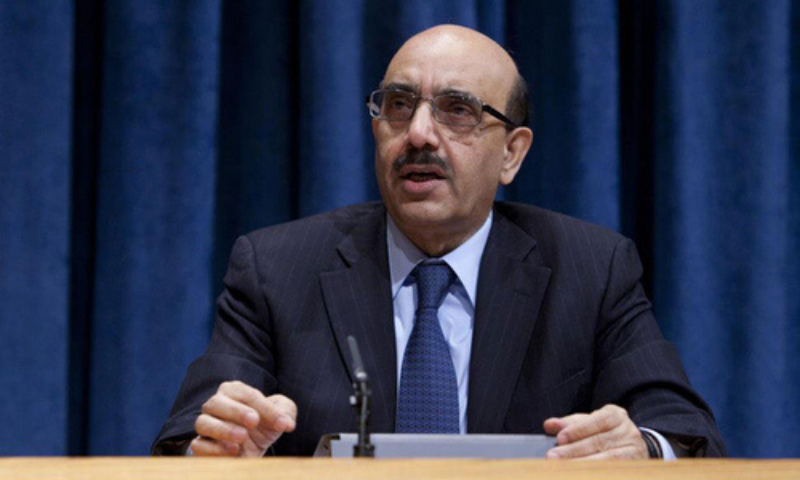
ISLAMABAD ( WNAM REPORT ): Ambassador Masood Khan, former President of Azad Jammu and Kashmir and former Ambassador of Pakistan to the United States and the United Nations, has described Pakistan’s participation in the newly convened Board of Peace as a significant diplomatic breakthrough, stating that it provides Islamabad its first opportunity at this scale to sit at the *diplomatic high table* and influence critical decisions concerning Gaza and the broader Middle East.
In a televised interview, Ambassador Khan underscored that Pakistan brings to the Board a proven record of advocating peaceful settlement of disputes, whether on Kashmir, Palestine, or other international conflicts. He emphasized that Pakistan is not a bystander but a stakeholder, having consistently lobbied—alongside a group of Muslim countries—for an immediate ceasefire and an end to what he termed the ongoing humanitarian catastrophe and genocide in Gaza.
Referring to recent developments, he noted that ceasefire violations continue, with 600 Gazans reportedly killed since the ceasefire came into effect, alongside controversial decisions regarding annexation of the West Bank and the expansion of illegal settlements in the occupied Palestinian territories. He stressed that the credibility of the Board of Peace would depend on its ability to halt hostilities, end the humanitarian blockade, restore full humanitarian access, and ensure Israeli withdrawal from occupied territories.
Ambassador Masood Khan reaffirmed Pakistan’s principled support for a two-state solution, advocating for the establishment of a sovereign, contiguous Palestinian state living side by side with Israel in peace and security. He warned that fragmentation of Palestinian territory through illegal settlements undermines the viability of such a solution.
Addressing speculation about the strategic orientation of the Board, Ambassador Khan observed that the world is increasingly multipolar and that Pakistan’s participation reflects prudent, balanced diplomacy. He clarified that Pakistan would not be drawn into any military enforcement operations or disarmament efforts but could consider participation in peacekeeping and peacebuilding initiatives, consistent with its longstanding contributions to United Nations peacekeeping missions worldwide.
He further noted that while the mechanism is currently led by President Trump, it does not replace the United Nations, particularly as the Board of Peace has been endorsed by the UN Security Council through Resolution 2803. Pakistan, he said, would utilize both the Board and parallel UN channels to advocate for an end to the killings, restoration of humanitarian assistance, and durable peace.
Ambassador Khan acknowledged the complexities of decision-making within the Board, including the strong influence of Israeli leadership and lobbying structures in the United States. However, he pointed to emerging debates within American Make America Great Again (MAGA) constituencies and the broader international community regarding continued funding of conflicts, suggesting that global opinion is evolving.
On humanitarian assistance and reconstruction, Ambassador Khan reiterated that Pakistan, despite economic challenges, has consistently extended financial and material support to Palestinians. He recalled presenting humanitarian assistance to the delegation of Palestine at the United Nations during his tenure as Permanent Representative and affirmed that Pakistan’s future contributions—whether financial, moral, diplomatic, or in peacekeeping roles—would be meaningful rather than symbolic.
He concluded by emphasizing that Muslim countries, Gulf states, and the broader Global South are increasingly vocal in their support for Palestinian self-determination. Public demonstrations across global capitals, he noted, reflect a growing international demand for justice, accountability, and an end to occupation.
“Pakistan’s presence at the Board of Peace,” Ambassador Masood Khan stated, “is guided by realism, moral clarity, and an unwavering commitment to peace, reconstruction, and the legitimate rights of the Palestinian people.”
Masood Khan: Pakistan’s Participation in Board of Peace a Diplomatic Success
105