
Overview
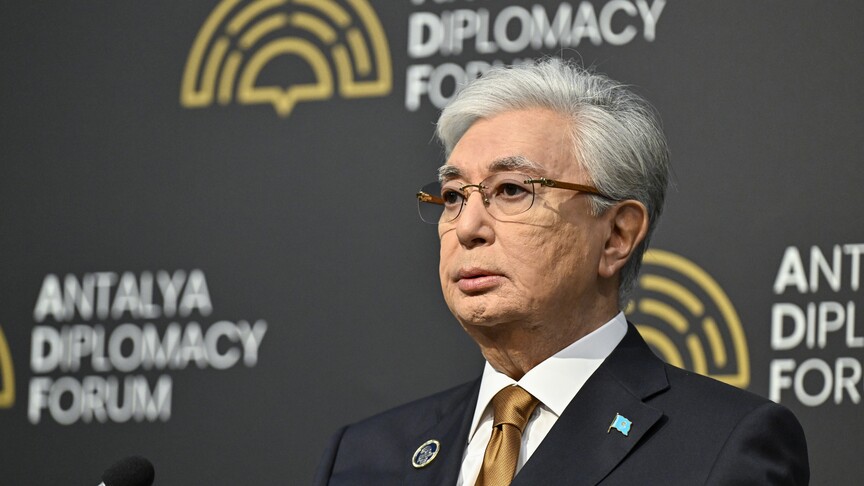
Kazakhstan’s President, Kassym-Jomart Tokayev, participated in a high-level panel session titled “Mapping Tomorrow, Managing Uncertainties” at the Antalya Diplomacy Forum on April 17.
In his remarks, the President outlined his assessment of the current international environment, highlighting the increasing globalisation of regional conflicts, the growing strain on multilateral institutions, and the need for more responsible and restrained leadership. He also addressed the structural challenges facing the United Nations, developments in the Middle East, and the evolving role of middle powers in global affairs.
Key Points from President Tokayev’s Remarks
UN Reform and the Multilateral System
- President Tokayev reaffirmed that the United Nations remains an “indispensable and universal organisation,”but emphasised that its effectiveness is increasingly constrained by structural limitations.
- While there is broad consensus on the need for reform, there is limited confidence that meaningful change will be achieved in the near term, given the prolonged nature of reform discussions and lack of tangible outcomes.
- The President identified the UN Security Council as the central issue in this context, suggesting that its structure and dynamics are a key obstacle to institutional reform and effective decision-making.
- He expressed concern that major negotiations on global conflicts are increasingly taking place outside UN frameworks, indicating a gradual marginalisation of the organisation’s rolein conflict mediation.
- Tokayev highlighted that this trend raises broader questions about the long-term viability and relevance of the current multilateral system, particularly in its ability to respond to contemporary geopolitical challenges.
- He also pointed to the need to reassess elements of the UN Charterthat reflect outdated geopolitical realities, noting that some provisions no longer correspond to the current international system.
Global Leadership and Strategic Restraint
- President Tokayev emphasised that effective global leadership in the current environment should be defined primarily by responsibility and restraint, particularly in matters of international peace and security.
- He argued that “strategic restraint”is essential in managing an increasingly complex and interconnected global landscape, where actions in one region can have far-reaching consequences.
- The President noted that the international system is experiencing a period of heightened uncertainty, with regional conflicts increasingly expanding beyond their original geographic scope and taking on global dimensions.
- In this context, he called for a more measured and responsible approach by political leaders, suggesting that escalation risks can only be mitigated through disciplined and pragmatic decision-making.
Middle East Tensions and Iran
- Addressing developments in the Middle East, President Tokayev described the situation as complex and emphasised the need for caution in public assessments.
- He confirmed that Kazakhstan has expressed solidarity with Gulf countriesand has consistently called on all parties to exercise restraint and avoid further military escalation.
- The President stressed that the economic consequences of regional conflicts are significant, noting that disruptions have affected global markets, including energy and trade flows.
- He highlighted the importance of maintaining open maritime trade routes, including through the Strait of Hormuz, while noting that such routes were functioning prior to the escalation and should not become a secondary focus of negotiations.
- Tokayev underscored that the central issue in the Iran-related context remains nuclear proliferation, arguing that this should be the primary focus of diplomatic efforts rather than peripheral economic concerns.
- At the same time, he observed that global trade continues to grow overall, but noted that its structure and quality present ongoing challenges.
Role of Middle Powers
- President Tokayev highlighted the growing relevance of so-called “middle powers” in the international system, including Kazakhstan and Türkiye.
- He suggested that such states often demonstrate a higher degree of responsibility and pragmatismin global affairs compared to major powers, particularly in efforts to address complex international challenges.
- The President indicated that middle powers can play a constructive role in facilitating dialogueand contributing to solutions on pressing regional and global issues.
- He also noted the potential for enhanced cooperation between Kazakhstan and Türkiyein addressing shared regional challenges, reflecting broader trends toward more diversified and flexible diplomatic engagement.
Future of International Institutions and Preventive Diplomacy
- President Tokayev expressed concern about the declining role of international institutions in managing conflicts, pointing to the absence of visible UN leadership in mediation efforts.
- He argued that the current system of global governance is under strain, with traditional mechanisms struggling to adapt to evolving geopolitical realities.
- The President emphasised the importance of preventive diplomacy, calling for greater focus on anticipating and mitigating conflicts before they escalate.
- He noted that despite decades of discussion around preventive approaches, implementation has remained limited, with international efforts often focused on reactive rather than proactive measures.
- Tokayev also raised the need to consider the impact of emerging technologies, including artificial intelligence, on international institutions and decision-making processes.
- Concluding this theme, he reiterated his support for multilateral diplomacy, while stressing that its effectiveness depends on substantive reform and renewed political commitment.
Background Information
- The Antalya Diplomacy Forum is an annual high-level platform convening global leaders, policymakers, and experts to discuss international security, diplomacy, and global governance challenges.
- The 2026 forum focused on navigating uncertainty in a rapidly changing geopolitical environment, with particular attention to conflict dynamics, economic disruption, and the future of multilateral cooperation.