
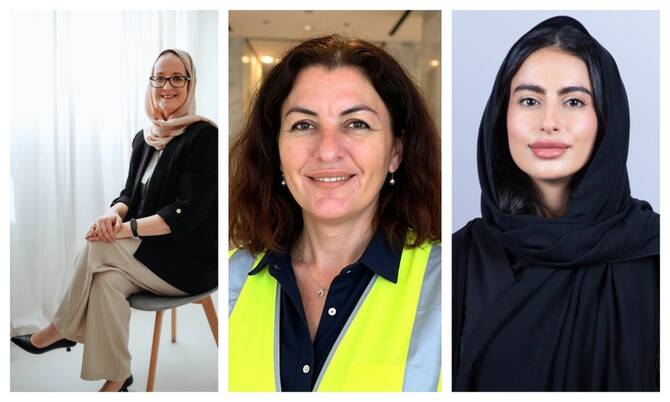
WNAM MONITORING: Women are steadily reshaping construction environments across Saudi Arabia, bringing new perspectives to one of the region’s most traditionally male-dominated industries as the country pushes forward with large-scale development projects.
From quarry floors to high-level project management, professionals across the sector say the transformation is less about headlines and more about everyday realities — in how teams collaborate, make decisions and structure the workplace.
Female workforce participation in Saudi Arabia has risen sharply, increasing from around 17 percent in 2017 to roughly 35 percent in recent years, according to official data from General Authority for Statistics and the Ministry of Human Resources and Social Development.
The shift reflects broader reforms under Vision 2030, which have expanded access to employment across sectors, including construction, engineering and project management.
For Sevgi Gul Gode, a stone consultant with Versatile International in Saudi Arabia, that change is most visible on-site.
Working across quarries and major construction projects, she operates in an environment that demands both technical precision and physical presence.
“I trained as a mining engineer and discovered that the natural stone sector offered a uniquely rich intersection of geology, design, and large-scale construction,” she told Arab News, adding that the field combines “engineering rigour, aesthetic judgement and logistical problem-solving.”
But Gode’s early interest in mining developed into hands-on experience across quarry operations, quality control and supply chains, before evolving into consultancy roles on large-scale projects in the Middle East.
On site, her role is both technical and highly physical. “A typical day might start with quarry visits, walking among the blocks, surrounded by the raw character of the stone,” she explained.
Her role brings together multiple disciplines, requiring close coordination across teams.
Earlier in her career, that presence often drew scrutiny. “Being a woman in quarries and stone factories attracted attention and sometimes hesitation,” she said. “But high-quality outcomes quickly turned curiosity into confidence.”
That shift, she added, has been reinforced by a broader change across the industry.
“Today the dynamic is very different … stakeholders recognize my expertise and rely on my guidance,” she said, pointing to stronger collaboration and growing professional trust.
In recent years, Gode has seen a rise in female representation across construction environments in Saudi Arabia.
“On site I now see many women architects and designers, and a clear increase in women across the industry, including engineers,” she said, noting that women are expanding into areas ranging from infrastructure to structural fields.
“Women bring complementary perspectives to work, adding depth, and attention to detail, both technically and aesthetically,” she added.
At the same time, Gode is clear that the demands of the job remain unchanged.
“This is a high-risk workplace, and every decision must be accurate, fast, and responsible,” she said. “Being a woman in such a field is not a limitation — it’s a strength.”
Similar observations are shared at the industry level by Rachael Jones, head of specialist services at JLL in Saudi Arabia, whose career spans more than two decades across property and construction.
“Working in a male-dominated industry has presented both challenges and valuable learning opportunities,” she said, noting that early hurdles around credibility were overcome through preparation and technical expertise.
Jones points to Saudi Arabia’s broader transformation under Vision 2030 as a key driver of change, with major projects creating demand for a more diverse workforce.
“The Kingdom’s ongoing transformation … has expanded opportunities for women across many sectors, including construction and engineering,” she told Arab News.
While there is progress to be made, Jones said this growing participation of women in the workforce is being driven by both policy and demand, as large-scale projects across the Kingdom require broader and more diverse talent pools.
Within construction teams, professionals say the impact is tangible but often subtle. “As teams bring together a broader range of perspectives, discussions around problem-solving have become more thoughtful and well-rounded,” Jones said, pointing to improvements in collaboration, planning and decision-making processes.
Companies are adapting site conditions, policies and professional development pathways to support a broader workforce, from better-fitting protective equipment to more flexible working arrangements and clearer leadership pipelines.
At the same time, the scale of Saudi Arabia’s construction pipeline — including mega-projects such as Diriyah, the Red Sea development and Qiddiya — is accelerating demand for talent across all levels of the sector for both men and women.
“The economic imperative is clear,” Jones said. “These projects require deep and diverse talent pipelines, and fully engaging the entire workforce, including women, is essential.”
Maha Almutlaq, founder of Bureau Bayn, said the role of women in shaping Saudi Arabia’s built environment is evolving beyond participation into influence.
“It’s not just about being present anymore, it’s about where women are positioned and how involved they are in shaping projects,” she said, pointing to a broader change in how decisions are made across the sector.
Working at the intersection of design, culture and construction, she collaborates closely with multiple teams to address the market’s needs and guide how projects are developed.
“We sit at the center of strategy (the why), curatorial thinking (the who), and design disciplines (the how),” she told Arab News.
By bringing stakeholders together, Almutlaq works to align teams around a shared goal and outcome.
“Saudi women are stepping into more roles across our industry, and that’s already enriching the ecosystem in a tangible way,” she said.
“We are not replacing our male counterparts but rather enriching what they do,” she added, noting that this collaboration is strengthening how projects are delivered.
In a sector traditionally defined by technical delivery, she believes there is a growing push toward more integrated approaches.
“As a female-led company, we are actively involved in shaping the direction of projects, not just supporting their delivery,” said Almutlaq.
She also emphasized the importance of design in determining how projects are experienced, particularly in Saudi Arabia where long-term engagement is a growing focus.
“Construction then becomes the execution of that vision. Without that clarity at the beginning, you risk delivering something that works technically, but doesn’t fully connect with the audience it’s meant for,” she said, adding that women bring “unique perspectives, lived experiences, and expertise,” and make up half of the national population.
These developments in the Kingdom are also being supported by changes at the education level, with more women graduating in engineering, architecture and construction-related disciplines, feeding into a sector increasingly shaped by digital tools, remote collaboration and new project delivery models.
“Younger Saudis, both men and women, are entering the workforce with fresh perspectives on equality and career development,” Jones said.
For Gode, the message to those considering entering the field is straightforward. “Don’t hesitate — construction and engineering reward curiosity, discipline and practical skill,” she said.