
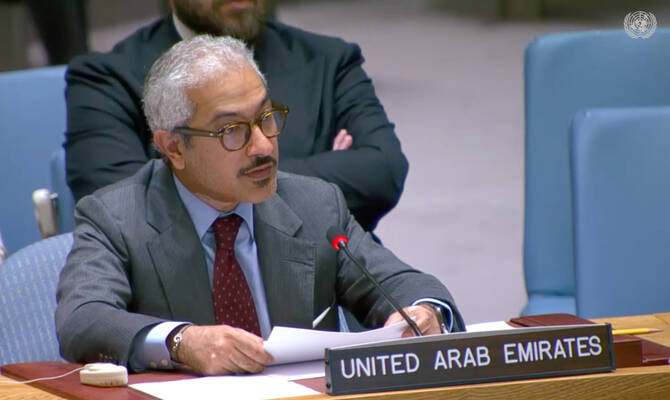
NEW YORK ( WNAM MONITORING): The UAE warned the UN Security Council on Tuesday that attacks on peaceful nuclear facilities are a “red line,” after a drone strike near the Barakah nuclear power plant triggered an emergency meeting requested by Bahrain amid mounting regional tensions.
Addressing the UNSC, UAE Ambassador Mohamed Abushahab condemned the “unlawful, unprovoked terrorist attack,” and warned that failure by the international community to respond decisively could normalize assaults on civilian nuclear infrastructure.
“The attack on Barakah constitutes a dangerous escalation in an already volatile regional environment,” Abushahab told council members.
“Threats and attacks of this nature are a red line for the UAE, and we reserve our full and inherent right to protect our territory and population in accordance with international law.”
The UAE said the drone strike caused a contained fire at an electrical generator outside the plant’s inner perimeter but did not affect reactor operations or radiation safety levels.
Abu Dhabi said the Barakah facility remains “safe, stable and operational,” continuing to provide up to 25 percent of the country’s electricity supply and generating more than 40 terawatt-hours of energy annually.
The UAE added that recent drone attacks targeting civilian and critical infrastructure, including Barakah, originated from Iraqi territory and formed part of a wider campaign of cross-border attacks involving Iran and its proxies.
Abushahab warned that extremist groups are threatening civilians, shipping routes, critical infrastructure and nuclear safety across the region, urging the UNSC to deliver a “clear, united and consequential response.”
Rafael Grossi, director general of the International Atomic Energy Agency, described the incident as a matter of “grave concern,” warning that a direct strike on an operating nuclear power plant could trigger catastrophic consequences.
He told the council that radiation levels remain normal and no injuries were reported, but that the risks associated with attacks on active nuclear facilities are severe.
“In case of an attack on the Barakah nuclear power plant, a direct hit could result in a very high release of radioactivity to the environment,” Grossi said.
He cautioned that damage to power supply lines could increase the likelihood of reactor core melting, potentially requiring evacuations, sheltering measures and iodine tablet distribution across hundreds of kilometers.
“Attacks on nuclear facilities devoted to peaceful purposes are unacceptable,” Grossi said, stressing that operating nuclear plants such as Barakah, Zaporizhzhia and Bushehr are protected under international humanitarian law. He said he would soon travel to the Gulf to continue emergency coordination efforts.
The emergency UNSC session highlighted growing international alarm over escalating attacks on civilian and energy infrastructure across the Middle East.
Bahrain’s UN Ambassador Jamal Fares Alrowaiei condemned the strike as a “serious and unjustified escalation,” and a “flagrant violation” of the UN Charter and Security Council resolution 2817.
He warned that attacks since February have evolved into a “systematic policy based on incremental escalation,” targeting countries such as Saudi Arabia, Qatar, Kuwait, the UAE, Jordan and Bahrain.
“These attacks are now expanding beyond military targets to chemical plants, nuclear facilities, maritime routes and civilian infrastructure,” Alrowaiei said.
Bahrain also condemned recent drone attacks against Saudi Arabia, and warned that global energy markets and supply chains are becoming “hostage” to regional instability.
US Ambassador Mike Waltz said the world should be “thankful” that the strike did not result in a catastrophic nuclear disaster.
“This very well could have been an attack where we are discussing the meltdown of a nuclear reactor,” he told the council, warning of an “untold and unprecedented humanitarian and environmental crisis.”
Waltz accused Iran of attempting to “weaponize” a civilian nuclear power plant after failing to obtain nuclear weapons capability, calling Tehran’s actions “outrageous and unacceptable.”
He praised the UAE’s nuclear program as the “gold standard” for safeguards and nonproliferation compliance, while accusing Iran of violating IAEA obligations and destabilizing the region through proxy groups including Hezbollah, Hamas and the Houthis.
Russia’s UN Ambassador Vasily Nebenzia also condemned the attack, calling any strike on peaceful nuclear facilities “categorically unacceptable.”
He warned that attacks on nuclear infrastructure could place the entire region “on the verge of nuclear and radiological catastrophe,” while criticizing what he described as inconsistent international reactions to strikes involving other nuclear sites in the region.
France, Greece, Pakistan and China all expressed solidarity with the UAE and warned that attacks on nuclear facilities represent grave violations of international law.
French Ambassador Jerome Bonnafont warned that attacks on operational civilian nuclear plants and their electricity systems “seriously endanger nuclear safety and security,” while Greece described the incident as an “extremely serious escalation” with potentially severe regional and environmental consequences.
Pakistan’s Ambassador Asim Iftikhar Ahmad said nuclear installations “must never be targeted under any circumstances,” warning that repeated attacks pose catastrophic risks to civilians and regional stability.
China’s Ambassador Fu Cong, whose country holds the rotating council presidency for this month, described the strike as a “dangerous and irresponsible act” and called for an immediate cessation of hostilities, warning that continued conflict threatens regional nuclear facilities, energy security and global trade routes, including the Strait of Hormuz.