
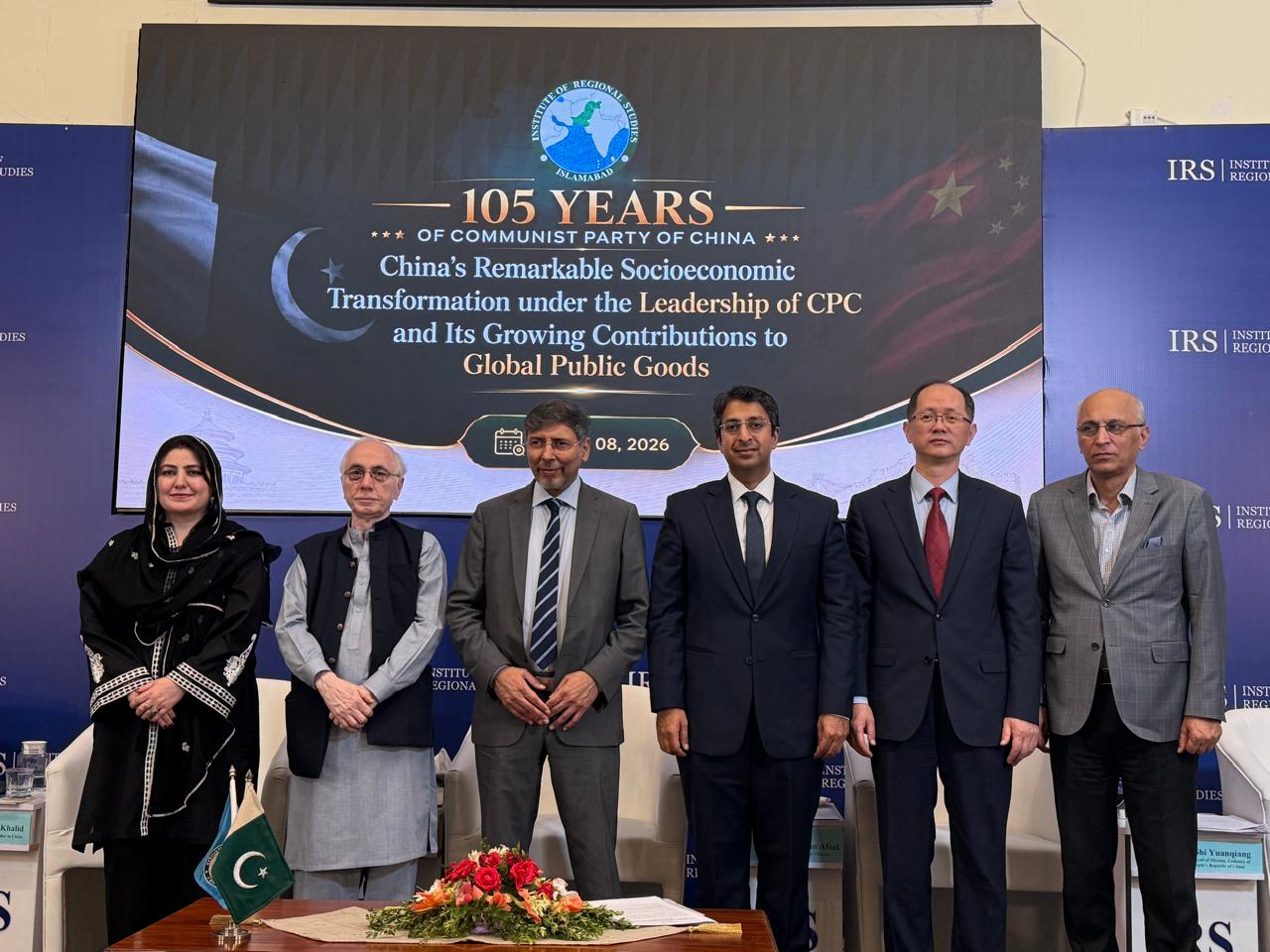
ISLAMABAD ( WNAM REPORT ): The Institute of Regional Studies (IRS), Islamabad, hosted a special seminar to commemorate the 105th anniversary of the founding of the Communist Party of China (CPC), titled “China’s Remarkable Socioeconomic Transformation under the Leadership of the CPC and Its Growing Contributions to Global Public Good”. Moderated by Ms. Nabila Jaffer, Head of the China Program, the seminar brought together senior diplomats, government officials, scholars, youth, and media.
In his opening remarks, Ambassador Jauhar Saleem, President of IRS, described China’s rise as one of the most remarkable transformations in contemporary history, lifting around 800 million people out of poverty and raising per capita income from about 156 US dollars in the 1970s to close to 13400 US dollars today, and leaping towards modernization. He identified meritocracy as the single most important lesson of China’s development, noting that several of its top leaders had engineering backgrounds, and pointed to Beijing’s dramatic improvement in air quality as a symbol of the change. Pakistan and China, he said, were “partners in peace, partners in progress, and development partners.”
Professor Gao Jian, Secretary General at Shanghai International Studies University, stated that China’s path to modernization, achieved through a governance model rooted in China’s own realities, has proved Fukuyama’s claim wrong that modernization would ultimately take the form of Westernization. Chinese modernization, he stressed, is not a template to be copied but an example that every nation must adapt to its own social realities. Professor Gao drew a philosophical distinction between Western and Chinese governance under CPC, saying that instead of falling into the trap of a confrontational relationship, a civilian versus state, Chinese governance adheres to a “people-oriented” principle, which centers on “the people” as a collective rather than on the individual civilian, and which measures policy by whether the people as a whole support and approve of it.
Ambassador Masood Khalid, Pakistan’s former ambassador to China, traced the CPC’s journey from its founding in Shanghai in 1921 to the current 15th Five-Year Plan. He highlighted China’s system of five-year planning, begun in 1953, as systematic, scientific, and pragmatic, with built-in course correction and a strong emphasis on data accuracy. He emphasized the Party leaders’ critical role in setting the stage for China’s socioeconomic ascent, delineating the policies from Mao to Xi era. He also opined that China is steering the rise of Asia as well. China’s rise, he said, had been peaceful; it sought not to dismantle the international order but to seek adjustments reflecting new realities, and aimed to become a fully modern country by 2049.
Ambassador Moin ul Haque, Pakistan’s former Ambassador to China, focused on the CPC’s engagement with the Global South. He traced the evolution of Chinese foreign policy from the Five Principles of Peaceful Coexistence and the 1955 Bandung Conference to President Xi Jinping’s global initiatives, under which China had moved from a recipient of development assistance to a development provider. He detailed China’s contributions to global public goods across infrastructure connectivity, development financing, poverty reduction, science and technology, public health, green development and human capital, citing CPEC projects, the provision of COVID-19 vaccines as a global public good, and training and scholarship opportunities for Pakistani students, officials and farmers.
Delivering the guest of honour address, Mr. Shi Yuangqiang, Deputy Head of Mission at the Embassy of the People’s Republic of China in Islamabad, drew on General Secretary Xi Jinping’s July 1 address in Beijing to outline three keys to the CPC’s success: a people-centered approach, a global vision oriented toward the common good, and rigorous party self-governance guided by “seeking truth from facts.” He said China moved from winning the battle against poverty to building a transport network exceeding six million kilometers and making rapid advances in artificial intelligence, biomedicine, and quantum technology. Describing CPEC as a pilot project of the BRI that had brought more than 25.5 billion US dollars in direct investment and over 260,000 jobs to Pakistan, he reaffirmed China’s commitment to an upgraded “CPEC 2.0” as the two countries mark 75 years of diplomatic relations.
Mr. Rana Ihsaan Afzal, Special Assistant to the Prime Minister on Commerce, in his special remarks, said the true measure of any governance model was its impact on people’s lives, and China’s record of improvement in public livelihood showed a model that had genuinely delivered. He attributed this to China’s ability to harmonize long-term vision with disciplined execution through its five-year plans and a “whole-process democracy” in which policies are piloted, tested and then scaled. Drawing lessons for Pakistan, he stressed the need for a robust, financially autonomous third tier of government, the devolution of economic, commerce, and export responsibilities to the provinces and districts, and long-term, sector-specific policies to break the country’s cycle of economic boom and bust.
In his concluding remarks, Ambassador Jauhar Saleem said the seminar’s central message was that political systems are a means to an end and not an end in themselves: “Politics is for people; people are not for politics.” He said people-centric governance, meritocracy, and a firm stand against corruption lay at the heart of China’s success. While acknowledging Pakistan’s challenges, from out-of-school children to stagnant growth, he said China’s experience offered valuable lessons not only for Pakistan but for many developing countries and opened new avenues of partnership as China advances in emerging technologies.
IRS Seminar: Experts Say China’s Transformation Under CPC is People-Centric
6