
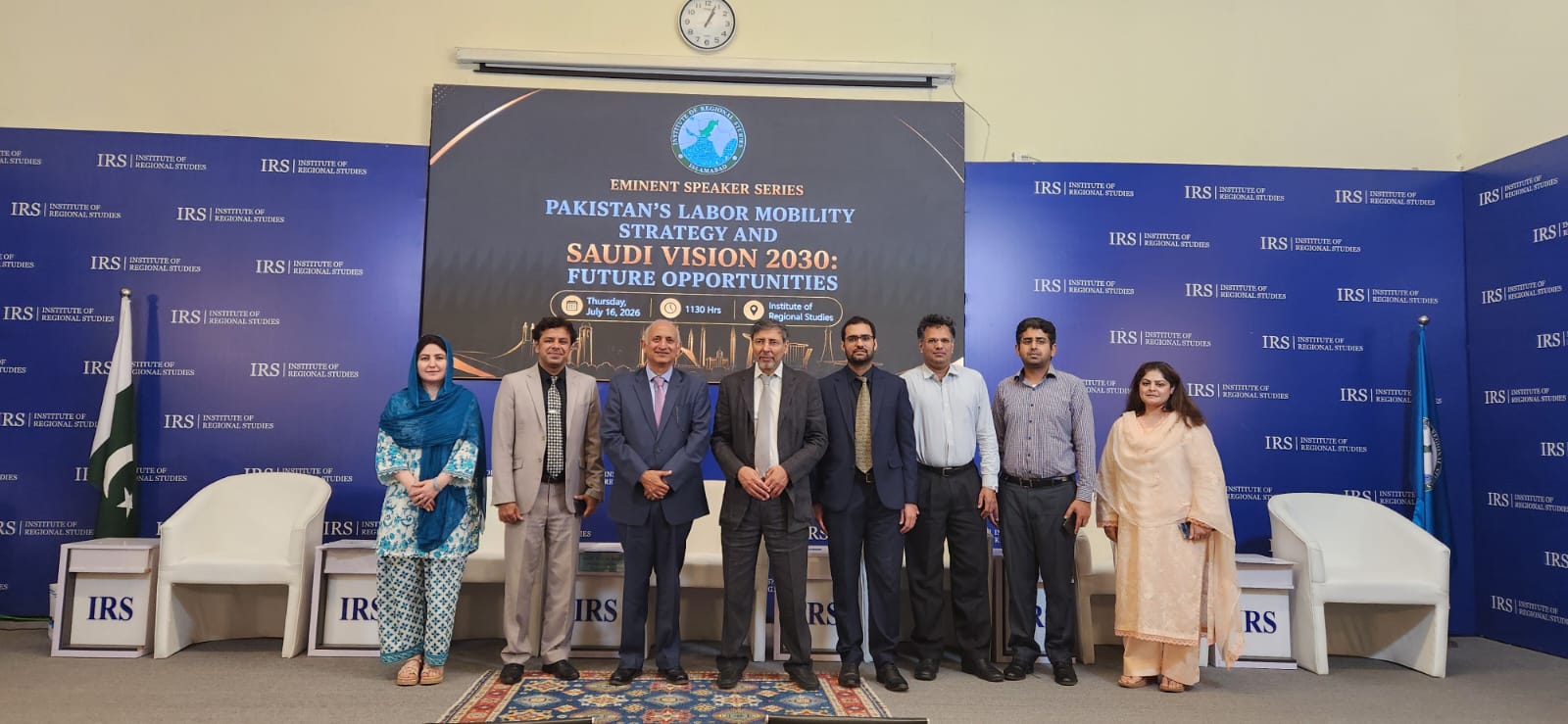
ISLAMABAD ( WNAM REPORT ): The Institute of Regional Studies (IRS) organized an Eminent Speaker Series talk on “Pakistan’s Labor Mobility Strategy and the Saudi Vision 2030: Future Opportunities,” featuring Haroon Sharif, Chairman of the Pakistan Regional Economic Forum (PREF) and Former Minister for Investment, as the principal speaker.
Ambassador Jauhar Saleem, President of IRS, highlighted the enduring strategic partnership between Pakistan and Saudi Arabia, describing it as a relationship founded on decades of friendship, shared values, religious affinity, and strong people-to-people ties. He noted that Saudi Arabia remains Pakistan’s largest destination for overseas workers and a key source of remittances. The Kingdom’s market also presents immense untapped potential for trade and investment. He emphasized that Pakistan’s young and growing population represents a strategic advantage at a time when the global risks of aging populations and shrinking workforces run high. However, he stressed that this demographic dividend can be effectively realized through sustained investments in education, technical training, and skills development. Referring to Saudi Arabia’s transformation under Vision 2030, he underscored that the Kingdom’s shift towards a diversified, knowledge-based economy presents significant opportunities for Pakistan to align its workforce with emerging labor market demands.
In his talk, Haroon Sharif argued that Pakistan-Saudi relations are entering a new phase, moving beyond traditional labor migration and towards a broader partnership centered on innovation, technology, knowledge, and human capital. He explained that global labor markets are undergoing profound demographic and technological changes. With 1.2 billion young people looking for job opportunities, and four million Pakistanis constituting that toll every year, Pakistan must fundamentally rethink its workforce development strategy.
Sharif emphasized that the future is skill-based, and thus invites recognition of performance capacities that are in line with changing industrial needs. While Artificial Intelligence (AI) is transforming the nature of work, it is also generating new opportunities in sectors spanning machine learning, healthcare, renewable energy, information technology, and advanced manufacturing. Drawing lessons from Singapore’s transformation into a knowledge-based economy, he argued that Pakistan must align its education and technical training systems with evolving global market requirements to drive sustainable economic progress.
Discussing Pakistan’s labor mobility strategy, Sharif underscored the value of the Saudi-Pakistan Economic Cooperation Framework (SPECF) and the Human Resource Deployment Plan (2025-2039), which seeks to deploy one million Pakistani workers to Saudi Arabia. Effective labor force gains demand a studied assessment of emerging priorities within the Kingdom’s US$1.4 trillion-strong economy, which is supported by low inflation and unemployment. However, the Saudi economy continues to rapidly diversify beyond oil through investments in tourism, logistics, technology, healthcare, sports, and renewable energy. While acknowledging the significance of Saudi Arabia’s US$500 billion Public Investment Fund (PIF), he emphasized that Pakistan should prioritize attracting greenfield investments that establish new industries, create jobs, and expand exports rather than relying solely on portfolio investments.
Sharif cautioned that Pakistan receives “nearly US$40 billion in remittances” but that these inflows “primarily support foreign exchange reserves and cannot replace productive investment.” He proposed several innovative models of regional cooperation, including triangular partnerships in which Pakistani professionals are trained domestically, collaborate with technologically advanced partners such as China, and contribute to projects in third country markets.
Mr. Sharif advocated a shift from “brain drain” to “brain circulation,” encouraging policies that enable skilled Pakistanis working abroad to return as entrepreneurs, investors, and innovators.
IRS hosts seminar: “Pakistan’s Labor Mobility Strategy and the Saudi Vision 2030: Future Opportunities”
40