

The author
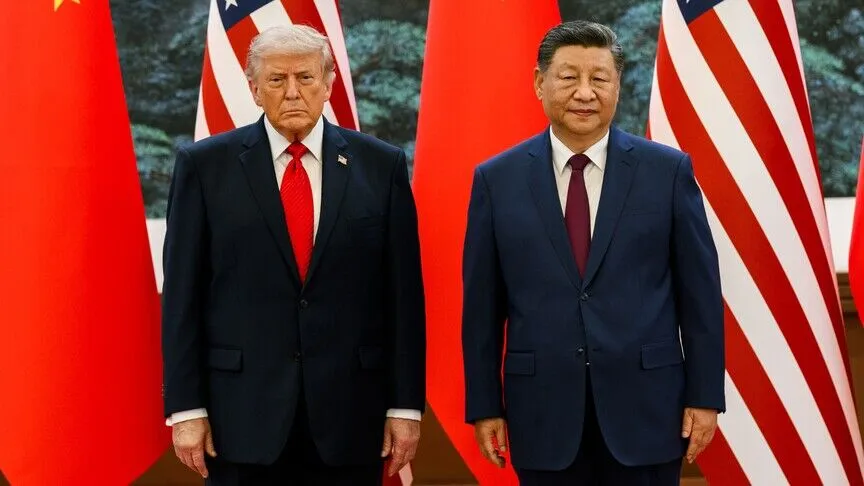
The Chinese President Xi arrived in Washington on the invitation of US President Trump. Therefore, this is the best opportunity for both leaders to find a solution for global peace and economy.
The global economy operates like a single, complex body, and the United States and China represent its two primary arms. When both arms work in coordination, they drive global trade, fuel technological innovation, and sustain unprecedented era-defining prosperity. However, when those arms lock into mutual conflict, the entire international economic mechanism suffers.
What began as a geopolitical and commercial rivalry has increasingly edged toward open confrontation. Thus, this systemic rift threatens to undo decades of global economic integration, fragment critical supply chains, and undermine global stability.
The structural interdependence between Washington and Beijing is not merely a theoretical concept; it is an economic reality. The United States remains an unmatched engine of financial capital, foundational scientific research, and high-value consumer demand. China stands as the world’s primary manufacturing workshop, boasting deep supply chain infrastructure and industrial scaling capacity.
When these two forces cooperate, the benefits extend far beyond their borders:
The interconnected trade buffers against localized economic shocks, and it becomes cost-effective. Consequently, the comparative advantages can keep consumer prices manageable worldwide.
The joint research accelerates advancements in critical fields like green technology, energy, and medicine thus decoupling these integrated components disrupts this equilibrium. When tariffs escalate, export controls multiply, and investment channels close, the resulting frictions destabilize third-party developing economies dependent on both systems.
Healthy economic competition is a natural driver of progress. It encourages nations to invest in domestic infrastructure, education, and research. However, when rivalry transforms into systemic confrontation, national security narratives begin to displace economic rationales across every sector.
When trade, artificial intelligence, and critical supply chains are viewed strictly as zero-sum battlegrounds, the risk of accidental escalation increases exponentially.
A fractured international order divides global markets into competing blocs, forcing secondary nations into difficult choices and raising the economic baseline for basic goods.
Washington faces internal and external “spoilers” factions, political actors, and defence interests that profit from sustained antagonism. These entities weaponize economic friction, frame strategic compromise as weakness, and derail delicate diplomatic efforts.
To maintain durable peace, leadership in both capitals must actively insulate diplomatic processes from these disruptive elements.
Neither nation can fully displace or absorb the other without causing severe, mutual harm. True strategic maturity lies in acknowledging structural differences while working together on shared priorities.
Instead of allowing rivalry to dictate the future, the US and China must build a framework focused on managed competition and constructive coexistence. Both powers must extend a firm hand of economic pragmatic cooperation. Restoring mutual trust, upholding open dialogue, and refusing to let peace efforts be sabotaged by hardline spoilers are essential steps toward ensuring global peace and shared economic prosperity. (Opinions expressed in this article are the author’s own and do not necessarily reflect the editorial policy of WNAM).