
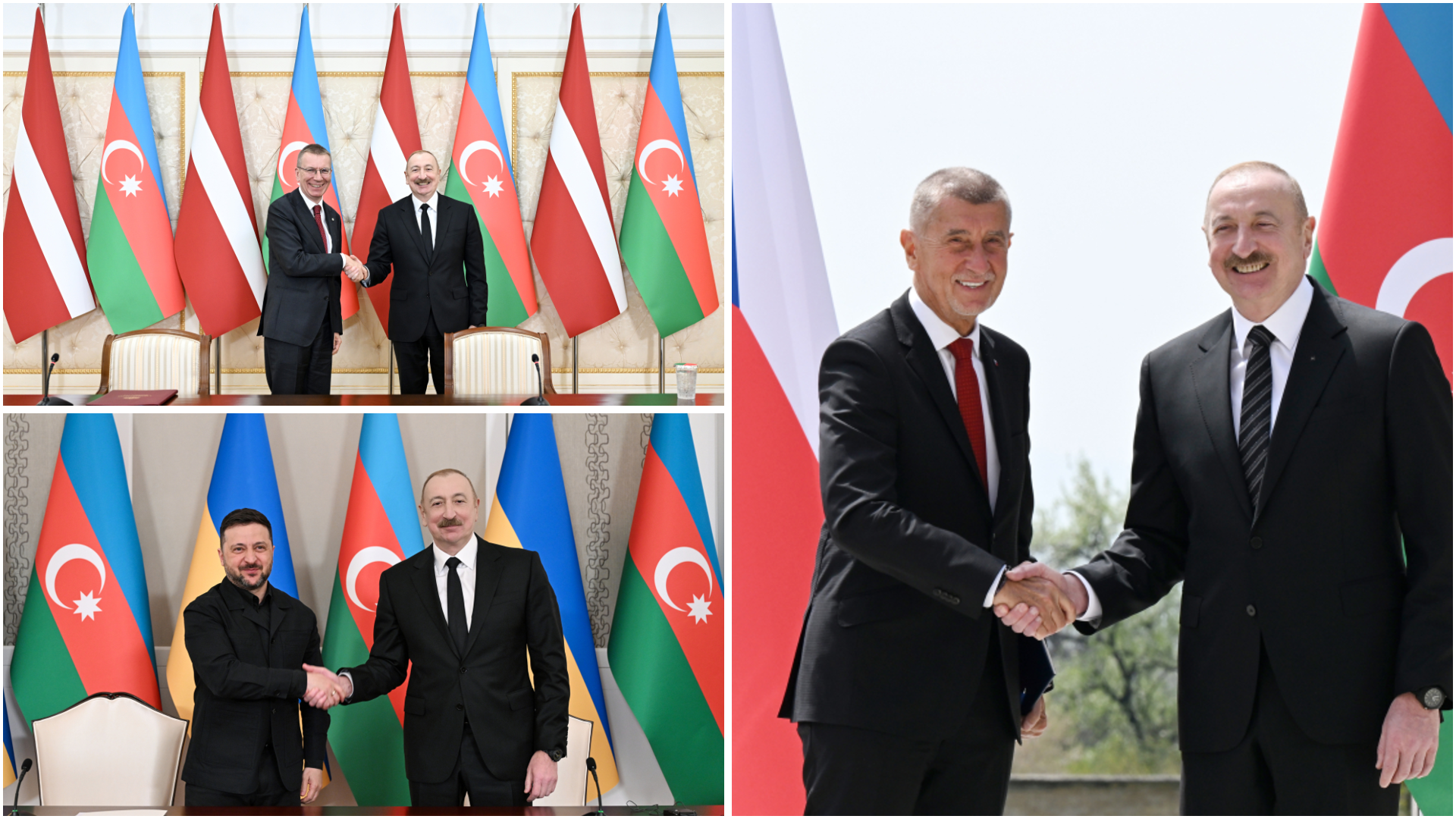
WNAM REPORT: When Czech Prime Minister Andrej Babiš touched down in Azerbaijan on 27 April, he made a point of noting publicly that Baku was his first destination outside the European Union. This was a calculated message from heads of state who wish to communicate to their domestic and international audiences that they have taken their ties to the next level. The leader did not come simply to pay a courtesy call but came with 50 representatives of his companies, a semi-state energy company looking for a long-term contract on natural gas, a defense company showcasing its latest training airplane, and a metro company trying to secure one of the largest infrastructure deals in Baku’s recent history. Four other European leaders had already paid visits to Azerbaijan in the seven days prior to his landing.
What makes them come here is actually clear…
After three months of the Iran situation, one-fifth of global energy production via the Strait of Hormuz is affected. The tight European energy market has been further squeezed with political pressure on securing supplies other than Russian and Middle Eastern sources becoming critical. Azerbaijan, which provides gas to 16 countries with 10 of them being EU states, and has promised to increase gas exports to Europe twofold by 2027, has become strategically important in a way it was not just two years ago. The BTC pipeline does not go through either Russia or Iran. The Southern Gas Corridor does not use either route. And the Baku-Tbilisi-Kars railroad does not run through either. When EU policymakers seek alternatives to the two supply routes disrupted, the state positioned along the route not being utilized has a packed agenda.
What are the statistics saying?
16 Countries receiving gas from Azerbaijan, 10 of which are EU members. Bilateral trade between Azerbaijan and the Czech Republic from January to November 2025 reached around $807 million, with 42% consisting of Azerbaijani oil. Bilateral trade between Ukraine and Azerbaijan by April 2026 has reached half a billion, with SOCAR actively involved in the Ukrainian market. One more important statistic is that the total foreign investment in Azerbaijan’s economy over the past 20 years is $350 billion.
Among all these visits, Babiš’ visit is the one that holds the highest economic weight. There is a strong economic connection between the Czech Republic and Baku. As was admitted by Aliyev, the nature of their economic relations had previously been primarily structural. Specifically, Azerbaijani oil provides 42 percent of the imports of crude oil into the Czech Republic, thus making it the largest source of oil for this nation. The current value of the bilateral trade for January- November 2025 is rather high, $807 million. However, there is an imbalance in its structure since it consists mainly of hydrocarbons from Azerbaijan and negligible exports from the Czech Republic. Both leaders explicitly named this as the central challenge. “We aim for the trade turnover to be more balanced,” Aliyev said at the joint press conference. Babiš agreed and arrived with a delegation designed to redress it.
At the core of the Czech business push in Baku was gas. ČEZ, the Czech semi-state energy company and a major gas distributor in central Europe, was at the forum instructed by Babiš to work out a long-term deal. There was a clear technical path to take. The Southern Gas Corridor moves Azerbaijani gas to Italy; the transit point for gas going further into Europe is Austria, which started receiving Azerbaijani gas in 2022; and Czechia itself is close-by. A Czech contract would extend that architecture one further link northeast, and, as Babiš pointedly observed, reduce Europe’s dependence on having “only two gas suppliers.” The implication, that the European Commission’s own directives sometimes disadvantage non-Russian suppliers, was a mild but unmistakable dig at Brussels, delivered in Baku with evident satisfaction.
Apart from gas, the Czech team offered a total of three industrial offers. ŠKODA Transportation, which is the transportation subsidiary of PPF Group, the biggest economic consortium of the Czech Republic, is offering the Baku Metro modernization project, with plans to form a joint venture and start production in Azerbaijan instead of exporting their products to the country. This strategy, invest, produce together, and transfer technology, is what Prime Minister Andrej Babiš referred to when he said that it was something “historically in our blood,” referring to the history of Czechoslovakia before the Second World War, as it was among the ten most industrialized nations in the world. Aero Vodochody offered the L-39NG training aircraft as the replacement for Azerbaijan’s L-39 aircraft.
Latvian part
Latvia’s pitch is structurally different from the Czech one, and in some ways more interesting. Whereas Rinkēvičs did not approach Azerbaijan as a purchaser of energy supplies, he was more focused on his potential as a facilitator for Azerbaijani energy exports, as well as a logistical bridge point. Latvia clearly expressed its intent to serve as a key transit country for Azerbaijani energy exports into Northern Europe, including Scandinavia and the Baltics, where direct Azerbaijani commercial ties have yet to be fully developed.
Sectoral dialogues at the Latvia-Azerbaijan Business Forum have proven to be quite diversified. According to Rinkēvičs, ICT, agriculture (in particular, precision agriculture based on drones), transport and logistics, forestry, pharmaceuticals, and sustainable technologies have been pinpointed as cooperation areas. In addition, a memorandum signed at the forum between AZPROMO and LCCI has provided a mechanism to connect the businesses of the two nations. With regards to the agriculture component of such cooperation, it is especially significant for Azerbaijan as it is currently working towards establishing an export base other than oil, and requires such expertise that cannot be easily obtained via conventional partnerships.
The Latvian side signed both a border service cooperation agreement and a memorandum between the ministries of the interior, aspects that fit into the larger picture of the EU Partnership Mission currently operating in Armenia. The fact that both Rinkēvičs and Aliyev were able to sign all of these documents, including this security-related package, along with business discussions, without any of the politicking that accompanies the EU Partnership Mission, demonstrates just how much the approach differs when dealing with Baku bilaterally than multilaterally.
Zelenskyy’s visit
Of all four visits, Zelenskyy’s is the most geopolitically significant, and perhaps, the most carefully watched in Moscow. It was his first official visit to the South Caucasus since Russia’s full-scale invasion of Ukraine in 2022, and it took place in a context that would have been unimaginable four years ago. Ukrainian air-defence specialists are already working in Azerbaijan, sharing the battlefield expertise accumulated over four years of combating Russian missiles and Iranian-supplied drones. Six agreements were signed, covering defence-industrial cooperation, joint production, energy, trade, and investment. Aliyev said military-technical cooperation had “wide-ranging perspectives.” Zelenskyy called the joint defence-industrial agreement a “very serious step.”
The drone dimension is particularly significant. Several states have approached Ukraine for the knowledge in combating the long-distance Iranian drones since the beginning of the Iran war; Azerbaijan, a neighboring country to Iran with growing needs for air-defense systems since February, is obviously going to benefit from this experience. SOCAR has offered eleven shipments of energy aid to Ukraine since the outbreak of the conflict, including fuel deliveries in response to Russia’s attacks on the electricity grid of Ukraine. Trade between the two parties surpasses $500 million. What the six agreements formalize is the already existing partnership of mutual benefit.
Zelenskyy’s public endorsement of Azerbaijan as a potential site for Ukraine-Russia-US trilateral talks is arguably the most important thing that happened all week. Azerbaijan has maintained a policy of equidistance in the past, engaging economically with Russia while forming strategic partnerships with Europe and keeping lines open to Tehran. This policy is still in place. However, the shooting down of the passenger jet in December 2024, the expulsion of Russian espionage networks, and now the offer to mediate between Ukraine, Russia, and the US indicate a drift in Azerbaijan’s foreign policy towards its center of gravity. Yet again, Baku can still potentially be a successful peace venue.
When added up, all these visits amount to more than just an aggregation of individual agendas. They amount to a coherent, albeit unplanned and disjointed, European realization that the strategic importance of Azerbaijan’s geographical and energy position has reached new heights amidst war in Ukraine on the one hand and Middle Eastern upheavals on the other hand. Baku does not seek membership in the EU, at least for now. Nor does it seek NATO membership. It pursues a flexible foreign policy of what President Ilham Aliyev calls a “flexible network of partnerships”. This week, when four European leaders landed in Azerbaijan, they understood this very well. The five-star welcome, the full-fledged delegations, the negotiations of long-term contracts, all these demonstrate that countries see Azerbaijan as no longer a peripheral player to be accommodated, but as a key player whose ties have to be strengthened. Czech Prime Minister Andrej Babiš made Baku his first stop beyond the borders of the European Union. He is not going to be the last one to do so. Next is Italian PM Giorgia Meloni.