
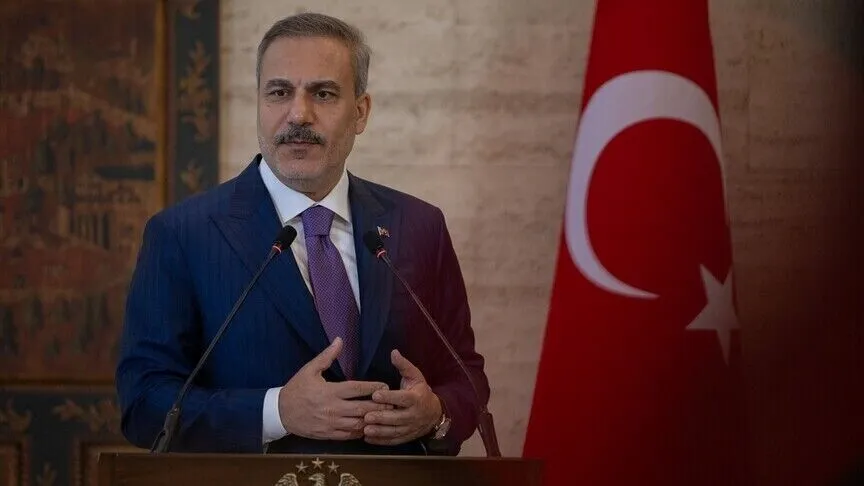
WNAM REPORT: Turkish Foreign Minister Hakan Fidan said Saturday that the three-nation Mecca Alliance between Türkiye, Saudi Arabia and Pakistan has reached an advanced stage, with efforts underway to establish its headquarters and assign personnel, describing the initiative as a “very game-changing platform.”
Speaking to Turkish broadcaster NTV on foreign policy and regional developments, Fidan said there is “a very strong will” behind the alliance and that Ankara is working to turn that political will into action.
“The Mecca Alliance is really at a good stage. There’s a very strong will that has been put forward. We’re working with all our strength to put this will into action,” Fidan said.
“The Mecca Alliance will be a very game-changing platform,” he added.
Fidan said steps toward institutionalizing the alliance are underway, particularly work to establish a secretariat envisaged under the agreement and a military headquarters affiliated with it.
He said detailed preparations on both structures have “almost been completed” and that the three countries have reached a common understanding on how they will operate.
“There are steps currently being taken toward institutionalization. In particular, the work on establishing the secretariat mentioned in the agreement and bringing an affiliated military headquarters into operation is almost complete.
“We have reached a common understanding. From now on, the remaining stage is to send personnel and make the headquarters operational. I am pleased with the process on this issue,” Fidan said.
He said that once institutionalization steps are completed, talks could be held with the other two founding countries on admitting new members.
“There is such a principle decision because our president said this from the beginning. If this does not grow, then it would not be an alliance area. We would have created a bloc. Our regional vision is for as many countries in the region as possible to come together and establish a common defense area.
“This defense area is not against outsiders; it is about solving problems within the region better through regional ownership and creating an environment of trust that has not existed before, in order to prevent new crises from emerging. The basic point of departure for all of this is the search for regional solutions to regional problems,” Fidan said.
He stressed that the alliance was not intended to create a new regional bloc against other countries but to establish a common defense framework based on regional ownership.
“It is an alliance open to the countries of the region,” he said.
Alliance responsibilities and Saudi Arabia
Addressing recent attacks by Yemen’s Houthis on Saudi Arabia, Fidan said the issue has existed for roughly a decade, adding that a ceasefire was reached in 2022 before tensions resurfaced following the start of the Gaza conflict.
He said Saudi Arabia’s territorial integrity, sovereignty and infrastructure had faced serious attacks.
“When we look at our agreement, countries have an allied responsibility toward one another. Our president is a leader who keeps his word. We have signed an agreement as states. We are in solidarity on this issue. In particular, we are assessing the situation together,” Fidan said.
He said Türkiye has condemned attacks targeting Saudi Arabia, particularly those directed at Mecca and the country’s oil infrastructure.
Fidan also said Saudi Arabia should remain outside the ongoing dispute between Iran and the US, saying Riyadh is not seeking involvement in that confrontation.
“Saudi Arabia should be kept outside this equation because they themselves are not seeking to become involved. As members of the Mecca Alliance, we are closely monitoring the situation. We have some consultations that are not reflected publicly. If there are military requirements, particularly in certain technical areas, we would have no difficulty meeting them,” he said.
Criticism of alliance
Asked about criticism from Israel, Iran, India and Greece that the alliance had remained only “on paper,” Fidan dismissed the claims.
He said the criticism itself demonstrated the attention some countries were paying to the initiative and described some of the comments as attempts to discredit the alliance through media campaigns and disinformation.
“When we look at the countries you mentioned, Israel, India and Greece, we actually understand how much of an impact and how important a move the Mecca Alliance is. These are reflections of discrediting operations through the press and disinformation methods. We laugh these off; they have no basis,” Fidan said.
Citing Türkiye’s decades of experience in NATO, he said an alliance should not be judged simply by how frequently its collective defense mechanisms are activated.
He noted that Türkiye has been a NATO member since 1952 and said NATO’s collective-defense mechanism under Article 5 had been activated only twice in its history.
Fidan said it was premature to describe the Mecca Alliance as ineffective when the agreement had been signed only recently, and institutional steps were already moving forward.
“No one called NATO a paper tiger or something made of paper because of that. An agreement signed only three months ago is already taking steps this quickly, yet it is being described in this way.
“This actually indirectly reflects the threat perception of those making these comments. We see them, we assess them, but they are not things to be taken seriously. You will see, the Mecca Alliance will be a very game-changing platform,” he said.
Netanyahu and Israel
Fidan also addressed Israeli Prime Minister Benjamin Netanyahu’s recent statements targeting Türkiye, saying Netanyahu is seeking to strengthen his political position at home, portray himself as indispensable and remain in power.
He said hostility toward Türkiye and efforts to portray Türkiye as a threat were also part of that approach.
“We do not underestimate this. We are closely following the statements and attitudes being put forward, particularly the military cooperation with countries in the region. Hopefully, Israel will adopt a foreign policy based on peace, respect and cooperation that serves both its own interests and those of the region. Otherwise, it will not only grow increasingly isolated, but will also pay the price itself together with the region,” Fidan said.
He said Türkiye was closely monitoring Israel’s policies and military cooperation with countries in the region.
Fidan also accused Netanyahu of seeking to create prolonged areas of instability in Syria, following Lebanon and Palestine, in order to strengthen his domestic political position and portray himself as indispensable.
“We clearly see that he is trying to make Syria, after Lebanon and Palestine, an area where he can establish his indispensability. We also clearly see the intention to create a problem there, turn that problem into an acute and permanent one, and then send his society a message along the lines of, ‘There is a serious problem here; if I am not here, this problem cannot be solved.’”
Fidan stressed that Türkiye would not be drawn into what he described as provocations.
“Türkiye is not a state that will fall for such provocations or cheap provocations. We know our position well, and we make our calculations carefully,” he said.
He added that Türkiye does not act alone in the region and maintains partnerships with regional countries.
“Israel is a threat not only to the region but to the world,” Fidan said.
He said international concern over Netanyahu’s policies was increasingly visible, including among countries traditionally considered close to Israel.
“The whole world is looking for solutions to deal with Netanyahu’s policies. As long as this continues, I think the necessary response will somehow be given. We are increasingly seeing these ideas and this position finding ground even among Israel’s traditional friends and among countries that feel indebted to Israel. This is also a very important development. We believe that, in the longer term, the process will ultimately favor the oppressed Palestinians,” he said.
Fidan also said the Muslim world was going through a difficult period and that President Recep Tayyip Erdogan’s leadership and the solidarity demonstrated toward the region could contribute to overcoming many problems.
Türkiye’s mediation efforts
Fidan said the identity and position of a country were crucial to successful mediation.
He said a mediator was effective when both sides respected and trusted it, citing the dispute between Ethiopia and Somalia as an example. He said the dispute, which had approached the point of conflict, was resolved following talks hosted by President Erdogan.
Fidan said wars involving multiple parties were more complicated.
“Some wars involve more than two parties. Take the Russia-Ukraine war. There is Russia, Ukraine, the US on one side, Europe and everyone else. In the Iran-US war, there is Israel on one side, the Gulf, other countries and many other elements. Because we closely follow mediation issues, we provide useful input not only on matters where we are mediators ourselves but also to mediators dealing with crises in our region.
“Sometimes we provide encouragement; sometimes we say, ‘Look at it from this perspective; this part is missing.’ That is also important. Everyone needs perspective. Complex problems are not things that anyone can solve alone with their own mind or overcome through their own psychology. As much as possible, reason needs to be devoted to these issues,” Fidan said.
He added that mediators who focused on achieving results rather than seeking credit were more effective and acceptable.
“If you advertise the work you have done, people do not want to see you in the next issue. There is also such a consideration. Therefore, it is necessary to see this somewhat as charity and carry it out discreetly,” he said.
Iran-US talks and regional tensions
Addressing regional tensions linked to Yemen and the Bab el-Mandeb Strait, Fidan said numerous diplomatic initiatives were underway but needed to produce outcomes acceptable to the relevant parties.
“There are many initiatives, but these initiatives need to produce outputs that are acceptable to the relevant parties,” he said.
Fidan said there had been a deadlock in negotiations between Iran and the US over the past few months.
“There has been a deadlock in the US-Iran talks for the past few months. As a manifestation of this deadlock, we are seeing not only attacks against each other, but also the Bab el-Mandeb dimension being opened from Yemen. We see the parties increasingly trying to expand this toward Saudi Arabia. It is becoming increasingly complicated. We are putting all our weight behind bringing the ongoing negotiations between the US and Iran to a conclusion, but there is great distrust between the parties,” Fidan said.
He said Iran and the US had reached a common understanding in Pakistan but that problems later emerged during implementation.
“They had reached an understanding in Pakistan, but problems emerged during the subsequent implementation. Now both sides have started interpreting the process differently in ways that serve their own interests,” he said.
Fidan said new proposals had been presented to the parties and expressed hope that they would be accepted.
He also warned that the economic consequences of the continuing regional crisis were becoming increasingly difficult for some countries to absorb.
There is a serious bottleneck affecting energy routes, he said, adding that countries such as Türkiye, whose industries and economies depend heavily on imported energy, are facing increasingly significant economic challenges.
Qatar, Pakistan and Oman mediation
Fidan said mediation efforts by Qatar, Pakistan and Oman in the US-Iran dispute were continuing intermittently.
He said Qatar was particularly affected by the conflict but remained in a position to communicate with both Iran and the US.
“Qatar cannot sell anything. They are also very close to Iran. They can talk to Iran. They have good relations with both Iran and America, and they are among the countries most affected. They are trying to do something using this position. I also spoke today with Qatari mediators. It is somewhat difficult to reconcile the positions the parties, particularly the US, are taking as it heads toward an election. But it is not impossible. Hopefully, I expect good results,” Fidan said.
Gaza and peace plan
Fidan said the Gaza Peace Plan had failed to move from its first phase to its second phase.
He said the Palestinian side, including Hamas, had fulfilled many of its responsibilities under the first phase, including releasing hostages, while Israel subsequently introduced new demands.
“It does not see itself as bound by this agreement. This is our biggest problem now,” Fidan said.
Fidan said the anniversary of the launch of the Gaza Peace Plan would come this month and that the deadlock needed to be overcome after a year.
“Now, after a year, this deadlock needs to be overcome, but as I said, Israel’s obstructive role continues. The international community and the countries involved in this issue need to work to overcome this deadlock. We do not see humanitarian aid being delivered in the amount and at the speed we want. It is not as bad as before, but it is not as widespread as we want.
“Housing issues need to be addressed because Israel has published lists of restricted materials, including iron and other items, and does not allow some shelter materials, prefabricated structures and construction materials to enter. This is extremely bad from a humanitarian perspective. On the other hand, although it is not carrying out killings on the scale seen during the war, it continues to strike selected targets.
“As you know, it struck an apartment building the other day. Children were killed again. These killings continue; there are violations,” Fidan said.
He said occupier violence in the occupied West Bank was also escalating and attracting increasing international attention.
“No one defends the illegal settlers, but is there anyone who can prevent them? This is the test for the international community and the Muslim world,” Fidan said.
He said Türkiye was working to facilitate a political and territorial connection between the West Bank and Gaza, adding that Türkiye was among the few countries able to maintain contacts with both Ramallah and Gaza.
Fidan said the Turkish government maintains an equal relationship with Ramallah and Gaza and that its priority is serving the Palestinian cause.
Syria integration process
On Syria, Fidan said there have been numerous issues requiring close coordination between Ankara and Damascus since December 2024, when the Assad regime fell, including Syria’s reconstruction, unity, territorial integrity and cooperation with regional countries.
He said Türkiye and Syria had been tasked by their presidents with establishing a joint planning group to closely monitor bilateral projects and other areas of cooperation.
“As the Foreign Ministry, we were tasked by our presidents with establishing a joint planning group. Within this framework, we need to closely follow the many issues and projects between the two states and meet continuously,” Fidan said.
He said Syria was improving day by day and described that development as important.
“Whatever happens in Syria and Iraq directly affects Türkiye. Therefore, stability, peace and development there are also important for us. We reviewed these issues again with President Ahmad al-Sharaa. I conveyed our president’s messages to him,” Fidan said.
Fidan also recalled that Erdogan and al-Sharaa met on the sidelines of the NATO summit in Ankara in July, where they discussed regional stability, potential risks, Syria’s integration process and counterterrorism efforts.
On the process of dissolving and integrating the Syrian Democratic Forces (SDF) into the Syrian state and military, Fidan said there was a desire among the parties to move the process forward in a controlled manner.
“The statements being made and the intentions reflected in the positions taken are extremely important. We actually see a desire among the parties to move the process forward in a controlled manner. Frankly, we welcome and support this,” Fidan said.
He stressed, however, that the process must be followed closely until all conditions are fulfilled.
“We are speaking closely with our Syrian brothers. How is the process going with the security and intelligence institutions there? Is it going well? Are there risks? How are those risks being managed? These are issues closely followed by us and our other institutions. The statements currently being made are positive. But practical steps need to follow them. We are also closely monitoring that,” he said.
Syria visit and historical ties
Fidan said his recent two-day visit to Syria was also intended to send a message of normalization and encourage greater engagement.
“There is a message we need to give: We stayed there for one night. Syria is normal now. We need to stay there and come there,” he said.
Fidan said some of the places he visited in Syria were important to Anatolian culture, faith and political history.
“Some of our historical roots are there as well. We need to preserve and embrace that,” he said.
He compared Syria with locations in the Balkans, Baghdad and Central Asia that contain historical sites connected to Türkiye’s broader cultural and historical experience.
Fidan said a deeper historical journey could enrich people’s search for identity and meaning.
“With a healthier reading of history and meaning, a better future is being prepared. I believe in that,” he said.
Russia-Ukraine war
Fidan said there were initiatives aimed at ending the Russia-Ukraine war but that producing a lasting result appeared difficult at present.
“But we need to continue working and not lose hope,” he said.
Fidan described the conflict as a conventional war until 2023, an attrition war through 2025 and a war of destruction after 2025.
He said energy, transportation and commercial infrastructure were being targeted, making civilian life more difficult.
“This is something that is making civilian life increasingly difficult. We need to prevent this destruction. The parties are now putting forward their own resilience, in a sense asking who will blink first, who will give up first. But there is no need to reach this point. We are speaking with states and working on what kind of interim formulas can be developed,” he said.
Fidan said trade in the Black Sea was also important for Türkiye.
He warned that if grain harvested from fields could not reach world markets, many countries could face food-security problems.
He said a previous agreement had collapsed but that a de facto system continued to operate for some time before attacks on ports and maritime activity increased.
“We have now sent a proposal to both sides on this issue. We are working on it and waiting for their responses. We have also received responses from the parties. We are trying to take this somewhere. It is difficult to reconcile their positions based on the lessons they drew from the implementation of the previous agreement,” Fidan said.
He added that Russian Deputy Prime Minister Alexander Novak had conveyed Russia’s perspective on resolving the issue and that Ankara was assessing all the information.
Fidan also noted that many African countries need grain and that grain is a product sold by both Russia and Ukraine.
Greece and Aegean
Fidan said there was a domestic political dimension to the Türkiye issue in Greece, particularly when Greek politicians seek to gain quick political points or attract public attention.
“If someone in domestic politics needs a shortcut, needs to gain quick additional points or needs the public wind behind them, the card they will play is the Türkiye card,” Fidan said.
He said Turkish politics did not operate in the same way and argued that Greece should not conduct its politics from such a narrow perspective.
Fidan recalled that Türkiye and the current Greek government had reached an understanding since May 2023 to make efforts to resolve problems in good faith and avoid the kind of tensions previously seen in the Aegean Sea until the next Greek election.
He said opposition parties in Greece often use Türkiye as the main issue with which to attack the government.
“Democracy is a good system, but sometimes it has, how shall we put it, some over-stimulated sides,” Fidan said.
On the Aegean disputes, Fidan said Türkiye’s position was clear.
“First of all, until the issues in the Aegean, including the continental shelf issue, are resolved, our position is clear. We are not in favor of creating tensions. We absolutely do not accept the arming of islands that have demilitarized status. We have very careful and persistent initiatives on this issue,” he said.
Fidan said many efforts were conducted without publicizing them because public discussion could create difficulties in Greece.
“This region needs peace, not armament. We have said this repeatedly. War is in no one’s interest. What matters is peace,” he said.
Fidan said Greece was moving toward an election atmosphere and that anti-Türkiye rhetoric could continue, but Ankara was focused on developments both in practice and officially.
He said the Turkish Armed Forces and Coast Guard Command were sensitive to the issue and expressed hope that no one would take a reckless step.
Fidan also recalled that Erdogan had demonstrated since 2003 that he wanted to resolve the issue, but said Greek governments and Greek politics had been unable to take further steps because of the nature of their domestic politics.
He said Greek voters may need to encourage politicians by supporting peace rather than war rhetoric.
“Türkiye is a serious state and follows these issues accordingly,” Fidan said, adding that he hoped statements by Greek officials would remain at the level of rhetoric.
He warned that if Greece sought to move toward irrational or adventurous steps, Türkiye’s seriousness and strength were known to everyone.
Türkiye’s regional role
Fidan said Türkiye’s stability had effects beyond its borders.
“The advancement of the Terror-Free Türkiye process, the will and position put forward by the People’s Alliance, our president and Mr. Devlet Bahceli are very important for this. I also think the response from the other side is valuable. Hopefully, this will be important not only for Türkiye’s future but also for the future of the region and for the regional peace and stability of our Kurdish brothers and sisters beyond our borders, including those living in Syria and Iraq.
“Türkiye’s stability does not only benefit itself; it also benefits the countries in the region. Not only the Kurds in Türkiye, but also Kurds across the border will receive a share of the stability and prosperity Türkiye produces,” Fidan said.
‘Terror-Free Türkiye’ process
Fidan said developments in Syria and Iraq were reinforcing the “Terror-Free Türkiye” process and that the process was advancing on two complementary tracks.
“There is no longer a political environment, an occupation environment or an understanding that would allow any armed element other than the armed forces of those countries to remain in Syria or Iraq. The governments of both countries, Baghdad and Damascus, are determined that there should be no armed groups or organizations in their countries other than their own armed forces,” Fidan said.
He said the current regional environment meant armed groups could no longer use Syria or Iraq as places to hide or launch attacks against Türkiye.
“If someone has a problem in Türkiye, there is one thing to do: come here openly, enter politics, take your case to the people, struggle, fall and get back up, but conduct that politics. The president did that, others did that. If you say, ‘I don’t like it, so I will take up arms,’ then you will find the state against you,” Fidan said.
He said neither Syria nor Iraq now wanted their territories occupied or controlled by the terrorist organisation PKK or other armed groups and expressed hope that the organization would take advantage of the current opportunity to permanently end the issue.
On the organization’s disarmament process, Fidan said progress had been slower than hoped.
“The organization declared in May 2025 that it had dissolved itself and ended its armed struggle. We are now in September 2026. More than a year has passed. Concrete steps regarding the laying down of weapons have not yet taken place. For this to happen from now on, some mechanisms need to be put into operation, and I think the time factor is important. It could be faster, but as I said, we need to be careful.
“There are statements and intentions that have been put forward, but it is important that the threat itself be eliminated and cease to be a threat. We need to follow this very closely,” Fidan said.
He also said the “Terror-Free Türkiye” process had received an extremely positive response during his Sept. 11 visit to Diyarbakir.
Regional development and Kurdish issue
Fidan said the political and security environment in Syria and Iraq was also creating conditions for greater economic and social development in Türkiye’s southeast.
He said the resolution of political and identity-related problems should be pursued through politics rather than violence.
Fidan described the removal of what he called identity denial as one of the major political reforms of the Justice and Development Party (AK Party) government.
“The greatest political revolution is the removal of identity denial. A person is not valuable because they are Kurdish, Alevi, Sunni or Arab, but because they are a respected and valued individual and citizen of the Republic of Türkiye, and therefore are protected by the Constitution. We made this possible,” he said.
Fidan said further progress was possible but should be pursued politically. He said Erdogan’s government had taken steps aimed at reconciling the state and society on issues concerning religious conservatives, Kurds and Alevis.
He said the political basis of the problem had ended and that the “Terror-Free Türkiye” process should now focus on ending the armed conflict and improving people’s welfare.
Fidan cited discussions about industrialization, transportation links, irrigation and economic development in Diyarbakir as examples of the kind of issues that should now receive greater attention.
He said irrigation-channel and dam projects in the region would eventually provide additional irrigation for 4 million decares of land and could increase agricultural output by 2.5 times.
“These are economically difficult demands but pleasant demands; the discussions that should be taking place,” he said.
Fidan said the objective was to improve prosperity, wealth and security once political and identity-related disputes were removed.
UN General Assembly and US-Türkiye ties
Fidan said President Erdogan would attend the 81st session of the UN General Assembly in New York the following week and that his annual address was being closely followed.
He said Erdogan would be among the first speakers and would deliver a comprehensive speech offering proposals on global problems, including a call for common action against future risks associated with artificial intelligence.
Regarding a possible meeting between Erdogan and US President Donald Trump, Fidan referred to their recent contacts and said Ankara wanted to improve bilateral relations and resolve outstanding issues.
“You know, CAATSA sanctions are an obstacle for us, particularly for our Presidency of Defense Industries. We are working to remove them. There are also some creative ideas on the way to resolving the S-400 issue, which caused the process to begin. We are trying to implement some solutions with mutual goodwill. Hopefully, we will take positive steps on this issue,” Fidan said.
Artificial intelligence
Fidan said societies were increasingly creating surveillance systems themselves through widespread recording and data collection.
Referring to footage of him being recorded by a vehicle camera while walking and the footage later appearing on social media, he said: “George Orwell’s total surveillance society is actually something we are building with our own hands. There is an irony here. When you compare the observation and recording done by the state with the observation and recording people do of one another, citizens are actually doing more. They are recording more, following more and producing more data about other people’s lives.”
Fidan said artificial intelligence represented a strategic issue rather than simply another technological or economic competition.
He said the US had already developed the technology and was beginning to see its effects and potential, while Türkiye needed to ensure it had access to and ownership of the technology.
“We need to declare a mobilization for this. This is extremely important,” Fidan said.
He said the US and China were preparing themselves for a new era through artificial intelligence investments and data centers.
Fidan compared artificial intelligence to nuclear technology, saying it could increasingly become a technology that countries either possessed or did not possess. He suggested that future sanctions could involve cutting countries off from artificial intelligence capabilities.
He said this process had already begun and could intensify, adding that artificial intelligence might not be something countries could simply purchase like other technologies.
Fidan said Türkiye needed to establish large data centers, produce large-scale datasets and cooperate with other countries in its region.
“There are steps we need to take, but particularly we need to produce big data, establish large data centers and take major steps by coming together with certain countries in our geography. We are also discussing this with the European Union to some extent. Steps in which Türkiye is also a shareholder need to be taken. There are ongoing studies in the government and there is a very high level of awareness among our ministers,” he said.
“This is no longer an ordinary technological or competitiveness issue. It is a matter of national security and existence. It is a very high-level issue. We need to view and pursue it from that perspective,” Fidan said.