
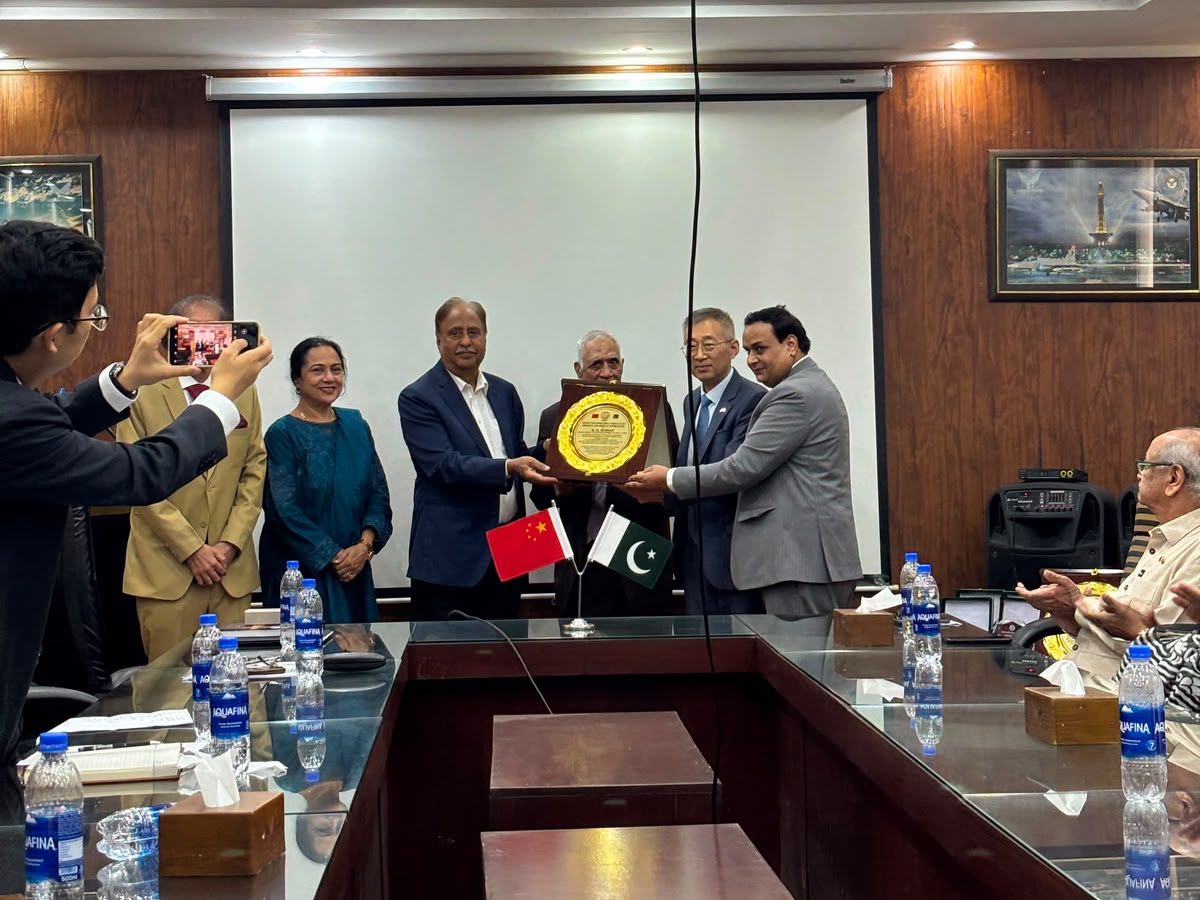
LAHORE ( WNAM REPORT ): A strategic dialogue marking the 75th anniversary of Pakistan-China diplomatic relations, the 105th anniversary of the Communist Party of China (CPC) and the 77th National Day of China was held at Lahore. The event also featured the launching of Dr. Mehmood Ul Hassan Khan’s book, “Pak-China Friendship: Strategic Vision, Achievements, Way Forward and China’s Economic Miracles.” Chinese Consul General in Lahore H.E. Sun Yan attended the ceremony as Guest of Honour and delivered a keynote address.
Speaking on the occasion, Consul General Sun Yan described Pakistan-China relations as an “ironclad brotherhood,” saying that the friendship between the two countries has developed into a comprehensive partnership encompassing political, economic, diplomatic, social and people-to-people relations. He said the 75-year journey of diplomatic ties reflected deep mutual trust, consistent support and a shared commitment to peace, development and prosperity.
The Chinese Consul General highlighted Pakistan’s longstanding support for China, recalling Pakistan’s vote in favour of restoring China’s lawful seat at the United Nations in 1971 and its continued support for China on core issues including Taiwan, Xinjiang and Xizang. He said China, in return, has always firmly supported Pakistan in safeguarding its sovereignty, security and development interests. The two countries, he added, have stood together through difficulties and challenges, establishing an exemplary model of political mutual trust and mutual support.
Referring to the historic visit of Chinese President Xi Jinping to Pakistan in 2015, Sun Yan said the visit elevated bilateral relations to an All-Weather Strategic Cooperative Partnership and gave strong impetus to the China-Pakistan Economic Corridor (CPEC). He noted that CPEC, as a flagship project of the Belt and Road Initiative, has brought $30 billion in direct investment to Pakistan, added more than 8,000 MW of installed power capacity, constructed 510 kilometres of highways and 886 kilometres of power transmission lines, and generated over 260,000 local jobs.
He said the benefits of CPEC were also visible in Punjab, mentioning the Lahore Orange Line Metro, which had completed 330 million passenger trips by the end of the second quarter, as well as the Sahiwal Coal-Fired Power Plant and Karot Hydropower Station. He stressed that CPEC has now entered an upgraded second phase, with cooperation expanding beyond infrastructure towards agriculture, industrial development, science and technology.
Speaking about the 105-year journey of the CPC, Consul General Sun Yan highlighted six qualities identified by Chinese President and CPC General Secretary Xi Jinping: commitment to truth and progress, serving the people, shouldering historic missions, keeping pace with development trends, maintaining confidence in overcoming challenges, and continuous self-strengthening. He said these qualities had helped the CPC lead China through revolution, development and reform and contributed to the country’s remarkable transformation.
He also highlighted the strategic significance of President Xi Jinping’s four Global Initiatives, saying they seek to address global deficits in development, security, civilization and governance while contributing stability and certainty to an increasingly changing international environment. He expressed confidence that the Pakistan-China All-Weather Strategic Cooperative Partnership would continue to reach new heights and deliver greater benefits to both nations.
Dr. Mehmood Ul Hassan Khan, President of the Center for Knowledge and Public Policy and author of the book, thanked Consul General Sun Yan for his participation and support in making the event meaningful. He said the 75th anniversary of diplomatic relations and the 105th anniversary of the CPC provided an opportunity to reflect on the strategic achievements of both countries and chart a more ambitious course for future cooperation.
Dr. Khan said his book examines the broad spectrum of Pakistan-China cooperation, including economic, political, social and diplomatic relations, with particular emphasis on CPEC Phase-I, CPEC 2.0 and future cooperation. He said the publication also explores the leadership visions of both countries and their shared objectives of regional connectivity, socio-economic prosperity, financial integration, modern infrastructure, hybrid agriculture, energy cooperation, education, culture and people-to-people contacts.
Calling China Pakistan’s “ironclad friend,” Dr. Khan said the relationship had evolved into a unique model of diplomacy, development, mutual trust and strategic cooperation. He emphasized that policymakers on both sides should now redefine and accelerate strategic cooperation under CPEC 2.0, particularly in renewable energy, solar and wind power, lithium batteries, electric vehicles, ICT, semiconductors, quantum technologies, big data, biomedical manufacturing and other emerging industries.
Prof. Dr. Mian Hanan Ahmed, Chairperson of the School of Journalism Studies, University of Punjab, highlighted the historical evolution and future potential of Pakistan-China relations, describing the partnership as a model built on mutual trust, respect, economic resilience and connectivity. He termed strong bilateral ties essential for regional balance, peace, stability and prosperity and also highlighted the importance of Pakistan-China security and defence cooperation.
Dr. Hanan further expressed support for enhanced economic and commercial cooperation, including greater trade, investment, joint ventures and expansion of CPEC 2.0 in Punjab. He said the School of Journalism Studies and the Center for Knowledge and Public Policy would collaborate on a certificate programme/workshop marking the 105th anniversary of the CPC.
Dr. Munzza Abdul Majeed of the University of Lahore also underscored the strategic importance of Pakistan-China diplomatic relations, describing them as pro-development, pro-prosperity and pro-humanity. She said the longstanding relationship had become an important pillar of Pakistan’s foreign policy, national security and development strategy. She stressed that CPEC 2.0 should serve as a platform for digitalization, artificial intelligence, modernization, green and quantum technologies, hybrid agriculture and medical sciences.
The ceremony also featured shield and commemorative medal presentations and cake cutting to mark China’s National Day. A large number of prominent scholars, researchers, corporate professionals, former senior government officials and media representatives participated in the event, reflecting broad interest in further strengthening the Pakistan-China strategic partnership.